





Resource Recycling
  • The Latest
  • Analysis
    • All
    • Certification Scorecard
    • Industry Announcements
    • Opinion

    Certification Scorecard — Week of May 18, 2026

    Aurubis: Thefts involved scrap sample manipulation

    Metals and electronics recyclers report growth

    Plastic packaging

    Why SB 54 source reduction planning is becoming the industry’s most challenging EPR test

    Recycler cites market pressure in short-term closure

    AI, data anxiety push enterprises to destroy working devices: report

    Before the Bin: America’s textile waste problem starts in your closet

    Colorado communities prepare for recycling access project

    How to get the reverse side of supply chains talking with the front-end 

  • Conferences
    • Resource Recycling Conference
    • Plastics Recycling Conference
    • E-Scrap: The Longevity Conference
    • Textiles Recovery Summit
  • Publications
    • E-Scrap News
    • Plastics Recycling Update
    • Policy Now
    • Resource Recycling
    • Other Topics
      • Brand Owners
      • Critical Minerals
      • Glass
      • Grant Watch
      • Markets
      • Organics
      • Packaging
      • Research
      • Technology
      • Textiles
      • All Topics
Subscribe
No Result
View All Result
Resource Recycling
  • The Latest
  • Analysis
    • All
    • Certification Scorecard
    • Industry Announcements
    • Opinion

    Certification Scorecard — Week of May 18, 2026

    Aurubis: Thefts involved scrap sample manipulation

    Metals and electronics recyclers report growth

    Plastic packaging

    Why SB 54 source reduction planning is becoming the industry’s most challenging EPR test

    Recycler cites market pressure in short-term closure

    AI, data anxiety push enterprises to destroy working devices: report

    Before the Bin: America’s textile waste problem starts in your closet

    Colorado communities prepare for recycling access project

    How to get the reverse side of supply chains talking with the front-end 

  • Conferences
    • Resource Recycling Conference
    • Plastics Recycling Conference
    • E-Scrap: The Longevity Conference
    • Textiles Recovery Summit
  • Publications
    • E-Scrap News
    • Plastics Recycling Update
    • Policy Now
    • Resource Recycling
    • Other Topics
      • Brand Owners
      • Critical Minerals
      • Glass
      • Grant Watch
      • Markets
      • Organics
      • Packaging
      • Research
      • Technology
      • Textiles
      • All Topics
Subscribe
No Result
View All Result
Resource Recycling
No Result
View All Result
Home Recycling

Republic: COVID-19 brings ‘uncontrollable challenges’

Colin StaubbyColin Staub
March 31, 2020
in Recycling
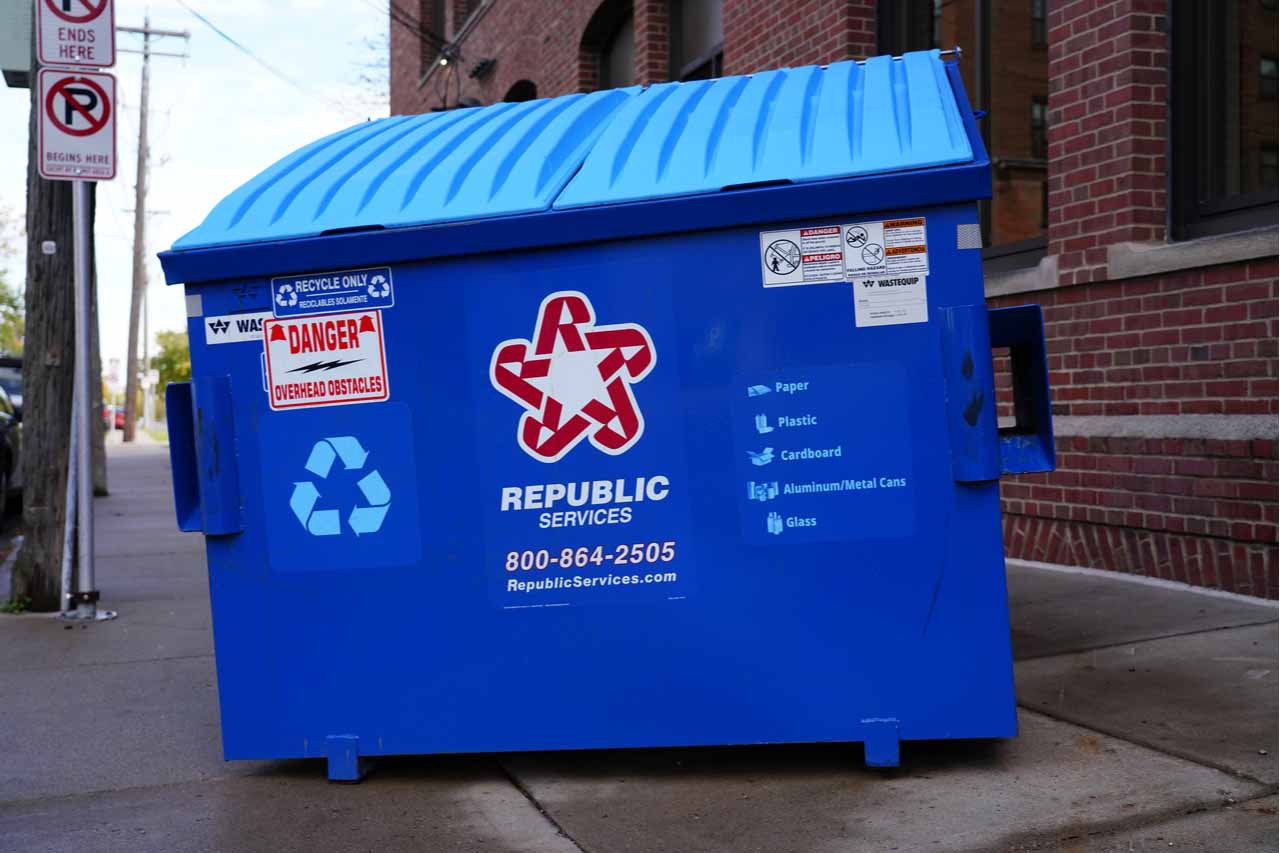
Republic forecasts servicing fewer commercial containers as bars, restaurants and schools temporarily close. | Aaron of L.A. Photography/Shutterstock

Republic Services foresees major changes in the residential and commercial recycling landscape due to the coronavirus pandemic.

In recent presentations to local governments in multiple states, Republic, the second-largest garbage and recycling hauler in North America, laid out a series of impacts the COVID-19 pandemic will have on residential and commercial materials recovery.

The predicted fallout has led Republic to stop certain collection services and to float the potential for disposal of recyclables due to processing capacity challenges. Additionally, in a report to investors, the company leaves open the possibility for higher rates levied on local programs.

Higher waste generation, higher contamination

A presentation shared with municipalities in multiple regions lays out significant disruptions and cost increases Republic anticipates.

Republic forecasts servicing fewer commercial containers, “as businesses, bars, restaurants and schools close for a period of time.” At the same time, the company predicts residential waste volumes will increase by 30% with more individuals staying home and “excess material obtained through panic purchasing.”

On the waste side of residential collection, given the additional volume, Republic expects trucks will fill faster and require more trips to the disposal site.

Meanwhile, “recycling contamination will increase as excess material from the homeowners finds its way into the recycling container,” the company stated. In messages shared with multiple communities, the company wrote that recycling contamination increased by 20% in the week prior to March 24.

Apart from the contamination challenge, Republic anticipates recycled material processing could be disrupted as some third-party processors slow down or stop operations altogether. The latter possibility could lead to recyclables being sent for disposal without a viable recycling outlet.

Taken as a whole, “this pandemic will drive uncontrollable challenges in recycling,” Republic wrote.

The residential municipal solid waste volume increase will increase costs by $2.15 per home per month, Republic estimates. And the additional contamination and potential disposal of recyclables could lead to increased disposal costs, the company wrote.

Adjusting services

To offset these costs, Republic has made a few key service changes in numerous municipalities.

In a statement to Resource Recycling, Republic said “the vast majority of our municipal partners have agreed to modify some services so we can prioritize residential solid waste collection during the COVID-19 crisis.”

According to municipal program announcements, the company is suspending residential curbside collection of yard debris and bulk materials, and in certain cases it will seek approval to dispose of recyclables due to contamination or processing capacity disruptions.

“These service changes have helped us offset some of our increased costs,” Republic told Resource Recycling. “We recognize the situation is evolving rapidly, and we are continuously evaluating the situation to help keep our employees healthy and safe while continuing to provide an essential service that is critical right now to our customers and communities across the country.”

Additionally, in many communities, Republic will only collect waste and recyclables that are bagged or placed within carts, rather than allowing excess material to be placed outside the cart.

In a March 24 update to investors, Republic noted it is “working closely with municipalities to adjust service and/or service fees to address [the] temporary increase in household waste as people spend more time at home,” the company wrote.

Some communities are already seeing the processing disruptions Republic described. In Hudson, Ohio, Republic will temporarily dispose of all materials placed in recycling carts. The city announced the change was made in response to rising residential garbage generation: Recycling carts will be used as overflow containers for garbage. Similar changes were made in Marshall, Texas and Jefferson City, Mo.

In a separate economic impact from the pandemic, Republic in the investor update reported a “favorable increase in recycled commodity prices due to slow down in recycling in China.” Bloomberg News reported many Chinese recycling centers closed due to the coronavirus pandemic, limiting the supply of domestic recyclables. Paper research firm RISI reported in late February that logistical impacts had “choked off domestic recovered paper supply,” leaving end users with significant shortages.

 

Tags: CollectionLocal Programs
TweetShare
Colin Staub

Colin Staub

Colin Staub was a reporter and associate editor at Resource Recycling until August 2025.

Related Posts

Bottle bill backers see opportunity for action

PET collapse exposes gaps in US recycling infrastructure

byStefanie Valentic
May 15, 2026

Joaquin Mariel, Circular Services president, broke down why recycling infrastructure is so hard to scale and used PET's rapid market...

Surveys examine gaps in consumer recycling education

Study finds lack of proper battery disposal

byPaul Lane
May 13, 2026

The “Michigan 2025 Battery Gap Analysis” finds state residents are mismanaging discarded batteries.

Extruder pushes out natural HDPE pellets at KW Plastics in Troy, Alabama.

Rare look inside the world’s largest plastics recycler

byBrian Clark Howard
May 13, 2026

KW Plastics in Troy, Alabama is a leading recycler of PP and HDPE—here’s a glimpse behind the gates.

Canadian city walks back fee on paper coffee cups

Recycling access for paper cups hits 20% of US

byPaul Lane
May 11, 2026

This figure represents a quadrupling in the past decade, spurred by significant investment and action.

Orange County landfill fees to spike 53%

Orange County landfill fees to spike 53%

byBrian Clark Howard
May 11, 2026

The rate increase goes into effect July 1 and is the result of a convergence of factors.

Liberty Waste expands in NC with Randolph deal

byStefanie Valentic
May 5, 2026

Allied-backed Liberty Waste has acquired Randolph County Garbage Services, further positioning the hauler in the North Carolina Triad market.

Load More
Next Post
Packaging maker to recycle thermoforms into new products

Our top stories from March 2020

More Posts

Bottle bill backers see opportunity for action

PET collapse exposes gaps in US recycling infrastructure

May 15, 2026
Niagara acquires rPlanet Earth assets in California

Niagara acquires rPlanet Earth assets in California

May 15, 2026
Extruder pushes out natural HDPE pellets at KW Plastics in Troy, Alabama.

Rare look inside the world’s largest plastics recycler

May 13, 2026
NJ e-scrap legislation

NJ qualifies PureCycle PP for minimum PCR law

May 14, 2026

American Battery Technology confirms second site

May 13, 2026
Back-to-school 2026/27: Apple vs. Google

Back-to-school 2026/27: Apple vs. Google

May 13, 2026
Plastic packaging

Why SB 54 source reduction planning is becoming the industry’s most challenging EPR test

May 19, 2026
Retail aisle with paper and plastic packaging.

Loblaw’s recyclability push could reshape packaging design across North America

May 14, 2026
Surveys examine gaps in consumer recycling education

Study finds lack of proper battery disposal

May 13, 2026

Before the Bin: America’s textile waste problem starts in your closet

May 19, 2026
Load More

About & Publications

About Us

Staff

Archive

Magazine

Work With Us

Advertise
Jobs
Contact
Terms and Privacy

Newsletter

Get the latest recycling news and analysis delivered to your inbox every week. Stay ahead on industry trends, policy updates, and insights from programs, processors, and innovators.

Subscribe

Welcome Back!

Login to your account below

Forgotten Password?

Retrieve your password

Please enter your username or email address to reset your password.

Log In

Add New Playlist

No Result
View All Result
  • The Latest
  • Analysis
  • Recycling
  • E-Scrap
  • Plastics
  • Policy Now
  • Conferences
    • E-Scrap Conference
    • Plastics Recycling Conference
    • Resource Recycling Conference
    • Textiles Recovery Summit
  • Magazine
  • About Us
  • Advertise
  • Archive
  • Jobs
  • Staff
Subscribe
This website uses cookies. By continuing to use this website you are giving consent to cookies being used. Visit our Privacy and Cookie Policy.