










This article originally appeared in the November 2018 issue of Resource Recycling. Subscribe today for access to all print content.
The idea of achieving a circular economy – one in which resources are continuously used, reused, and recycled to their highest use – is a key concept in today’s sustainability-conscious world.
In order to help develop a circular economy and achieve broader sustainability objectives, numerous companies are adopting recyclability goals for the packaging they manufacture or use. Meeting these goals requires efficient and effective materials recovery and recycling infrastructure, paired with informed and motivated residents who routinely and properly recycle.
Unfortunately, despite recycling programs having been in place for decades in most areas, optimum infrastructure still does not uniformly exist in the United States.
While 94 percent of the U.S population has access to some form of recycling, only 53 percent of the population has curbside recycling automatically provided to their home.
Furthermore, The Recycling Partnership estimates that $7 billion is needed in the way of capital for building recycling access and making necessary processing improvements. The group also states $375 million is needed for programming to increase participation and improve the quality of materials recovered. And market pressures in the wake of China’s ban on recyclables imports only add urgency to the situation.
Now is the time to ask some important questions. What types of funding mechanisms are appropriate to fund improvement in various recycling program elements? Which are most effective? Which are generally supported?
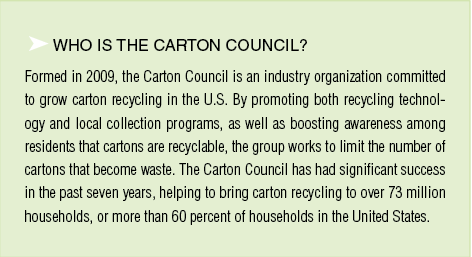
The Carton Council recently engaged RSE USA to investigate funding mechanisms and respond to these issues, with the goal of identifying one or more strategies that could have broad industry support and truly strengthen our move toward greater circularity.
Bringing together range of voices
To conduct this work, the RSE USA project team first performed a literature scan and interviewed 14 industry stakeholders who were selected based on their:
- Knowledge, experience and positioning in industry recycling efforts.
- Demonstrated proactive interest in exploring and advancing expanded packaging recycling.
- Established relationships with Carton Council team members.
Diversity of positions within the industry supply chains, including brand owners, packaging manufacturers and different packaging formats.
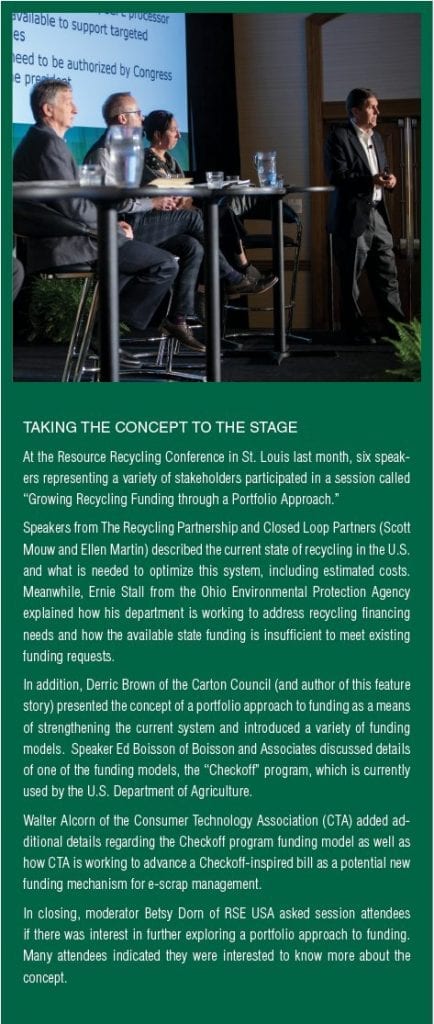
The project team produced a white paper summarizing study findings, which was circulated for stakeholder feedback and subsequent refinement. The final report, “Moving the Needle – An Industry Approach to Increase Funding for Recycling,” was completed in August 2018 and can be downloaded at cartonopportunities.org/supporting-policy-tools.
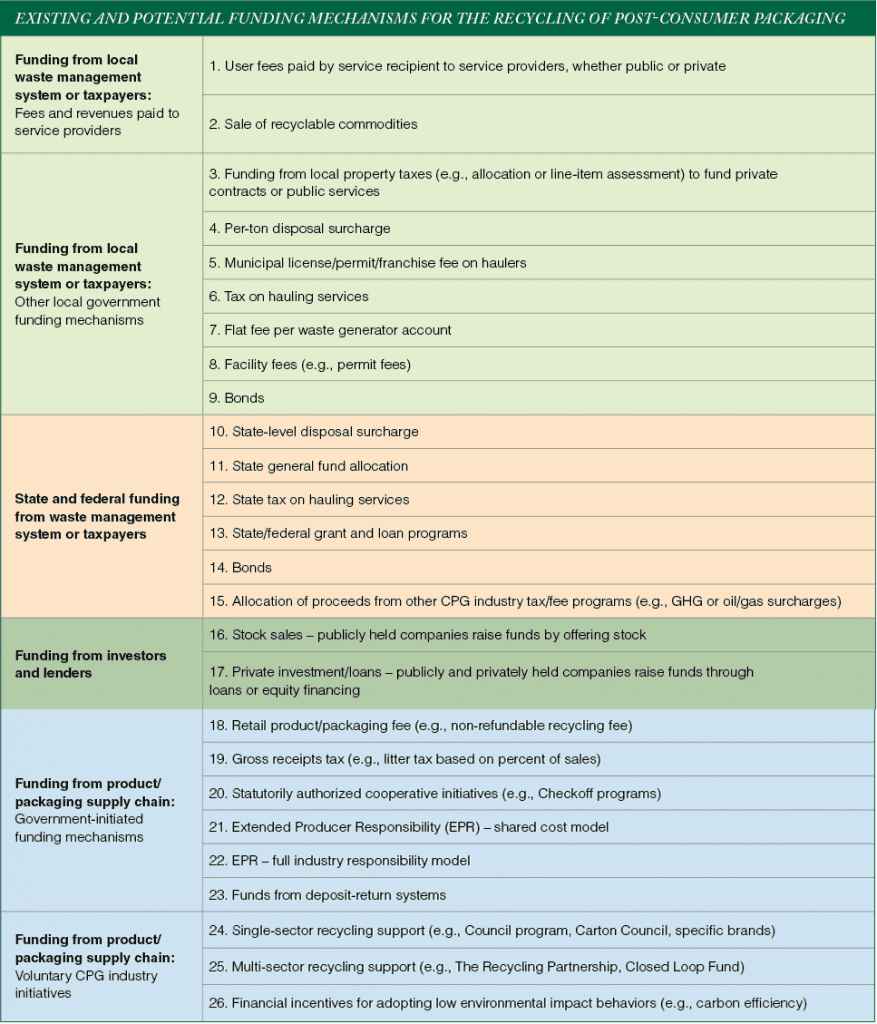
In undertaking this study, 26 existing and potential funding mechanisms were identified and grouped into four major categories by funding source. These mechanisms are presented in the table below. More-detailed descriptions of each mechanism are provided in the “Moving the Needle” report appendix.
Industry stakeholders interviewed for this project agreed in principle that any funding system for recycling be based on the following characteristics:
- Reliable – Able to withstand market volatility and expected to provide needed levels of revenue for a specified time frame.
- Efficient and Effective – Has reasonable administrative costs, encourages positive behavior and funds desired element.
- Equitable and Fair – Allocation of costs are perceived as fair among all contributors, “free riders” exist only by design, and transparency and accountability exist.
In practice, no one funding mechanism can meet all needs. Current recycling funding systems represent a portfolio of different mechanisms with funding provided by multiple stakeholders including: individuals (whether acting as waste generators, tax payers or consumers); local, state and federal governments; private companies involved in waste management and recycling; private companies and individuals involved in the financial industry; and private companies involved in the product and packaging supply chain.
Knowing who fits where on funding
Research and stakeholder input pointed to the need to identify appropriate roles for different funding sources, as different funding mechanisms tend to be suited to meeting different needs.
For example, local funding sources (from taxpayers or local waste management customers) are best matched to cover costs associated with ongoing collection and processing operations. They may also be used to secure financing for one-time capital investments in facilities and for other needs. Local governments can structure service contracts and requirements to encourage or even require such private sector investments.
Local funding sources, however, are not well suited to fund broad needs such as research, market development or system optimization, especially when such needs extend beyond local jurisdictional boundaries and responsibility/expertise. And while local governments have historically been responsible for informing service recipients about how to recycle, they usually are not well positioned to optimize programs and conduct effective recycling promotion and outreach campaigns across MRF-sheds or broader geographic regions.
State and federal sources, meanwhile, are generally well suited for supplementing local funding, and can also play a role in broader activities, such as research, market development, system optimization and cross-community promotion and education activities.
At the same time, it is appropriate that private lenders and investors provide funding for one-time capital and/or startup investments, where private or public sector entities qualify for such financing. These investments are typically backed by revenue streams from other funding sources listed in the table below.
Most industry stakeholders interviewed for the Carton Council project strongly suggested that industry should not be responsible for ongoing operational costs related to recycling collection and processing. Instead, the majority agreed that funding from industry-related sources is best suited to meeting needs that complement and strengthen local programs that are often not funded currently. These include cross-community promotion and education campaigns as well as research, market development and system optimization projects that broadly benefit all packaging/commodity types.
These purposes also align with industry’s role in the design, manufacture and use of packaging, its expertise in consumer facing marketing, and the growing commitment to broad sustainability goals, and more specifically, recycling goals.
(story continues below table)
Possible paths forward
Two funding mechanisms presented in the Carton Council white paper that could derive additional revenue stood out as fair and equitable.
The first is the concept of mandated supply chain funding mechanisms. Although many industry stakeholders are opposed to any type of mandate, some industry stakeholders view retail fees (No. 18 in the table) as a potential approach, especially in lieu of other mandated options. Each transaction fee can be small but still generate substantial revenue overall, and the fee system can be structured in a way that addresses equitability concerns across market/industry segments.
This funding mechanism can also include a sunset date, as was the case in Delaware, where a fee mechanism placed on certain beverage containers was used to help fund the transition to universal recycling.
The second funding pathway identified by the research is statutorily authorized cooperative initiatives (No. 20 in the table). Although not yet applied to the recycling arena, this mechanism provides an intriguing model that many stakeholders interviewed for this project found worthy of additional consideration.
“Checkoff” programs are a type of such initiative that have been implemented for 22 agricultural industries – paper, milk, beef and almonds, among others – to provide a framework to pool resources and combine efforts to develop new markets, strengthen existing markets and conduct important research and promotion activities.
The current Checkoff program model is structured as follows: A federal agency is authorized to broadly organize the effort, appointing industry members to a board that implements and oversees the program. Member companies make funding commitments and can serve on the board.
When a specified percentage of the industry’s market share is fully committed, the initiative is launched, and at that point member companies are obligated to provide funding into the program. Initiatives have included national advertising campaigns to promote product groups, with the “Got Milk?” ad effort serving as one memorable example. However, the model could be adapted to broadly promote recycling and/or to undertake more focused educational campaigns in targeted markets, perhaps backed by other industry activities that demonstrate successful local programs and practices.
The model could also potentially provide industry support to address other funding gaps as discussed above.
Time to strengthen a key component of society
Recycling matters to consumers, and it stands as a central component of the circular economy and the overall economy. To make recycling work, additional funding is needed. It is the Carton Council’s hope that the results of this research will be helpful in informing discussions of funding mechanisms for advancing recycling in the United States.
Derric Brown is the vice president of sustainability for the Carton Council. He can be contacted at [email protected].