





Some of the key recovered commodities generated by materials recovery facilities have been fetching high prices lately, including aluminum and fibers. But China’s import restrictions have introduced an element of the unknown in the market.
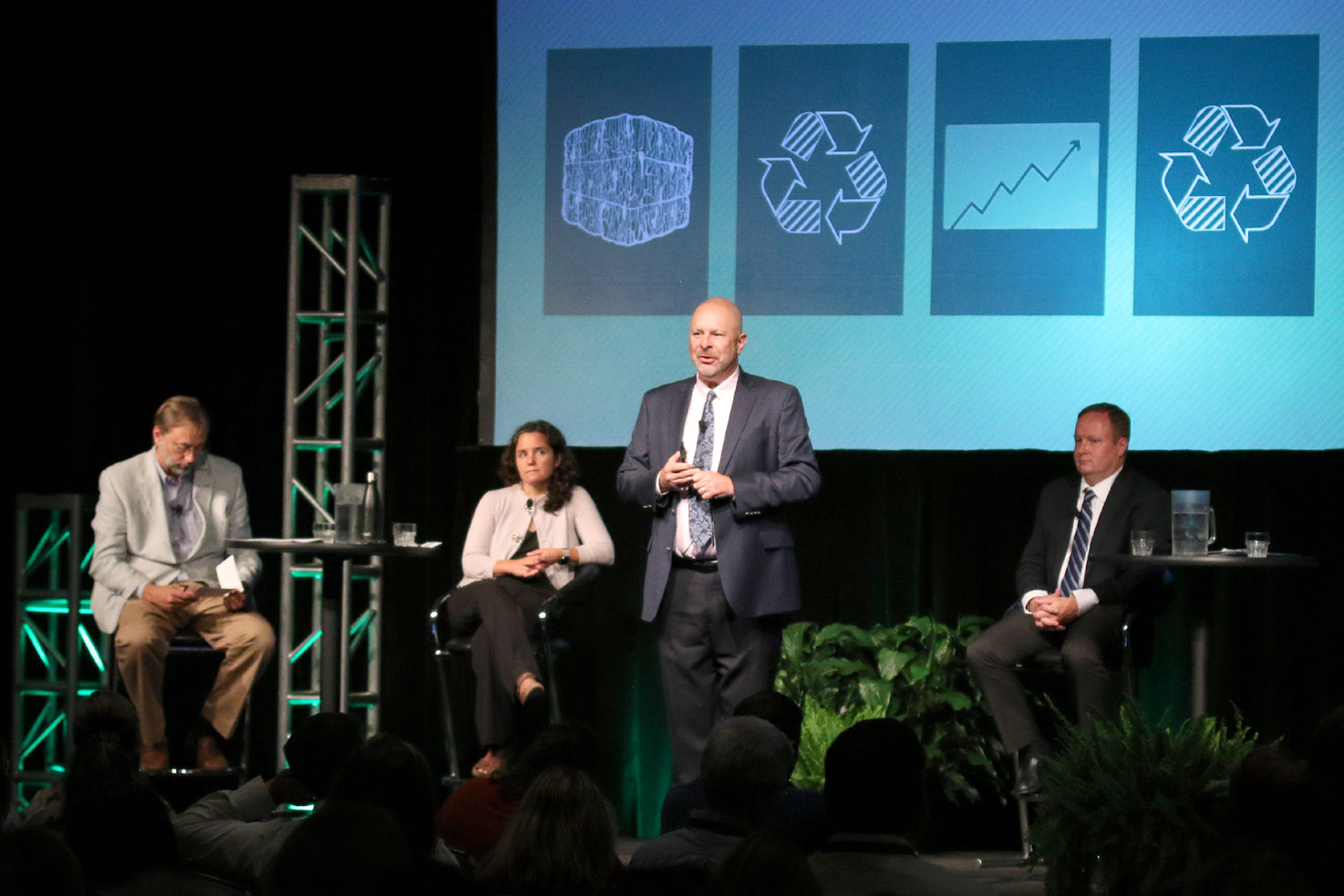
That was one takeaway from a markets-focused plenary session at the 2017 Resource Recycling Conference in Minneapolis. Taking the stage to discuss recovered fiber, metals and plastics were DJ VanDeusen of WestRock, Joe Pickard of the Institute of Scrap Recycling Industries (ISRI) and Nina Bellucci Butler of More Recycling.
While the economy has been generally strong, the outlook varies strongly by material. And underlying discussions of past and current prices and recovery volumes is a concern about China’s plans.
“Obviously a lot of press and market attention has been given to the potential scrap import bans – or restrictions, if you will – expected in China,” Pickard said. “Certainly, paper and plastics were first in line. But [there’s] increasing concern about the expectations for import bans on a number of important grades of copper and aluminum alloy from the United States, including on electrical appliance scrap, on insulated wires and cables, electric motors.”
Big picture on the economy
Pickard, chief economist and director of commodities at ISRI, presented a generally optimistic picture of the current state of the economy and commodities markets. Consumer sentiment, which has important implications for spending, is at extremely high levels, he said. Surveys of business leaders also show optimism for future sales, capital spending and employment.
On the downside, wages have stagnated since the recession, and labor productivity is below par, he said. When wages stagnate, income disparities increase, which leads to eventual slowing of spending.
Politics is also affecting sentiment. Many ISRI members were excited at the prospect of significant tax reform, which hasn’t happened yet. But about 43 percent of companies polled expect major corporate tax reform by the end of 2018, Pickard said.
The International Monetary Fund (IMF) revised its estimate of U.S. growth in 2017 downward, to 2.1 percent, which is still better than last year’s growth. The change is partly because IMF doesn’t believe the federal government will complete stimulus efforts, tax code changes or other major overhauls this year, Pickard said.
Good news for metals
After laying the groundwork of economic indicators in general, Pickard explored pricing for ferrous and nonferrous metals.
Aluminum, a key commodity for materials recovery facilities (MRFs), has increased 23 percent from the end of 2016. Prices for recovered aluminum now sit around $2,100 a ton. Copper has increased in value by 22 percent over that time, and it now sits at about $6,700 a ton, or over $3 a pound.
“These are multi-year highs for most of the base metals,” Pickard said.
Part of it has to do with expectations for improving demand from China, and part is due to the weaker U.S. dollar, which makes prices for U.S. commodities more attractive compared to those purchased in other currencies. During the first six months of this year, aluminum scrap exports from the U.S. were up 11.5 percent, compared to the same period in 2016. Exports to China, which receives the bulk of U.S. aluminum scrap shipments, were up 13 percent.
Ferrous markets have also had encouraging news in terms of pricing. In August, three grades of ferrous were up 30 percent compared to August 2016 levels. Boosting the prices are rising iron ore prices, high steel production in the U.S. and improved demand overseas for U.S.-generated ferrous scrap, Pickard noted.
That being said, the U.S. continues to import growing volumes of steel. For the first six months of this year, U.S. imports of steel increased 22 percent year over year, he said.
“That’s important for scrap recyclers because the steel that we import into the country displaces demand for domestically produced steel,” Pickard said. “When domestically produced steel is displaced, that’s reduced demand for scrap to produce that steel in the first place.”
The weaker U.S. dollar is also helping to drive exports of U.S. ferrous scrap. About one-fifth of U.S. ferrous scrap is exported, and more demand oversees helps drive prices domestically.
“That rising demand for overseas scrap is important, even if you’re not in the export markets,” Pickard said.
Shifts in fiber markets
VanDeusen, senior vice president of recycling at WestRock, noted his firm’s unique perspective on recycling markets: It’s a paper and packaging producer that also runs 22 recycling facilities, manages a recycling brokerage business and provides collection service to thousands of accounts. WestRock handles about eight million tons of recyclables a year. Five million tons are fed into the company’s own mills and the rest is sold.
In his presentation on fiber pricing, VanDeusen took the wide and long view, covering the worldwide growth in consumption of recovered fiber over the past two decades. Global consumption of recovered fiber has nearly doubled since 1997, up to about 250 million tons this year.
It hasn’t been evenly distributed, however. While North America and Western Europe’s consumption of recovered fiber has been basically flat over that time, developing countries, particularly China, are using much more now than they did in the ‘90s.
“The growth is coming from emerging nations,” VanDeusen said. “It’s coming from places where the recovery rates aren’t keeping pace with what the demand is for the material there.”
Dramatic shifts have occurred in the grade mix for North America. Total demand is essentially flat at 30 million metric tons per year, but the consumption of OCC has increased dramatically, mostly at the expense of ONP, which isn’t as plentiful anymore because of changes in the way consumers get their news.
“Mixed paper and the others grades have really become export commodities,” he said. “It still gets consumed in the U.S., but the majority of that material that gets recovered in North America ends up offshore.” Specifically, estimates put the percentage of North America’s mixed paper that’s exported at two-thirds to three-quarters, he noted.
Worldwide, the consumption of OCC has effectively tripled in the past two decades, from around 40 million metric tons to 120 million metric tons. Meanwhile, worldwide mixed paper usage has doubled, from around 20 million metric tons to 40 million metric tons.
“The demand for recovered fiber has never been higher, and there’s nothing on the outlook side that says this is going to dramatically change,” he said. “This is what we’re faced with.”
The past decade has also brought with it increased volatility in pricing. During that time, the price has varied around 40 percent off the average pivot point, he said.
“That’s incredibly difficult to manage, incredibly difficult to plan for,” he said.
He cast doubt on China completely stemming the flow of fiber into the country. It needs the material, he said. Over the next two years, factories capable of producing two million tons of new containerboard are expected to come on-line in China, and while the country does a pretty good job of recovering its own fiber, “there’s no way for them to collect enough fiber to meet the demands of what’s happening with the paper mills,” he said. “Thirty million tons of fiber needs to find its way to China for those paper mills to continue to run.”
That being said, imported bale quality will have to get better, he said.
He looked back at China’s Green Fence imports crackdown in 2013 and said that while it was incredibly painful at the time, the quality of mixed paper got better globally as a result.
“Ultimately, it put some measures in place that made the whole world a little bit better about making mixed paper that actually had paper in it,” he said.
The mixed story of plastics
In the world of recovered plastics, recycling realities really depend on the resin.
Butler, CEO of consulting and research firm More Recycling, noted that of the five billion pounds of plastic collected for recycling in the U.S. last year, 34 percent was PET bottles, 23 percent film, 22 percent HDPE bottles and 21 percent non-bottle rigids.
More Recycling’s research has shown that while North America has been collecting more plastic, it has been exporting less. For PET and HDPE bottles, the continent still has the capacity to purchase and process more of the plastics, although PET and HDPE reclaimers are facing challenges from lightweighting and shifts to flexible film packaging, she said.
PP is an emerging material that has seen growing recycling rates, she said, but for it, as with the other plastics, the key is separation to create a quality bale, Butler said. The weak link isn’t in downstream processing capabilities.
“We have capacity to purchase HDPE, PET, PP and other resins,” Butler said. “We don’t have the capacity to take the material from the MRF, further segregate it so we can get those discrete resins to market.”
Recovered PS also has quite a bit of end-user demand but lacks secondary sorting capacity to generate a clean stream. The industry also needs to find more efficient ways to condense expanded PS and potentially combine it with rigid PS to get it to market, Butler said.
With films and non-bottle rigids, China’s ban is likely to do more damage. That’s because collection has been increasing – films are now collected at 18,000 retail drop-off locations – but end markets have depended on exports. There simply isn’t enough domestic processing capacity.
China’s import policies aren’t the only factor affecting weighing on recycled plastics prices. The increasing supply and low price of virgin PE is, too. The availability of low-cost shale gas led to a boom in the development in virgin PE production capacity, Butler noted.
“The demand side of it is, we do have fortunately good economic conditions right now so there’s demand for product. We have some commitments for use of PCR (post-consumer resin). We have some legislation that encourages more PCR,” Butler said. “But the low price of virgin has fundamentally affected the foundation, the fundamentals, of the supply-demand balance of scrap plastic.”