







This story originally appeared in the January 2016 issue of Resource Recycling.
Subscribe today for access to all print content.
This is the second article in a three-part series on multi-family recycling. In “Multi-family mythbusting” (Resource Recycling, December 2015), we cast a critical eye on five common assumptions about recycling in the multi-family sector. This month’s article draws on research, examples from leading cities, and our own on-the-ground experience to present five best practices for boosting multi-family recycling.
Best practice 1: Set standards for access and service equity
This may seem obvious, but successful multi-family recycling begins by providing residents with the opportunity to recycle, an opportunity that a surprising number of multi-family residents still lack. While a recent AF&PA survey suggests that municipalities covering 78 percent of the U.S. population provide curbside recycling programs to residents, a separate survey conducted by packaging industry group AMERIPEN found that less than half of municipal curbside programs extend to apartments and condos.
Past research has clearly linked recycling access requirements to higher diversion rates. In the multi-family sector, however, these requirements often ensure the property manager or owner has access to service while leaving a loophole regarding resident access. Property managers who opt out of recycling service can deny their residents the opportunity to recycle. Recognizing the shortcomings of this approach and its consequences for multi-family recycling participation, the state of Oregon recently passed a bill expanding the definition of “collection service customer” under its Recycling Opportunity Act to explicitly include residential and commercial tenants, ensuring that recycling service is something all apartment residents can count on and is not a “perk” offered at the discretion of a property manager.
While ensuring access to recycling service is essential, it is also important to ensure that the service provided is sufficient to meet the needs of residents and that all parties involved in providing successful multi-family recycling access do their part. This requires defining “sufficient service” for your community and working with recycling service providers, property managers and developers to make sure they meet those standards.

Service standards should include guidelines for appropriate collection service levels; container types and colors; and requirements around labeling and signage, service frequency and resident outreach. The Austin, Texas Universal Recycling Ordinance is a great example of how a municipality can establish comprehensive service standards for multi-family properties, even when it doesn’t provide service directly.
Lack of adequate space for recycling containers and service logistics often severely limits multi-family recycling success. Developers must consider recycling space allocation during the design phase, as reconfiguring inadequate space after construction is extremely challenging. To avoid this barrier in new apartment buildings, municipalities are increasingly establishing minimum space and design requirements for recycling collection areas in new developments.
Depending on how multi-family recycling collection is provided in your community, ensuring recycling access and service equity for multi-family residents might involve making changes to a long-term service contract, establishing policy through a local ordinance, or making changes to local code. It is not an easy proposition, but this step is essential for ensuring that investments you make to boost multi-family recycling will have lasting results.
Best Practice 2: Put in place the four Cs of supportive infrastructure
Through an extensive review of research on the drivers of recycling behavior and our own work in partnership with local governments and service providers to improve multi-family recycling in Washington and California, Cascadia has identified four aspects of supportive recycling infrastructure that are vital for boosting resident participation – before conducting education or outreach.
To understand and address the infrastructure barriers in place in your community, visit all or a sample of properties in your jurisdiction to assess how the existing recycling infrastructure stacks up against these benchmarks for the four Cs of infrastructure:
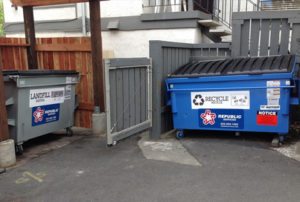
Convenience. To the extent possible, recycling containers should be co-located with garbage containers at every point of collection. Co-location allows residents to discard recyclables at the same time they discard garbage, preventing the need for a separate trip. Co-location also reduces contamination that occurs when a resident with garbage in hand encounters a lone recycling container. Where co-location is not possible, such as in buildings with trash chutes, recycling should be as convenient as possible for residents and clear signs should be posted at disposal points to alert residents about the location of recycling containers.
Clarity. All containers should have large, identifying labels (for example, “Garbage” and “Recycle”). In addition, image-based informational signs should be posted above containers at every point of collection. Labels and signs should be large and use a white background so they are easy to decipher from a distance and in dim light. Recycle signs should also highlight high-volume and high-value materials such as cardboard boxes, newspapers, metal cans and plastic bottles. Do not depict every possible accepted item – doing so is confusing for most residents.
Capacity. A multi-family property’s recycling capacity should be at least 30 percent and preferably 50 percent of its total service volume. For most properties, weekly recycling capacity should likely be in the range of 20 to 30 gallons (0.10 to 0.15 cubic yards) per unit. Insufficient collection capacity is a growing issue because changes in the composition of recyclables, especially increases in cardboard and plastics, mean that recyclables simply take up more space now. Based on current average density factors, a recycling collection container must be twice the size of a garbage container to hold the same tonnage, which means service levels that were sufficient several years ago are no longer adequate. Properties that do not have space for more or larger recycling containers can increase capacity through more frequent pick-ups. However it is achieved, sufficient collection capacity is critical for success. Service adjustments should be planned in consultation with the service provider and property manager to ensure operational feasibility.
Color. Recycling and garbage containers should be consistently and meaningfully color-coded. Preferably, container colors should match color-coding that residents are likely to encounter on containers elsewhere in the community – at work, in public spaces and at event venues. The color-coding of containers is no small task and requires substantial investment. If full color-coding of containers is not possible, consider using color-coded lids and reinforce container differentiation with color-coded signage.
Without these four Cs in place, investing in outreach or promotional campaigns is unwise. Efforts to increase multi-family recycling participation will be thwarted if residents cannot locate the recycling collection area, differentiate the recycling container from the garbage container or, perhaps worst of all, arrive with a bag of diligently separated materials only to find that the recycling container is overflowing and has no space for their items.
Establishing the four Cs as part of your community’s service standards is an important first step, but making sure these standards are implemented requires conducting boots-on-the-ground outreach and providing technical assistance to property managers. This is especially true for increasing capacity, as each property has unique attributes that must be factored into container and service arrangements – and property managers often do not have the expertise necessary to determine optimal service arrangements on their own.
Cascadia’s work in partnership with service providers and representatives of King, Snohomish and Kitsap Counties in Washington to implement the four Cs of infrastructure through pilot programs has shown that providing a supportive recycling infrastructure can deliver dramatic and immediate results. Across dozens of properties and a wide range of resident demographics in three counties, recycling volumes at properties receiving infrastructure improvements increased between 40 percent and 130 percent (by volume) over baseline levels, with minimal changes in contamination rates.
Best Practice 3: Give property managers tools and support
Property managers are essential partners in successful multi-family recycling, but they need resources to educate and engage their residents. Jurisdictions and service providers can support property managers by taking the initiative to deliver useful tools and make them easy to access. Most property managers will not seek them out on their own or will give up if they are not easy to locate. Increasingly, communities are providing easy-to-navigate online portals that give property managers step-by-step guidance for setting up a recycling program. Other attributes include downloadable resources and templates as well as order forms for tools such as posters and signs, multilingual recycling guidelines, container decals and recycling tote bags. Examples of great property-manager resource hubs include those developed by the City of Chicago, City of San Francisco (through service-provider Recology), City of Austin and New York City.
Recognizing the critical role of property managers in facilitating successful resident recycling, municipalities such as San Francisco, Austin and Portland, Ore. require that property managers give residents up-to-date information about how and where to recycle when they first move in and again at least once a year. Even if it is not a requirement, jurisdictions should encourage property managers to give residents specific information when they move in, including the following:
- Where recycling areas are located at the property
- What items can be recycled (providing a copy of recycling guidelines)
- How to transport materials to recycling areas (ideally also giving residents a tote bag they can use to collect recyclables in their units and transport them to the central collection area)
- How to dispose of bulky items or special wastes
By communicating with residents about recycling from the start, property managers can encourage new residents to establish and maintain the habit of recycling by sending the message that recycling is an expected practice and shared norm of the property.
Many property managers are willing to participate in promoting recycling to residents but do not know where to start. Service providers and jurisdictions conducting regular outreach to property managers to assess their needs, give them resources and offer support can go a long way toward boosting buy-in and stimulating action.
Best Practice 4: Deliver educational materials directly to residents
Even though property managers are important partners in successful recycling, relying solely on them to distribute information to residents can lead to inconsistent outcomes and leave many residents without the information and education they need to effectively participate in recycling and waste diversion.
The value of communicating directly with apartment residents has been well established. In its 2001 report, “Multifamily Recycling – A National Study,” the U.S. Environmental Protection Agency noted communities with high diversion rates were more likely to directly mail information to individual households frequently, and it found communities with lower diversion rates tended to use mailings less frequently and rely more on property managers to communicate with residents.
Direct mailing of program information to residents is a good start, but research shows that door-to-door outreach has significant positive effects on resident recycling participation and waste diversion. A 2006 survey of U.S. households (including apartment dwellers) conducted by Hilary Nixon and Jean-Daniel Saphores found that face-to-face communication is the most effective medium for getting people to recycle. Although door-to-door outreach is time- and resource-intensive, it can ultimately prove to be highly cost-effective compared with other education methods. Door-to-door outreach to thousands of multi-family residents conducted by Cascadia has resulted in average resident interaction rates of 30 to 40 percent, substantially higher than typical open rates of direct mail. And with each resident interaction providing two to three minutes of face-to-face, tailored education and information for each household, the effect of this kind of education is much more powerful.
Distributing tote bags along with other educational materials to multi-family residential units through door-to-door outreach can also be a great way to tackle commonly cited barriers to resident recycling participation. Tote bags can serve as efficient in-unit collection receptacles where storage space is limited and can provide a convenient way for residents to transport collected recyclables to a central collection area without having to use a disposable plastic bag (a common woe for recycling processers handling multi-family sector material). On their own, tote bags will not increase recycling in the absence of supportive infrastructure, but they have been shown in pilot programs to amplify recycling participation among residents where the four Cs of infrastructure are in place.
For maximum impact, outreach should be performed by a multilingual/multicultural team selected to align with the languages spoken in each community. Outreach materials should be provided in multiple languages and should be “trans-created” – not just translated – when possible.
Best Practice 5: Monitor building performance
Readers likely know the old adage – you can’t manage what you don’t measure. On its own, developing a database of properties in your community may lead to better program outcomes and can help sustain the value of investments over time. The EPA’s 2001 multi-family recycling study found that keeping track of basic property-level information (how much recycling service is available at each building, the number of units per building and other figures) can lead to improved program performance.
Compiling such information can also help you focus your energy on raising the lowest performers, establishing benchmarks that are realistic for your community and tracking progress over time.
Up next: including the whole community
Following these five best practices in your community is a great starting point for boosting multi-family recycling. The final article in this series will take a closer look at how to include residents from all cultures and communities in multi-family recycling programs.
McKenna Morrigan is a senior associate at Cascadia Consulting Group in Seattle, where she specializes in recycling and materials management policy, program design, research and analysis. She can be contacted at [email protected].