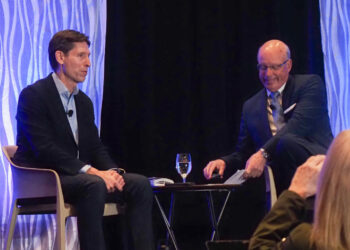

The May 28 webinar, “Coalition Building for Extended Producer Responsibility for Packaging and Paper Products,” featured Resa Dimino, managing partner at Signalfire, as a moderator and panelists Liz Chapman, executive director of Recycle Colorado; Washington State Rep. Liz Berry; and Dawn Timm, chair of the New York Product Stewardship Council.
When it comes to building a coalition, the panelists recommended starting early and broadly. Chapman, who helped get Colorado’s packaging and paper EPR bill passed in 2022, said the only way for a bill to get across the finish line is if “it’s full of compromise. It’s got to be a lot of push and pull and push and pull.”
Colorado’s coalition included “the folks that you would expect,” Chapman said, such as other recycling groups and environmental groups, but also a number of business partners.
“We found the nexus between what the recycling advocates wanted and what were the business needs,” Chapman said. “Where those things met is where we pursued going forward.”
Berry, a Democrat representing part of Seattle, has been involved in packaging and single-use plastics legislation since she was elected in 2020. She’s authored EPR legislation for the past couple of years as different groups in the state have worked to get a bill passed.
She said the coalition in Washington has “been built in a really organic way over the last three years.” It now includes 25 to 30 environmental organizations, dozens of labor organizations representing over half a million people in the state, consumer advocacy organizations, local governments and some industry associations, including Ameripen.
Timm noted that with a large coalition, “you have to be willing to evolve and move and become nimble.”
“Having a real strong, effective leadership and a coalition across the state has been beneficial and positive,” she said.
Over 100 stakeholder meetings in addition to weekly partner meetings led to a bill in Colorado that most groups could either support or remain neutral on, Chapman said. Supporters found it helpful to figure out the hard lines for each group early on.
“I think because of the frequency of meetings and because of that willingness to start the process long before we put any bill language on paper … it built a sense of trust amongst the partners working together and amongst the lobbyists meeting with one another, it allowed people to have hard conversations,” Chapman said.
She also recommended finding groups to work with that represent significant stakeholders, such as the Colorado Municipal League, which represents municipalities across the state.
“Us having a representative group that could go out to a larger group and then distill that feedback to that small group made it much more effective,” Chapman said.
Colorado’s bill stayed focused on EPR, Chapman said, after starting out far more broadly.
“It had a lot more ancillary elements to it in terms of chemicals involved in packaging, in terms of workers rights,” she said. “Having those extraneous things diluted our support.”
Timm said New York’s bill, which is “such a behemoth of a bill, with a lot of externalities and components,” such as aggressive rates and dates, language on toxic substances in plastics and other requirements, has “weighed us down a little bit.”
“We’ve become really heavy and it’s been difficult and challenging at times to get inertia moving to our benefit,” she said.
Support, neutrality, opposition
While it’s important to get a broad agreement on any piece of legislation, Chapman said not everyone came on board in Colorado, despite all the meetings, and “I don’t think it’s necessary that everyone is on board.”
“This is not likely to be unanimous support, you just need to get more support than you have opposition,” she said. “And if the opposition feels they’ve been heard and the opposition feels like their concerns have been taken into account, even if it doesn’t get them into a place of support, it gets them away from being in a position of active opposition, and I think that is equally useful to getting across the finish line.”
Early and consistent meetings with those in opposition are a key part of getting there, especially with specific groups. Timm noted in New York, it’s been vital to work with the agricultural community. New York State is the largest producer of yogurt, so the coalition made sure the dairy industry had a voice in shaping the exemption thresholds.
In Colorado, the agricultural community was part of the working group before any bill language had been drafted, Chapman said.
“We never got agriculture in Colorado in a position of actively supporting, but because we met with them early and we let them write the language for their exemptions, they also did not actively oppose, which made a huge difference,” Chapman said. “Colorado is also a very rural and agriculturally driven economy, and if they had decided to actively oppose us, I don’t know that we would have succeeded despite our municipal support.”
Grocers, restaurants and haulers are typically in opposition, the panelists all said. Chapman noted while the solid waste community never supported the bill as a group, the coalition was able to get support from a few individual companies who “felt like they could live with this policy.”
Chapman pointed out that EPR can seem like a death sentence for many in that industry, so “finding a way to craft policy that does not put them under, that they actually are beneficiaries of in the same way that the municipalities are beneficiaries of, I think is the way forward and how we were able to get to that neutral position with so many of the individual companies.”
Colorado took the same individual company tactic with beer brewers, who as a group opposed the bill, but some local brewers came on board and decided to actively support the bill.
Berry said many businesses used to be “very staunchly opposed to these types of policies, but have come around to the idea that something has to be done. Something has to give.”
Between consumer pressures and the growing popularity of state-level policies, many companies “would rather be seated at the table than be on the menu.”
“I’m not going to say – many of you are on this call – that your company is involved now out of the goodness of your heart,” Berry said. “You know that if you don’t pass policies like this … we will ban certain materials, there will be other sorts of policies coming down the pipe that you don’t really like.”
She said she appreciates the companies who have decided to come to the table and “figure out how to write a policy that we can live with,” and she would love to see similar action from haulers.
Sharing tips
The panelists’ advice for others working to get EPR passed came down to education, compromise and focus.
Chapman said the Colorado coalition started educating legislators in 2018, ahead of the bill being passed in 2022. They had lawmakers tour facilities in the offseason and learn about how the recycling system was working – or wasn’t.
“That process that took two years was, I think, absolutely crucial into building the support that we needed at the State House in order to get this type of legislation passed,” she said. “And we didn’t jump from that study group to all of a sudden (packaging) EPR. There were a number of different step-legislations that happened in between,” such as EPR for paint and e-scrap.
Looking back, Chapman said she wishes the coalition had done the same educational process with other stakeholders.
“If we had reached out and had been more aggressive about educating the producers, the business partners, the municipalities, the retailers, if we had made that same effort to educate those communities about this before we were presenting them with active legislation, I think we would have had much more productive conversations and the path to success would have been a little bit easier,” she said.
On the lawmaker side, Berry advised not recreating the wheel. Most national brands and companies have already had conversations about packaging EPR in other states, and she recommended looking at successful legislation for lessons.
“It’s so interesting now traveling around the country and doing the EPR thing, it’s the same characters all over the place,” she said.
The Washington coalition spent a lot of time building a definition of “producer,” Berry noted. “I’m really proud that because of that work, our producer definition is now being seen as a model around the country,” she said, including the recently passed bill in Minnesota.
She added that she’s “digging deep into the Minnesota law right now to see if there are any lessons learned” for Washington.
Another challenge that Timm has faced in New York after five legislative cycles of working on the bill is the turnover of lawmakers.
“You’re constantly educating, and you’re constantly reinforcing the point,” she said.
Expect support to ebb and flow as bill language changes, she added, and remember that a majority is needed, not unanimous consensus. Timm also recommended falling back on existing facts and studies if the opposition starts to get nasty, but staying nimble enough to respond quickly to misinformation.
“You just need 51 out of 100,” she said, and when it seems like nobody is happy, it can be helpful to “double down on the strength of the coalition in these matters.”
“The strong leadership of a coalition agreeing to the core principles and making sure that, in the spirit of evolution, that there is compromise,” is vital, she said, because “not everyone’s going to walk away from the table happy, but I can say that now, because we’re still very much all at the table, nobody’s happy because we don’t have a bill.”
All three panelists had a resounding answer when asked if passing EPR for plastic packaging only was a better way: No.
Timm said that while plastic pollution is an overwhelming issue, “from a municipal government standpoint, there is far more involved in our municipal recycling stream than just plastics.”
“I would advocate for an extended producer responsibility policy that focuses on the entire municipal recycling stream,” she said. “Plastic is a low percentage.”
In fact, a plastics-only EPR bill was introduced in New York several years ago, she added, and “it didn’t take flight for a lot of reasons.”
One way to generate support for packaging EPR is to focus on the jobs a stronger recycling system will bring, Chapman noted, and “if you’re focused simply on plastics, you’re not generating the kind of jobs that you need to make an economic case for the benefits that this program is going to bring to your state.”
Berry also focused on the effect on municipal governments, which “have to deal with everything.”
“I think it’s really important that we have that holistic approach and not just carve out those specific problematic materials,” she said. “Of course they are the most problematic, but we include all of them together.”
A version of this story appeared in Resource Recycling News on June 4.