





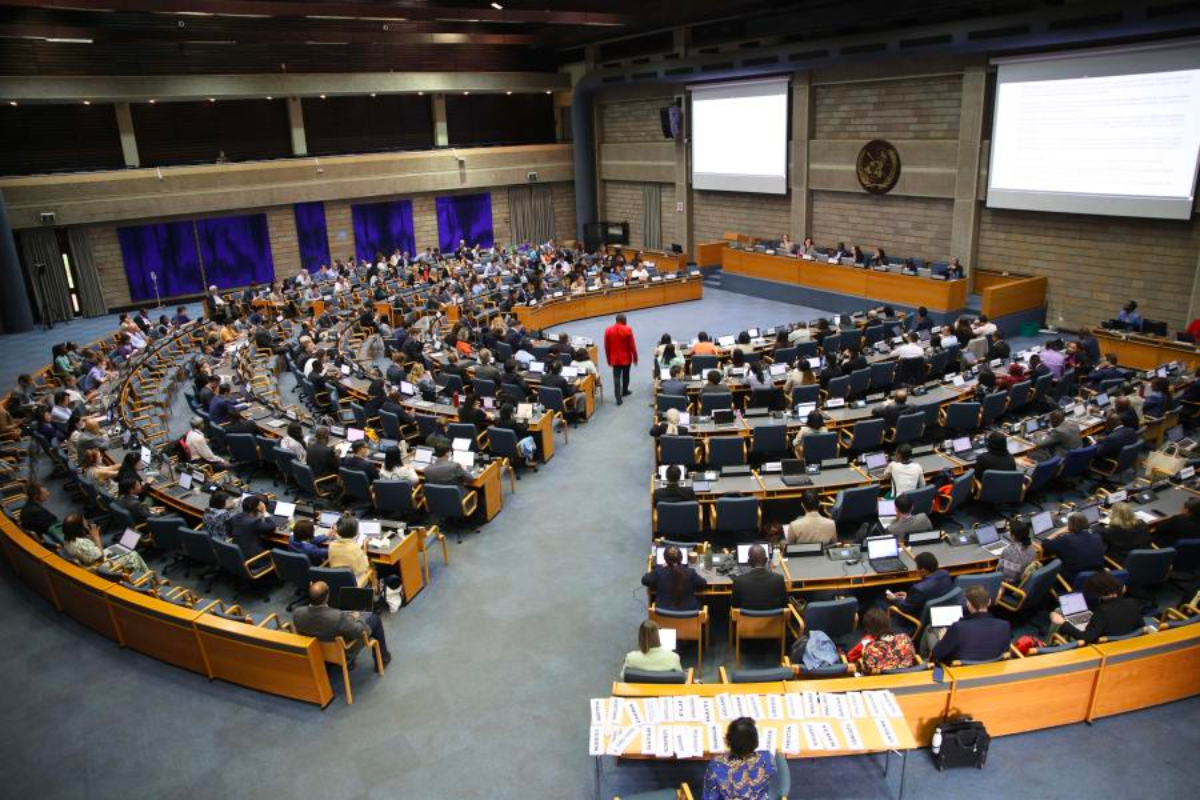
As the third meeting of the United Nations Intergovernmental Negotiating Committee wrapped up in Kenya, delegates once again expressed frustration about the slow progress toward an internationally binding resolution on plastic pollution.
The third United Nations Intergovernmental Negotiating Committee meeting (INC-3) in Nairobi, Kenya from Nov. 13-19 was initially intended to produce a second full draft of the treaty and set the stage for a significant amount of work to be completed between sessions, but delegations walked away without meeting either of those goals.
The meetings follow a 2022 vote on a U.N. resolution to create a legally binding agreement by the end of 2024 to end the leakage of plastic waste into the environment. The fourth committee meeting will take place in Ottawa, Canada from April 21-30, 2024.
According to the Earth Negotiations Bulletin, a division of the International Institute for Sustainable Development, pushback from a small group of delegates, out of the 1,500 who attended the INC-3 meeting, again slowed down progress.
However, a revised draft treaty will come out of the negotiations by Dec. 31, Earth Negotiations Bulletin noted, one that is much longer than the initial “zero draft.” In some cases, three paragraphs in the zero draft expanded to 10 pages, leaving one delegate on Nov. 17 to note that the text “is so big, we don’t even know where to start.”
“At this point, it is clear that a herculean effort will be needed during the intersessional period to ensure the text is in good shape for INC-4,” the Nov. 17 daily report noted, though in the end no plan for intersessional work was agreed upon.
Among the topics that saw changes from the zero draft are definitions of emissions, financial mechanisms, the merging of several different sub-options from the original draft text, periodic assessment and monitoring of the progress of implementation, and how to approach capacity building, technical assistance and technology transfer.
In general, delegates praised a “heightened trust in the process and the people” and said they had a “clearer understanding of where countries stand,” though others felt the “ghost of Paris is haunting us,” referring to the “endless hours of circular debate held at INC-2,” the Earth Negotiations Bulletin noted.
Reactions on the ground
Many groups expressed mixed feelings about the work completed at INC-3. The International Alliance of Waste Pickers noted in a press release that it succeeded in its goal of getting the term “waste picker” included and defined in the draft text, as well as “just transition.”
However, the Center for International Environmental Law (CIEL) said while the week started with high hopes, several delegations instead blocked progress and are endangering the entire treaty.
“Governments that began the week with a ‘Zero Draft’ of the treaty text and a clear mandate to agree on an active intersessional program of work are leaving eight days later with a ‘Revised Zero Draft’ that has ballooned to 100 plus pages, with no intersessional agenda and a clear warning that entertaining endless debate by those few who want to block progress at every turn is a recipe for inertia and eventual disaster,” CIEL said in a statement.
Carroll Muffett, CIEL president, called out the “massive presence” of 143 fossil fuel and chemical industry lobbyists registered for the negotiations.
A strong treaty is “still achievable in these talks, but only if negotiators acknowledge and confront the coordinated campaign by fossil fuel and petrochemical exporters to prevent real progress of any kind,” Muffett added.
CIEL also criticized the United States for trying to “replace concrete global commitments with catchy buzzwords and unenforceable promises.”
“It’s clear the present process cannot overcome the coordinated opposition of those who block consensus and progress at every turn,” Muffett said. “Absent a major course correction, Canada will host a polite but massive failure when talks resume in Ottawa next year.”
Jacob Kean-Hammerson, an ocean campaigner at the Environmental Investigation Agency, also said in an emailed statement that “the path towards a strong final agreement looks treacherous.”
“These negotiations ended with more questions than answers about how we can bridge the political divide and craft a treaty that stimulates positive change,” he said. “As always, the devil is in the details, so it is crucial that ambitious states stand firm against attempts to weaken progress by some of the world’s major oil and petrochemical producers.”
The World Wildlife Fund (WWF) called on countries to “stand firm as delaying tactics drive global plastic pollution treaty talks into deadlock” and also highlighted some positive work to come from the third meeting.
“Despite obstruction by a small number of countries, a significant majority of countries support moving forward with a comprehensive and robust treaty,” the statement noted. “More than 100 countries support global bans and phase-outs of the most harmful and avoidable plastics, and 140 countries want to establish global binding rules as opposed to a treaty based solely on voluntary actions, which some countries are pushing for.”
Since there was not a formal plan made for intersessional work, the WWF also said countries should “advance information gathering and sharing on their own to ensure that the process does not stagnate in the next five months,” with particular emphasis on what to ban, the scope of the treaty, voluntary versus mandatory measures, where financial support will come from and go to, and if ratification will be a formal consensus or a majority vote.
Industry response
On the industry side, Ned Monroe, president and CEO of the Vinyl Institute, told Resource Recycling that “while we can all agree on the overarching goal of eliminating plastic pollution, we must be cautious not to overcorrect and ban vital materials needed by disadvantaged communities here in the U.S. and in developing nations globally.”
He highlighted the need for clean water in developing countries and safe global blood supplies, which “could be frustrated by attempts to ban specific plastics” such as polyvinyl chloride (PVC).
“The Vinyl Institute is working to address the problem of plastic pollution, enhance recycling and clean up our environment,” Monroe added. “Despite misconceptions, PVC is not actively contributing to the global waste challenge – more than 75% of PVC resin produced is used in durable applications with a service life of 25-plus years. Banning PVC will not be the silver bullet to combatting plastic pollution.”
Global Partners for Plastics Circularity, which represents the plastic industry, said the third meeting “made progress towards an effective and practical plastics agreement,” a press release noted.
“The GPPC continues to advocate for an agreement that will accelerate circularity, maximize the participation of UN member states and is equitable to developing countries,” the press release noted. “This can be best accomplished by creating demand signals that will unlock investments in product design innovations, collection and recycling infrastructure and financing systems that incentivize circularity to keep used plastics out of landfills, incinerators and our environment.”
However, the group noted it would like to see more focus on circularity and invited governments “to work with us on finding solutions that can help solve the unique challenges countries face in eliminating plastic pollution.”
The Business Coalition for a Global Plastics Treaty, which represents over 170 companies and organizations, said while it was encouraging to see “a significant majority of countries support moving forward with a comprehensive and robust treaty,” it is concerned by “attempts to narrow the scope of the treaty text to focus only on downstream measures.”
“We need action across the entire plastics value chain, and specifically upstream solutions such as: elimination of problematic plastic materials and chemicals of concern, better product design and scaling of reuse and refill systems,” a press release noted. “These measures are essential, as we know that recycling and waste management alone are not a viable approach to stop plastic pollution.”
The group also expressed disappointment about the number of alternative text proposals put forward, which included attempts to remove “key provisions related to primary plastic polymers, identification of chemicals and polymers of concern as well as problematic and avoidable plastic products.”
“The lack of agreement on any intersessional work may cause further delays to the negotiation process, which we cannot afford with the limited time left,” it noted, adding that “businesses respond to regulatory certainty.”