










Resource Recycling
  • The Latest
  • Analysis
    • All
    • Certification Scorecard
    • Industry Announcements
    • Opinion
    HP receives ocean plastics certification

    HP Inc. earnings point to memory inflation challenge

    Certification scorecard for the week of Feb. 23, 2026

    Umicore highlights strength in recycling, catalysis

    Apto, Tusaar partner on rare earths recovery

    Apto, Tusaar partner on rare earths recovery

    Certification scorecard for the week of Feb. 16, 2026

    Sims Lifecycle leverages hyperscale decommissioning

    Sims Lifecycle leverages hyperscale decommissioning

    The electronics recycling industry is undergoing a transformation from labor-intensive manual operations to highly automated, AI-driven facilities that use advanced robotics, cleaner chemistry and digital tracking systems to extract critical materials.

    The cyber-physical MRF: AI and robotics reshape e-waste recovery

    Certification scorecard for the week of Feb. 9, 2026

    Meta-Corning deal signals IT hardware retirement wave

    Meta-Corning deal signals IT hardware retirement wave

  • Conferences
  • Publications

    Other Topics

    Textiles
    Organics
    Packaging
    Glass
    Brand Owners

    Metals
    Technology
    Research
    Markets
    Grant Watch

    All Topics

Subscribe
No Result
View All Result
Resource Recycling
  • The Latest
  • Analysis
    • All
    • Certification Scorecard
    • Industry Announcements
    • Opinion
    HP receives ocean plastics certification

    HP Inc. earnings point to memory inflation challenge

    Certification scorecard for the week of Feb. 23, 2026

    Umicore highlights strength in recycling, catalysis

    Apto, Tusaar partner on rare earths recovery

    Apto, Tusaar partner on rare earths recovery

    Certification scorecard for the week of Feb. 16, 2026

    Sims Lifecycle leverages hyperscale decommissioning

    Sims Lifecycle leverages hyperscale decommissioning

    The electronics recycling industry is undergoing a transformation from labor-intensive manual operations to highly automated, AI-driven facilities that use advanced robotics, cleaner chemistry and digital tracking systems to extract critical materials.

    The cyber-physical MRF: AI and robotics reshape e-waste recovery

    Certification scorecard for the week of Feb. 9, 2026

    Meta-Corning deal signals IT hardware retirement wave

    Meta-Corning deal signals IT hardware retirement wave

  • Conferences
  • Publications

    Other Topics

    Textiles
    Organics
    Packaging
    Glass
    Brand Owners

    Metals
    Technology
    Research
    Markets
    Grant Watch

    All Topics

Subscribe
No Result
View All Result
Resource Recycling
No Result
View All Result
Home Plastics

Dispatches from Europe: A step to stem the plastic tide

byClarissa Morawski and Samantha Millette
October 31, 2018
in Plastics

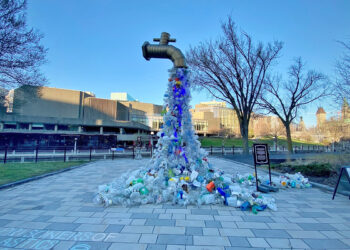
Single-use plastics are everywhere, with most of us regularly relying on the convenience of products such as plastic bags, straws, utensils, takeaway coffee cups, food packaging and water bottles.

Clarissa Morawski

But it’s also becoming clear we have made, used and disposed of too many. According to one recent academic analysis, only 9 percent of all plastic ever created has been recycled, 12 percent has been incinerated and the rest – 79 percent – has been dumped in landfills or littered in the natural environment (intentionally or not).

In an attempt to stem the tide of throwaway plastic pollution, European Union lawmakers on Oct. 24 voted to back a policy proposal that would ban some items directly and require ambitious recycling rates for others.

Leaders must still work out final details of the plastic effort, but the action last week nonetheless represents a major moment in Europe’s push to address single-use plastics (and the recovery of those items) in a direct and meaningful manner.

The path of the policy

The EU policy has been in development for some time.

Samantha Millette
Samantha Millette

On Jan. 16 of this year, the European Commission published its communication laying out a strategy for plastics in a circular economy. The first-ever EU Plastics Strategy identified key challenges, including low reuse and recycling rates for plastic waste, the greenhouse gas emissions associated with plastics production and incineration, and the presence of plastic waste in oceans. The strategy then proposed a comprehensive set of measures to address these problems.

Then, in May, the European Commission published a directive focused on single-use plastics. It proposed a new law to tackle the 10 most common plastic waste items found on Europe’s beaches, as well as fishing gear (which, together, make up 70 percent of marine litter, according to some sources).

On Oct. 11, the European Parliament’s Committee on Environment, Public Health, and Food Safety adopted a number of amendments to strengthen certain provisions of the proposal. That set the stage for the Oct. 24 vote, in which the committee’s version of the directive (a compromise text) won the backing of 571 parliament members (with just 53 against). The vote represented the clearing of a major legislative hurdle toward the proposal becoming EU law.

Under the proposal, single-use plastic items that have reusable or readily available, non-plastic alternatives would be banned from the EU market by 2021. Examples of covered products are cutlery, cotton buds, straws, stirrers, oxo-degradable plastics, and food and beverage containers made of expanded polystyrene.

Member states would also be obliged to separately collect and recycle 90 percent of plastic beverage containers (including caps and lids), and ensure those items contain 35 percent recycled content by 2025. In addition, member states would have an obligation to reduce the consumption of several other plastic items, such as single-use food containers, by at least 25 percent. And the proposal includes provisions that would involve manufacturers of single-use plastic packaging to cover the costs of waste collection for these products, including transport, treatment and litter collection.

Similarly, member states would also have to ensure that at least 50 percent of lost or abandoned fishing gear containing plastic is collected per year, with a recycling target of at least 15 percent by 2025.

And finally, the policy states reduction measures should cover post-consumption waste from tobacco products, namely cigarette filters containing plastic. The proposal requires member states to ensure that tobacco companies reduce the amount of plastic in its filters by at least 50 percent by 2025, and 80 percent by 2030.

Reinforcing EU’s leadership role on environment

Later this month, representatives of the 28 member states will meet to agree on a joint position, and then the final negotiations to make the plan binding legislation will begin between the national governments, the European Parliament and the European Commission.

It is expected those government stakeholders will reach an agreement (“compromise amendments”) on the text just before the end of the year, which would conclude with the official publishing of the legislation in May 2019. Member states would then have two years to transpose the text of the directive into their own national legislation.

The EU is often regarded as a world leader when it comes to environmental policies, and this latest directive is no exception.

While news headlines around the world continue to reveal a grim picture of discarded plastics choking albatrosses, killing fish and creating islands of garbage, in the EU real action is taking place.

Last week’s vote gives hope that the tide is starting to turn on plastic pollution. It is now up to member states to translate words into action and ensure that the ambition stays high.

Clarissa Morawski is based in Barcelona and serves as the managing director of the Reloop Platform, which brings together industry, government, and nongovernmental organizations in Europe to form a network for advances in policy that create enabling system conditions for circularity across the European economy. She is also principal of Canada-based CM Consulting Inc. She can be contacted at [email protected].

Samantha Millette is an environmental consultant specializing in the areas of waste management research, policy, and planning. She is the owner of SAMI Environmental and can be contacted at [email protected].
 

Tags: Europe
TweetShare
Clarissa Morawski and Samantha Millette

Clarissa Morawski and Samantha Millette

Related Posts

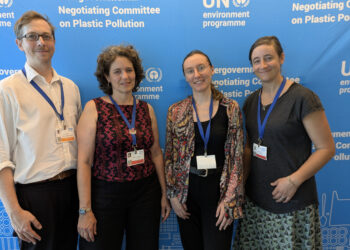
Member states select new chair for global plastics treaty

Member states select new chair for global plastics treaty

byAntoinette Smith
February 10, 2026

During a short session, the Intergovernmental Negotiating Committee elected Chilean diplomat Julio Cordano to continue efforts toward an internationally binding...

Royal Mint, Procurri partner for ITAD metals recovery

byScott Snowden
February 5, 2026

Reformation Metals partnered with Procurri to combine secure IT asset disposal with clean technology recycling that recovers up to 99%...

Auditors warn EU may fall short on critical metals

Auditors warn EU may fall short on critical metals

byDavid Daoud
February 4, 2026

A recent report showing Europe is unlikely to secure enough critical minerals by 2030 has implications for ITAD firms and...

German researchers say plastics treaty still within reach

byAntoinette Smith
February 4, 2026

In a new white paper, the group proposes three key changes to revive the treaty talks after a new chair...

VW investing millions in auto recycling in Germany

byAntoinette Smith
January 28, 2026

The German vehicle manufacturer plans to invest up to €90 million in its Zwickau plant, in efforts to supply its...

Ineos launches R-PP grade for EU cosmetics packaging

byAntoinette Smith
January 27, 2026

The new hybrid resin contains 70% mechanically recycled PCR plastics with virgin "booster polymers" for use in cosmetics applications including...

Load More
Next Post
How one reclaimer is accessing new markets for PS

How one reclaimer is accessing new markets for PS

More Posts

WM opens new $90m MRF in south Florida 

WM opens new $90m MRF in south Florida 

February 23, 2026
PET bales stacked for recycling.

Evergreen closing RPET plants in Ohio, New York

February 24, 2026
Battery fire risk isn’t going away. Insurance is responding

Battery fire risk isn’t going away. Insurance is responding

February 24, 2026
Study links tagging tactics to lower contamination rates

Arizona, Reynolds reach settlement on Hefty bag lawsuit

February 23, 2026
Minnesota publishes prelim EPR assessment

Minnesota publishes prelim EPR assessment

February 20, 2026
Chinese processing group details goals for US visit

AMP lays out vision of next-generation, AI-driven MRFs

July 24, 2024
How will 2026 unfold for plastics recycling?

How will 2026 unfold for plastics recycling?

February 19, 2026
Recycled plastic lumber firms report diverging results

Trex CEO to retire after 23-year run

February 25, 2026
Polyolefins producer provides PCR updates

Economic downturn forces LyondellBasell to trim sustainability goals

February 23, 2026
State policy is redefining plastics recycling in the US

State policy is redefining plastics recycling in the US

February 19, 2026
Load More

About & Publications

About Us

Staff

Archive

Magazine

Work With Us

Advertise
Jobs
Contact
Terms and Privacy

Newsletter

Get the latest recycling news and analysis delivered to your inbox every week. Stay ahead on industry trends, policy updates, and insights from programs, processors, and innovators.

Subscribe

Welcome Back!

Login to your account below

Forgotten Password?

Retrieve your password

Please enter your username or email address to reset your password.

Log In

Add New Playlist

No Result
View All Result
  • The Latest
  • Analysis
  • Recycling
  • E-Scrap
  • Plastics
  • Policy Now
  • Conferences
    • E-Scrap Conference
    • Plastics Recycling Conference
    • Resource Recycling Conference
    • Textiles Recovery Summit
  • Magazine
  • About Us
  • Advertise
  • Archive
  • Jobs
  • Staff
Subscribe
This website uses cookies. By continuing to use this website you are giving consent to cookies being used. Visit our Privacy and Cookie Policy.