







Resource Recycling
  • The Latest
  • Analysis
    • All
    • Certification Scorecard
    • Industry Announcements
    • Opinion
    URT builds alliance to remake electronics plastics at scale

    ICYMI: Top 5 e-scrap stories from January 2026

    Server resale values surge in AI-driven markets

    Certification scorecard for the week of Feb. 2, 2026

    Auditors warn EU may fall short on critical metals

    Auditors warn EU may fall short on critical metals

    Industry announcements for January 2026

    Industry announcements for February 2026

    ICYMI: Top 5 recycling stories from January 2026

    Certification scorecard for week of Jan. 26, 2026

    New entrepreneurs bring renewed energy to e-cycling

    Europe pulls ahead on ITAD now while US growth remains slower

    Recyclers are facing unprecedented changes

    Leveraging materials testing for procurement efficiency

  • Conferences
  • Publications

    Other Topics

    Textiles
    Organics
    Packaging
    Glass
    Brand Owners

    Metals
    Technology
    Research
    Markets
    Grant Watch

    All Topics

Subscribe
No Result
View All Result
Resource Recycling
  • The Latest
  • Analysis
    • All
    • Certification Scorecard
    • Industry Announcements
    • Opinion
    URT builds alliance to remake electronics plastics at scale

    ICYMI: Top 5 e-scrap stories from January 2026

    Server resale values surge in AI-driven markets

    Certification scorecard for the week of Feb. 2, 2026

    Auditors warn EU may fall short on critical metals

    Auditors warn EU may fall short on critical metals

    Industry announcements for January 2026

    Industry announcements for February 2026

    ICYMI: Top 5 recycling stories from January 2026

    Certification scorecard for week of Jan. 26, 2026

    New entrepreneurs bring renewed energy to e-cycling

    Europe pulls ahead on ITAD now while US growth remains slower

    Recyclers are facing unprecedented changes

    Leveraging materials testing for procurement efficiency

  • Conferences
  • Publications

    Other Topics

    Textiles
    Organics
    Packaging
    Glass
    Brand Owners

    Metals
    Technology
    Research
    Markets
    Grant Watch

    All Topics

Subscribe
No Result
View All Result
Resource Recycling
No Result
View All Result
Home Plastics

Scrap plastic sampling and sorting guidelines released

byJared Paben
October 3, 2018
in Plastics

Public and private entities regularly sample waste streams to glean data on the plastics that could be captured for recycling. Now, guidelines have been developed to standardize the process so results can be compared.

The Association of Plastic Recyclers (APR) this week unveiled the best management practices for sorting plastics during waste characterization studies. A Sept. 26 webinar introduced the standards to the industry.

Plastic waste characterization studies involve scooping samples of garbage or recyclables, sorting out the plastics and weighing them. The data helps reclaimers, materials recovery facility (MRF) operators, public recycling programs, state governments and others understand what’s in the plastic stream and how it’s changing over time. For reclaimers, it can also help inform decisions on capital investments to maximize recovery and, thus, revenue.

The problem is not all studies categorize and sort plastic items the same way, making comparisons difficult or impossible. APR’s best management practices are intended to provide standardization.

“What we know is that there’s a loss of clarity when we diverge from standards, so we can’t necessarily compare like items to like items if we’re not calling them and dividing them and sorting them in the same way,” Tonya Randell of More Recycling said during the webinar.

More Recycling conducts industry surveys to gather data for national plastics recycling reports, so the consulting film understands the importance of apples-to-apples comparisons, she said.

“The best management practices help us with better comparisons across the board,” she said.

‘A great idea because it allows consistency’

Liz Bedard of APR and Stacey Luddy of More Recycling took the lead in creating the best management practices, with input from Cascadia Consulting, MSW Consultants, RSE USA, RRS and SCS Global Services. They were developed with support from the American Chemistry Council (ACC).

The effort started a couple of years ago, Bedard said, when APR’s Rigids Committee gathered various waste characterization studies and found the results couldn’t be compared. For example, one study may have sorted PET into eight different subcategories while another used four.

“Without that consistency, without that ability to compare, it was impossible for us to understand trends,” she said.

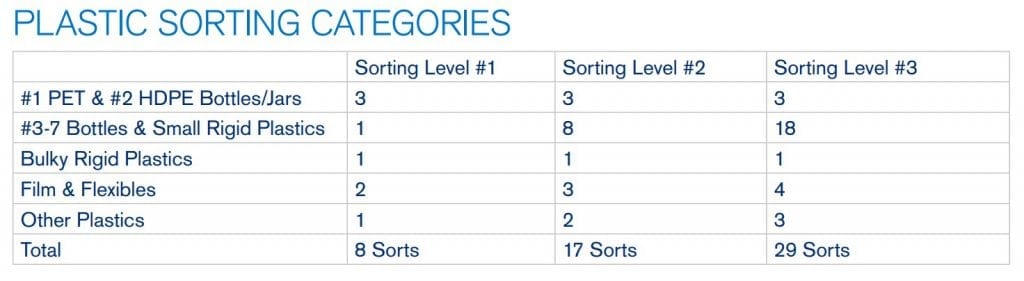
APR’s standards broadly place plastics into five categories: PET and HDPE bottles and jars, Nos. 3-7 bottles and small rigids, bulky rigids, film and flexibles, and other plastics.

Three sorting levels are provided, depending on how extensive a study is desired and how much money is available to pay for it. Level 1 means separating plastics into eight sub-categories, level 2 involves 17, and level 3 involves 29.

“These categories are based on marketable bales,” Bedard said. “We want this to very much be based on reality, what’s happening out there in the real world.”

The number of sub-categories varies. For example, all three levels require separating PET/HDPE into three sub-categories: PET, HDPE natural and HDPE color. “Those are the commodities that are really being pulled out by just about every program in the United States,” Randell said.

But the number of sub-categories jumps substantially in the 3-7s category – from one in level 1 up to 18 in level 3 – simply because of the huge variety of plastics in the 3-7 category.
Stacey Demers of SCS Engineers explained that the more categories you have, the more time it takes and, generally, the more expensive it becomes. Her firm conducts waste characterization studies for municipalities, states, businesses and institutions.

“Every time we do a different study, there’s always a different list of materials. Sometimes they’ve copied it from another study they’ve seen. Sometimes it’s just curiosity. Sometimes they’re not even sure why they have those categories,” she said. “So having … the best management practices put out for the different categories, I think, is a great idea because it allows consistency. It allows material that can fit into categories to help municipalities know the percentage of recyclable plastics that’s in their waste stream and what their program needs to target later on.”

Photo credit: Tunatura/Shutterstock

 

Tags: Industry Groups
TweetShare
Jared Paben

Jared Paben

Related Posts

SWANA hires new executive director

SWANA partners with Product Stewardship Institute

byStefanie Valentic
February 4, 2026

The Solid Waste Association of North America and the Product Stewardship Institute are formalizing their collaboration to address materials management...

German researchers say plastics treaty still within reach

byAntoinette Smith
February 4, 2026

In a new white paper, the group proposes three key changes to revive the treaty talks after a new chair...

PP cups now ‘widely recyclable’ with increased acceptance

byAntoinette Smith
February 3, 2026

With more than 60% of US households having access to curbside recycling collection for PP to-go drink cups, the How2Recycle...

Flexible Film Recycling Alliance releases first report

byAntoinette Smith
February 2, 2026

The Flexible Film Recycling Alliance has published its first report on progress made toward accelerating recycling rates, expanding access to...

Emerging state EPR shows trend toward harmonization

Emerging state EPR shows trend toward harmonization

byAntoinette Smith
January 29, 2026

During an APR webinar, recycling policy experts explored the growing list of EPR bills for packaging, and the implications for...

US Plastics Pact announces leadership change

US Plastics Pact announces leadership change

byAntoinette Smith
January 21, 2026

Crystal Bayliss will serve as interim executive director, the group's board of directors said in a statement.

Load More
Next Post

Our top stories from September 2018

More Posts

Agilyx leaves US chem recycling, Houston sorting center

Agilyx leaves US chem recycling, Houston sorting center

February 4, 2026

Eastman looks to recycling plant to drive growth

February 2, 2026
Stakeholders respond to California recyclability report

CalRecycle opens SB 54 draft for comments

February 2, 2026
Emerging state EPR shows trend toward harmonization

Emerging state EPR shows trend toward harmonization

January 29, 2026
Chinese processing group details goals for US visit

AMP lays out vision of next-generation, AI-driven MRFs

July 24, 2024

Cirba Solutions: Battery fires stoking EPR bill movement

February 2, 2026
Third ExxonMobil recycling plant operational

Third ExxonMobil recycling plant operational

February 4, 2026
WM: Upgrades temporarily slow tons recovered

WM sees ‘notable growth’ despite low recycling commodity prices

January 30, 2026

International Paper creates two new, separate entities

January 29, 2026
Dow makes case for PE price hikes amid layoffs

Dow makes case for PE price hikes amid layoffs

January 30, 2026
Load More

About & Publications

About Us

Staff

Archive

Magazine

Work With Us

Advertise
Jobs
Contact
Terms and Privacy

Newsletter

Get the latest recycling news and analysis delivered to your inbox every week. Stay ahead on industry trends, policy updates, and insights from programs, processors, and innovators.

Subscribe

Welcome Back!

Login to your account below

Forgotten Password?

Retrieve your password

Please enter your username or email address to reset your password.

Log In

Add New Playlist

No Result
View All Result
  • The Latest
  • Analysis
  • Recycling
  • E-Scrap
  • Plastics
  • Policy Now
  • Conferences
    • E-Scrap Conference
    • Plastics Recycling Conference
    • Resource Recycling Conference
    • Textiles Recovery Summit
  • Magazine
  • About Us
  • Advertise
  • Archive
  • Jobs
  • Staff
Subscribe
This website uses cookies. By continuing to use this website you are giving consent to cookies being used. Visit our Privacy and Cookie Policy.