










Advertisement Header Ad
Resource Recycling
  • The Latest
  • Analysis
    • All
    • Certification Scorecard
    • Industry Announcements
    • Opinion

    Certification scorecard for Dec. 18, 2025

    Industry announcements for the week of Dec. 15

    Certification scorecard for December 10, 2025

    Industry Announcements for Week of December 8

    Certification Scorecard for December 3, 2025

    Industry Announcements for Week of December 1

    News from Dynamic Lifecycle Innovations, Precision E-Cycle

    News from Northeast Recycling Council, Plastipak and more

    News from Northeast Recycling Council, Sortera Technologies and more

  • Conferences
  • Publications

    Other Topics

    Textiles
    Organics
    Packaging
    Glass
    Brand Owners

    Metals
    Technology
    Research
    Markets
    Grant Watch

    All Topics

Subscribe
No Result
View All Result
Resource Recycling
  • The Latest
  • Analysis
    • All
    • Certification Scorecard
    • Industry Announcements
    • Opinion

    Certification scorecard for Dec. 18, 2025

    Industry announcements for the week of Dec. 15

    Certification scorecard for December 10, 2025

    Industry Announcements for Week of December 8

    Certification Scorecard for December 3, 2025

    Industry Announcements for Week of December 1

    News from Dynamic Lifecycle Innovations, Precision E-Cycle

    News from Northeast Recycling Council, Plastipak and more

    News from Northeast Recycling Council, Sortera Technologies and more

  • Conferences
  • Publications

    Other Topics

    Textiles
    Organics
    Packaging
    Glass
    Brand Owners

    Metals
    Technology
    Research
    Markets
    Grant Watch

    All Topics

Subscribe
No Result
View All Result
Resource Recycling
No Result
View All Result
Home Plastics

Study explores what works — and what doesn’t do much — in curbside recycling

byJared Paben
December 13, 2016
in Plastics
Share on XLinkedin

A report from The Recycling Partnership and U.S. EPA lays bare the reality there is no silver bullet for creating a stellar curbside recycling program. That being said, researchers did paint a detailed portrait of what successful programs look like.

“There was not one individual attribute that indicates success, but several that affect performance and trends became evident,” according to the report. “The majority of the highest-performing programs collect material single-stream, collect curbside recycling automatically, use an automated cart-based system, and have public engagement that influences curbside recycling to occur in their community.”

The 2016 State of Curbside Report, released Tuesday, Dec. 13, was written by the nonprofit group The Recycling Partnership with grant funding from the U.S. EPA. The project’s lead researcher was Cody Marshall of The Recycling Partnership (see the related question-and-answer piece with Marshall). He and other experts gathered data on recycling programs in 465 cities across the U.S., making sure to include the 250 most-populous cities and each state capital. In all, the communities represent 29 percent of the homes in the U.S. that could potentially receive curbside recycling service.

Their report points to steps communities can take that are likely to significantly increase recycling weights. But the report also demonstrates that other oft-discussed strategies, such as collecting recycling on a weekly basis, may not boost recycling weights all that much.

Factors driving diversion

The research found the 465 communities collected an average of 357 pounds per household per year (note: This refers to all households in the studied jurisdictions, not just the households that actively recycle).

More than 8 in 10 of the communities utilized single-stream collection, and more than half of them collected material every week.

To find factors potentially driving higher recycling weights, researchers examined 20 percent of the top-performing communities, or those collecting at least 400 pounds per household per year.

More details on what they found:

One bigger stream: Among top performers studied, 96 percent utilized single-stream collection. Across the country, single-stream programs collected an average of 364 pounds per household annually. In contrast, communities that collect fibers and containers separate in dual streams averaged 277 pounds per households.

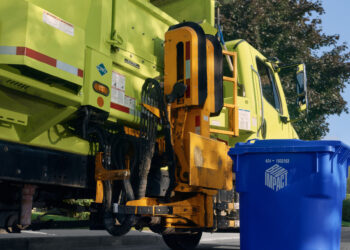
Cart before the bin: Among the top-performers, 83 percent use carts instead of bins. Nationwide, carts collected an average of 389 pounds per household, compared to 271 pounds for bins.

If you provide it, they will come: Among the top-performers, 93 percent provide recycling containers and service to residents automatically, without requiring the household to take any action. Across the country, communities that did this collected 374 pounds per household, compared to 264 pounds per household for those requiring residents to opt-in to service.

Key role of government: Among the top-performers, 100 percent took some action to incentivize recycling. One example is creating licensing agreements or franchises that bundle garbage and recycling service together, regardless of whether residents have to opt-in to garbage service. Across the country, programs taking “public actions” to incentivize recycling collected 359 pounds per household, compared to 247 pounds for those that didn’t.

Less important factors

The report found other attributes that may not have as significant of an impact as some may guess.

For example, researchers found that jurisdictions with high landfill tip fees tended to collect more recyclable materials than those with lower fees, but it wasn’t as big of a spread as they expected. Jurisdictions with tip fees in excess of $40 a ton collected about 380 pounds of per household per year. Those with tip fees less than $40 collected 340 pounds per household.

“This was largely due to a number of municipalities in high-tip fee environments with low recovery rates, as well as municipalities in low tip fee environments having high recovery rates,” according to the report. “More detailed research on this specific topic is needed to draw further conclusions.”

Additionally, picking up recycling weekly, as opposed to once every other week, resulted in only a slight increase in collection weights. Communities collecting weekly brought in 366 pounds per household, and those collecting every other week brought in 362 pounds.

Lastly, who does the collecting doesn’t seem to matter too much: Researchers didn’t find a major weight difference between communities where private workers collect recyclable materials and those where municipal workers collect them, they wrote. Communities with private haulers averaged 371 pounds per household, while those with public haulers averaged 345 pounds per household.

“There appears to be no correlation to effective collection of recyclables and whether the material was collected by private or public entities,” according to the report.

Weima

Tags: CollectionIndustry GroupsLocal Government
Jared Paben

Jared Paben

Related Posts

Grant funds EPS foam recycling in Nebraska

Grant funds EPS foam recycling in Nebraska

byAntoinette Smith
December 16, 2025

First Star Recycling in Omaha and the City of Lincoln each received $25,000 grants from the Foodservice Packaging Institute's Foam...

landfill

Virginia opens comment for state solid waste plan

byPaul Lane
December 11, 2025

Virginia is taking public comment on a draft solid waste plan that updates decades-old rules, raises recycling goals, expands data...

New rules push OEMs to design for repair, reuse

byScott Snowden
December 11, 2025

Right-to-repair rules are pushing longevity and reuse deeper into product design, but thin hardware, device locks and weak data are...

plastic bale

NAPCOR finds RPET imports hit record in 2024

byAntoinette Smith
December 11, 2025

Despite gains for thermoforms and other materials, bottle recovery rates and RPET consumption eased from 2023 highs amid abundant imported...

Recycling conveyor belt

Canadian groups building flexibles database

byAntoinette Smith
December 10, 2025

Using composition analysis and industry input, the Circular Plastics Taskforce and PROs in British Columbia and Quebec aim to provide...

Colorado approves final EPR plan for packaging

Colorado approves final EPR plan for packaging

byAntoinette Smith
December 10, 2025

The state approved the plan from Circular Action Alliance, clearing the way for the law's implementation within the next six...

Load More
Next Post
PetroChem Wire: Recycled HDPE loses pricing ground in 2015

PetroChem Wire: Recycled Nylon Prices Rise in Early December

More Posts

ERI and ReElement partner on rare earth magnet recovery

ERI and ReElement partner on rare earth magnet recovery

November 26, 2025
Cyber risks confront ITAD work, contracts, coverage

Cyber risks confront ITAD work, contracts, coverage

November 26, 2025
Ohio start-up turns plastics into high-end furniture

Ohio start-up turns plastics into high-end furniture

November 24, 2025
WM adds PP and paper cups to curbside recycling lists

WM adds PP and paper cups to curbside recycling lists

November 24, 2025
Atlas acquisition boosts Circular Services’ organics reach

Atlas acquisition boosts Circular Services’ organics reach

November 24, 2025
Policy Now | December 2025 – Year-end nears, policy talks continue

Policy Now | December 2025 – Year-end nears, policy talks continue

December 1, 2025
WM rolling out curbside acceptance of PP cups 

WM rolling out curbside acceptance of PP cups 

November 25, 2025
Ohio startup creates end market for small challenging plastics

Ohio startup creates end market for small challenging plastics

November 25, 2025
Global recycling patent trends may reflect legislative push

Global recycling patent trends may reflect legislative push

November 25, 2025
Oregon’s Recycling Modernization Act faces injunction

Oregon’s Recycling Modernization Act faces injunction

December 2, 2025
Load More

About & Publications

About Us

Staff

Archive

Magazine

Work With Us

Advertise
Jobs
Contact
Terms and Privacy

Newsletter

Get the latest recycling news and analysis delivered to your inbox every week. Stay ahead on industry trends, policy updates, and insights from programs, processors, and innovators.

Subscribe

Welcome Back!

Login to your account below

Forgotten Password?

Retrieve your password

Please enter your username or email address to reset your password.

Log In

Add New Playlist

No Result
View All Result
  • The Latest
  • Analysis
  • Recycling
  • E-Scrap
  • Plastics
  • Conferences
    • E-Scrap Conference
    • Plastics Recycling Conference
    • Resource Recycling Conference
    • Textiles Recovery Summit
  • Magazine
  • About Us
  • Advertise
  • Archive
  • Jobs
  • Staff
Subscribe
This website uses cookies. By continuing to use this website you are giving consent to cookies being used. Visit our Privacy and Cookie Policy.