This article originally appeared in the Fall 2018 issue of Plastics Recycling Update. Subscribe today for access to all print content.
Today in Europe, far too much plastic waste still escapes collection systems. Out of 60 million metric tons of plastics produced in the EU every year, around 25.5 million metric tons are collected for recycling and only 6.6 million metrics tons are sent for recycling. The remaining waste, including the contamination discarded during recycling processes, cannot be recycled due to very poor quality or poor design. It is therefore sent to incineration plants, or in the worst case, to landfills.
These figures show there is an urgent need to change the way we produce, use and dispose of plastics.
This transformation needs to start by increasing the value of waste through the application of design-for-recycling principles. It’s the view of trade group Plastics Recyclers Europe that every product placed on the market should be designed and manufactured in a way that considers its end-of-life stage. Product design should aim to balance the product’s durability, usability, marketing and recyclability. All new products placed on the market must be fully compatible with recycling technologies if we are to move toward a true circular economy.
It’s true the issue of design for recycling has long been an industry talking point, but the topic has taken on added importance since the implementation of China’s ban on waste imports. Countries that were exporting large quantities of “unwanted” materials are now confronted with difficult decisions about how to handle these discards.
The problem ultimately stems from badly-thought-out designs that have led to sortation challenges and poor-quality bales.
Now more than ever, we need to ensure that plastics are being produced sustainably and managed properly at the end of their life cycles. Fortunately, new tools are emerging to help the industry move forward.
Common approach to ‘recyclability’
When it comes to moving the needle on design for recycling, the first challenge is simply defining what recyclability really is, especially as more and more manufacturers make unchecked claims about their products.
Without finding a common ground for what is currently recyclable, it is impossible to reach a consensus about which kind of products are genuinely compatible with state-of-the-art mechanical recycling technologies. As a result, Plastics Recyclers Europe (PRE) and the Association of Plastic Recyclers (APR) developed a global recyclability definition. It stipulates that to be considered recyclable, a product has to be able to be collected and sorted in sufficient quantities. At the same time, it must be compatible with existing industrial recycling processes, or be available in sufficient quantities to justify the development of new recycling processes.
The definition allows the establishment of a global and harmonized approach by providing a common direction for the industry.
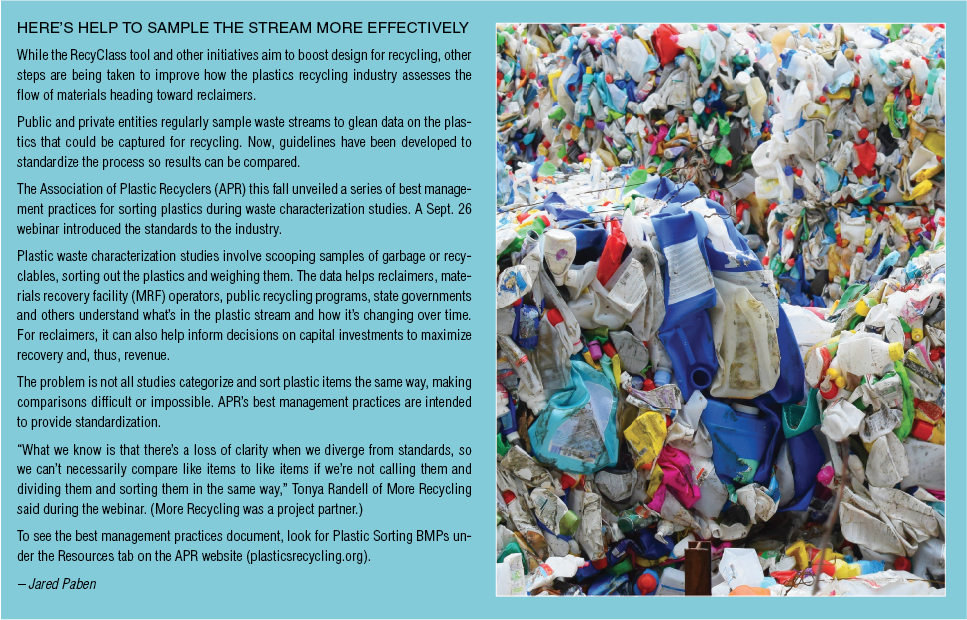
Thanks to specialized knowledge and insights from the field, PRE took a step beyond the definition stage and developed a program called RecyClass. This tool aims to provide advice on how to improve and upgrade a plastic packaging item in terms of its recyclability. PRE sees this as a fundamental step on the way to boosting collection, growing recycling rates and ultimately bolstering the quality of recycling.
RecyClass is a free online tool that rates a plastic packaging with a grade from A to F based on its recyclability performance. The grading system is inspired by the European energy labeling protocol, a European Union effort that ranks electrical appliances on a scale from A to G according to the energy consumption of different appliances.
To give an example of how RecyClass works, a packaging would be rated with an A grade when it is fully recyclable and genuinely compatible with current recycling technologies. On the other hand, if incineration is the only feasible option for the product at end-of-life, then RecyClass will grade the product with an F. Additionally, the tool shows to what extent a package is suitable for recycling and offers advice on how the recyclability rating of the product could be improved.
(story continues below sidebar)
Steps to an assessment
To start the analysis, a new user needs to register on the RecyClass website (recyclass.eu). The user will then be guided through a series of questions related to the packaging, starting with whether the item is eligible for the analysis. Here the tool provides indications on what kind of packages cannot be tested, such as products that are contaminated with dangerous substances or made from bio-degradable or oxo-degradable plastics.
Another requirement of RecyClass is that the analyzed package needs to be made from at least 25 percent of plastic and have at least 50 percent of its surface made from plastics.
Once the item is deemed suitable for the analysis, the user will be guided through five areas of questioning: the product’s general recyclability, incompatibilities of the design, quality of recycled material (if any), how much residue content remains in the packaging after its normal emptying, and REACH compliance (REACH is a regulation of the European Union, adopted to improve the protection of human health and the environment from the risks that can be posed by chemicals). After this series of questioning, the user will receive an interim result which can be further upgraded or downgraded through subsequent steps of the analysis.
An example of the type of thing assessed during the first step of the grading process is how easy it will be to separate different polymers used in the construction of a single item. This characteristic is covered by the general questions of the analysis.
In the case of a water bottle, the separation of an HDPE cap from a PET body will be very easy due to the differing densities of the two polymers. During the recycling process, after shredding, the two polymers can be easily separated in a float-sink tank. Other packaging types, however, may contain polymers with similar densities that are impossible to separate – this fact would have a negative impact on that product’s grade.
Throughout the analysis, the user can at any time access a RecyClass manual that has been designed to help a user answer each question precisely. At the end, a report is provided, with a summary of all the questions and a series of advice on how to improve a package if it has been graded lower than A.
The RecyClass tool also has ties to the Recyclability Evaluation Protocols, which PRE developed in close collaboration with APR.
The Evaluation Protocols aim to provide guidance and evaluation of plastics products, specifically in regards to their behavior throughout a recycling process. In September of this year, PRE released the Recyclability Evaluation Protocol for PE Films, which was received with great interest from all actors across the plastic value chain.
The document proposes a common methodology for testing the recyclability of different technologies, such as adhesives, additives or multi-layer barriers, and it assesses at a laboratory scale the compatibility with a specific recycling stream established in Europe. Because the plastics recycling process varies from one polymer to another, PRE is currently working on developing Evaluation Protocols for other recycling resin streams.
Additionally, due to different functions and properties of each packaging product placed on the market, different plastic types require specific Design for Recycling Guidelines. Both PRE and the European PET Bottle Platform (EPBP) use the findings from ongoing testing to develop these guidelines.
The guidance efforts on design carefully consider specifications of each packaging type and polymer. Given these specifications, different aspects of a packaging are considered when determining whether it is “fully recyclable,” “recyclable but detrimental” or “non-recyclable” (each tested piece of packaging will ultimately be classified within one of the three categories based on its compatibility with recycling lines). The Design for Recycling Guidelines are regularly reviewed to adapt to the latest technologies widely available in Europe.
Bringing recyclability to a global level
The change of the status quo in plastics manufacturing demands cooperation between all industry actors, starting with raw material producers and moving to converters, retailers, brand owners, collectors, sorters and recyclers.
Finding a common approach to plastics recyclability that is endorsed by the industry as a whole is clearly necessary. Accordingly, RecyClass will eventually need to be extended to plastic products other than packaging, encouraging industry-wide application of design for recycling principles.
Collaboration and engagement from packaging producers and brand owners is key in further development of RecyClass. Their involvement plays a crucial role when it comes to validating scientific evidence behind these guidelines and protocols, as well as validating various recyclability claims.
PRE looks forward to engaging all the relevant stakeholders to take part in this initiative.
Antonino Furfari is the managing director at Plastics Recyclers Europe. For more information, contact recyclass@plasticsrecyclers.eu.