




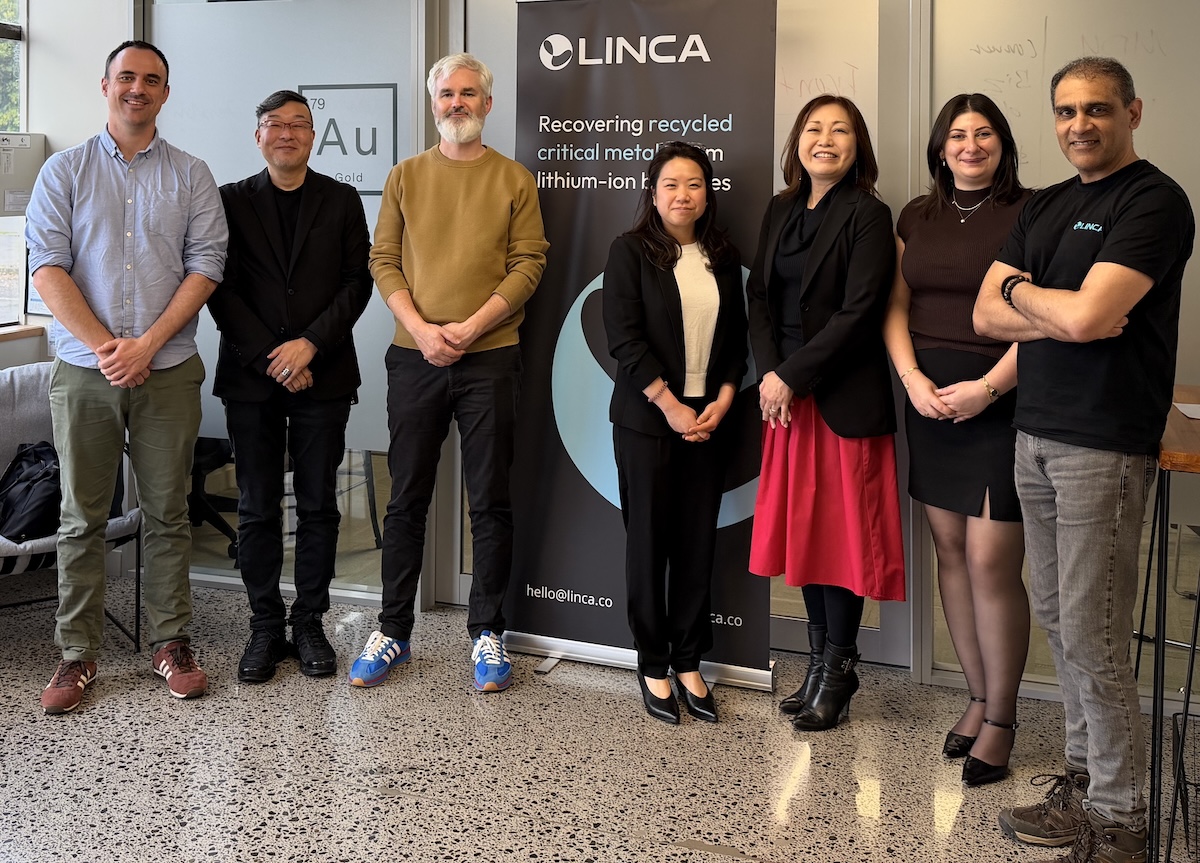
New Zealand-based battery mineral recovery company Linca has partnered with a global trading house as it looks to make its refining capabilities available worldwide.
The memorandum of understanding between Linca and Mitsui & Co. will let Linca explore collaboration opportunities as the company looks to commercialize its black mass refining technology, Linca CEO Ollie Crush said.
Linca’s hydrometallurgical process recovers cobalt, nickel and other minerals from the black mass generated during the processing of end-of-life EV batteries. The company’s process does away with solvent-based extraction, lowering cost and complexity — part of Crush’s mission to make the technology usable at a reasonable cost in areas where space may be a concern.
The company spun off from Mint Innovation earlier this year amid plans to build a demo facility in the United Kingdom. That facility will be commissioned early next year, Crush said, and will serve more to “retire as much technical risk as possible” than to generate revenue. If all goes well there, Linca plans to ramp up the technology for commercial-scale use by the end of the decade, he said.
Mitsui will play a big role in that, Crush said. The Tokyo-based company will help Linca identify raw material sources, connect the company with potential offtakers and facilitate technical and commercial information exchanges.
“This enables us to use their global networks to understand, ‘Where does our midstream refining technology have the most impact?’ ” Crush said. “Mitsui can source feedstock and has users for salts that come out of the process. They’re a global player. They will be invaluable.”
Fumiya Kamikawaji, general manager of the Battery Materials and Recycling Business Department at Mitsui, said the arrangement provides a framework for evaluating Linca’s technology and potential applications. One example Crush cited was Mitsui sending experts into the demo facility to evaluate operations and offer potential improvements.
Once Linca is technically and commercially ready to scale up, Mitsui will help it line up joint venture opportunities in parts of the world looking to build up their refining capabilities, Crush said, including the US, European Union and Japan.
Europe is an initial target market, Crush said, but he wants to expand into any area that’s looking to reduce its dependence on Chinese-sourced refined black mass. It could also help the US secure the mineral independence it desires while adhering to new federal mandates banning the export of black mass.
Long term, the goal for Linca is to license joint ventures to spread the technology around the world, Crush said. The company would likely own and operate facilities at first, then look to partner with other companies to use the technology inside their facilities. The company has secured millions of dollars in seed funding and grants, but Crush said it’s looking for strategic investors over a couple more funding rounds to drive quicker development.
“We see Mitsui as a fantastic and large Western conglomerate,” Crush said. “For supply chain resilience, recovering critical minerals from scrap batteries — it’s a no-brainer. A lot of these Western nations have that desire to bring refining back onshore. We want to be a part of that.”
- American Battery Technology Co. is looking to build a second black mass refinery in the US Southeast to complement its Nevada facility. The company received a one-year exemption on the black mass import ban as that work continues.
- Nth Cycle has secured funding and offtake agreements for a black mass processing facility it’s building in the Southeast.
- Cyclic Materials is following up the opening of a mineral recovery facility in Arizona this year with a rare earth recycling campus that’s expected to open in South Carolina in 2028.
- Bridge Green Upcycle partnered with Hartree Partners to market the black mass produced at its upstate New York facility.