Editor’s note: Electronics recycling will be featured in sessions at the 2026 E-Scrap: The Longevity Conference Oct. 26-28 in New Orleans.
Nestled in the southern tip of Ontario’s Golden Horseshoe, Rugged Books is set to start its second decade in business by expanding its durable electronics refurbishment sales base across the Atlantic.
The Canadian company is based in Niagara-on-the-Lake and is surrounded by resources in a financial and natural sense — the Toronto skyline is visible to the north, the mist coming from Niagara Falls to the southeast and the Buffalo skyline to the south. What Mahmoud and Naz Nahle started in the Niagara region in 2016 has grown into an international operation that has tapped into what they quickly found was an underserved market.
They had spent years prior to launching the business reselling laptops and other devices online, according to Ahmad Nahle, Mahmoud’s cousin and the company’s sales and marketing manager. But they saw the demand for rugged laptops — the seemingly armor-encased devices seen in police cars, ambulances and on oil rigs — was particularly high. Since such devices have to withstand sunlight, sand and other elements, new ones often cost more than $5,000 each; Rugged Books can refurbish and sell devices for half that or less.
The company specializes in brands that make ruggedized devices such as Panasonic, Dell and Getac. Items are sold through the company website, eBay and other e-commerce channels.
“Whether it’s an EMS company here in Canada, fire departments — they don’t have a large budget,” Nahle said. “Especially in today’s economy, you have a lot of companies that don’t need the highest, brand new, latest thing. They just want something that works. … so that’s what we focus on, refurbishing and rugged, because we merged those two sectors. And that left us in a unique, blue ocean position where we can be the go-to people for ruggedized laptops.”
What’s old is new again
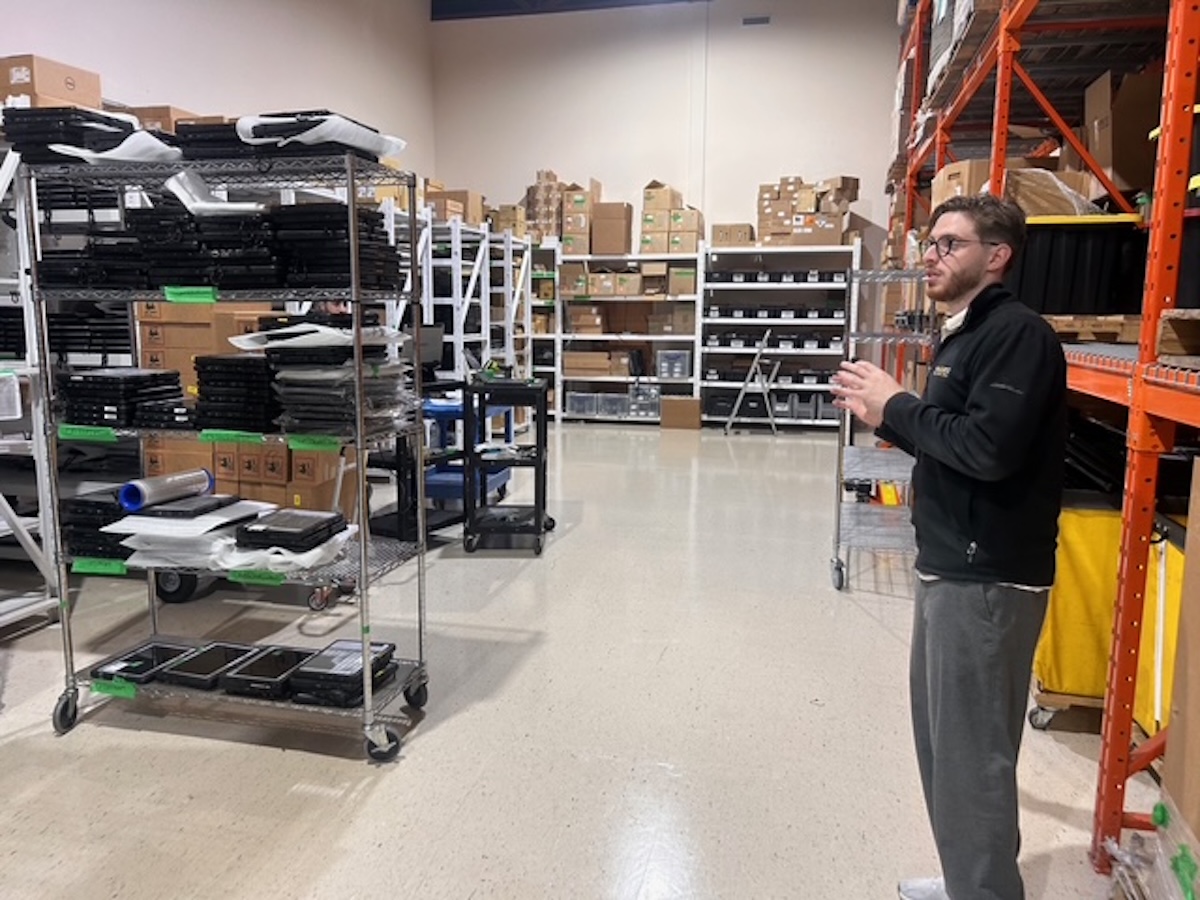
That’s what the more than one dozen employees of the family-owned business spend their days doing in Rugged Books’ nondescript warehouse just off the Queen Elizabeth Way, which wraps around Lake Ontario’s western shore connecting cities in the Golden Horseshoe. They sort hundreds of devices weekly, running diagnostics on batteries, memory boards and other components to see what’s salvageable.
Parts that can be reused are sorted for future use in other devices when needed. Several employees handle the repairs, attaching new parts or returning existing parts to working condition. Others work in intake, shipping, sales and warehousing, helping with the extensive tracking and monitoring that’s required for Rugged Books to retain ISO and R2 certifications.
One employee handles the relatively new job of 3D printing, creating battery covers and other components that aren’t individually sold and generally wouldn’t be worth a manufacturer’s time to replace. A pilot program launched about 18 months ago was successful enough to warrant a four-printer investment.
“We might try to find suppliers in China, but then there could be quality issues,” Nahle said. “It can get extremely expensive, especially if you just want 10 or 20 pieces, to have a custom order just for that. And we’re talking about ports and covers. There’s no part number for them. It’s not like you can just Google search these parts or find them on eBay.”l
A substantial part of the company’s space is devoted to storing parts for future use, as well as new devices it also makes available; an expansion set to finish later this year will accommodate more storage and processing capacity. Anything that isn’t usable is held to sell to an outside recycling company.
That expansion is needed due to continually brisk business — Rugged Books refurbished more than 10,000 laptops last year and expects to exceed that number this year; the company broke down a total of 50,520 kg (55.7 tons) of devices last year. About 90% of Rugged Books’ business comes from the US, Nahle said, mainly in states like Florida and Texas with climate hospitable to year-round construction and engineering work. Among its customers along the way — Amazon, Toyota, Nissan and Costco.
Customers of all sizes have contributed to a sales surge that Nahle attributes to a hardware “fear of missing out” of late.
“They want to buy the hardware today because they know next year it will be more expensive,” he said. “The enterprise businesses — we’re talking about the Dells and the Microsofts and the Amazons — these guys are pushing for procurement of all computers and all the RAM and storage and computers and data centers. So this affects the market as a whole.”
Plugging into a new market
The company keeps several US warehouses and works with partners on both sides of the border, but is looking overseas for its next expansion. Rugged Books is investigating sites outside of London to set up a UK presence to expand its rugged computer sales there by the end of next year, Nahle said. Beyond that, the company is also looking at establishing a sales presence in the European Union.
The goal is to expand the customer base while using regulatory advantages there; France, for example, required public entities to acquire at least 20% of their tech from second-hand sources. European expansion will also defocus a US market that’s showing some instability amid continued trade conflict, Nahle said, despite it being a 10-minute drive away.
“It’s overdue for us to expand, but also the reliance on the US market is not something that we can depend on,” Nahle said. “There could be tariff issues, trade wars. So our job as business owners … is to diversify the assets, diversify the clientele.”
That clientele has Rugged Books heading in the right direction, Nahle said, as the company enters year 11. The company does its part to maintain positive relationships — returns are accepted, and products come with a limited warranty that customers have the option to extend — and he said the company wants to return the favor by creating a place in the second-hand market that people will trust, both for financial and sustainability reasons.
“We understand that most of our customers are in professional industries,” he said. “They’re engineers or they’re police departments or they’re EMS, and they need something quick.
“If you’re buying maybe 100 refurbished laptops for your fleet or your mining contract that you’re doing next year, you want to make sure that these computers are 100% going to work.”