




Resource Recycling
  • The Latest
  • Analysis
    • All
    • Certification Scorecard
    • Industry Announcements
    • Opinion
    Feds to develop repairable computer donation program

    The whitebox blind spot in PC recycling

    Analysis: circular design still elusive in laptops

    PC shipments grew in Q1, but questions remain

    The independent ITAD at a crossroads

    The independent ITAD at a crossroads

    Certification Scorecard — Week of April 20, 2026

    Apple Watch on product box.

    Wearables are coming and ITAD isn’t ready

    Certification Scorecard — Week of April 13, 2026

    EV Battery Pack - Sergii Chernov-Shutterstock

    Redwood, Rivian deal fuels US infrastructure plans

    Bloom ESG and e-Stewards roll out critical metals metric

    Colorado regulators suggest mid-range EPR scenario

    Why collaboration on plastic waste still matters

  • Conferences
  • Publications

    Other Topics

    Textiles
    Organics
    Packaging
    Glass
    Brand Owners

    Metals
    Technology
    Research
    Markets
    Grant Watch

    All Topics

Subscribe
No Result
View All Result
Resource Recycling
  • The Latest
  • Analysis
    • All
    • Certification Scorecard
    • Industry Announcements
    • Opinion
    Feds to develop repairable computer donation program

    The whitebox blind spot in PC recycling

    Analysis: circular design still elusive in laptops

    PC shipments grew in Q1, but questions remain

    The independent ITAD at a crossroads

    The independent ITAD at a crossroads

    Certification Scorecard — Week of April 20, 2026

    Apple Watch on product box.

    Wearables are coming and ITAD isn’t ready

    Certification Scorecard — Week of April 13, 2026

    EV Battery Pack - Sergii Chernov-Shutterstock

    Redwood, Rivian deal fuels US infrastructure plans

    Bloom ESG and e-Stewards roll out critical metals metric

    Colorado regulators suggest mid-range EPR scenario

    Why collaboration on plastic waste still matters

  • Conferences
  • Publications

    Other Topics

    Textiles
    Organics
    Packaging
    Glass
    Brand Owners

    Metals
    Technology
    Research
    Markets
    Grant Watch

    All Topics

Subscribe
No Result
View All Result
Resource Recycling
No Result
View All Result
Home E-Scrap

Mobile-shred workers uniquely vulnerable to toxic metals

byJared Paben
September 17, 2020
in E-Scrap
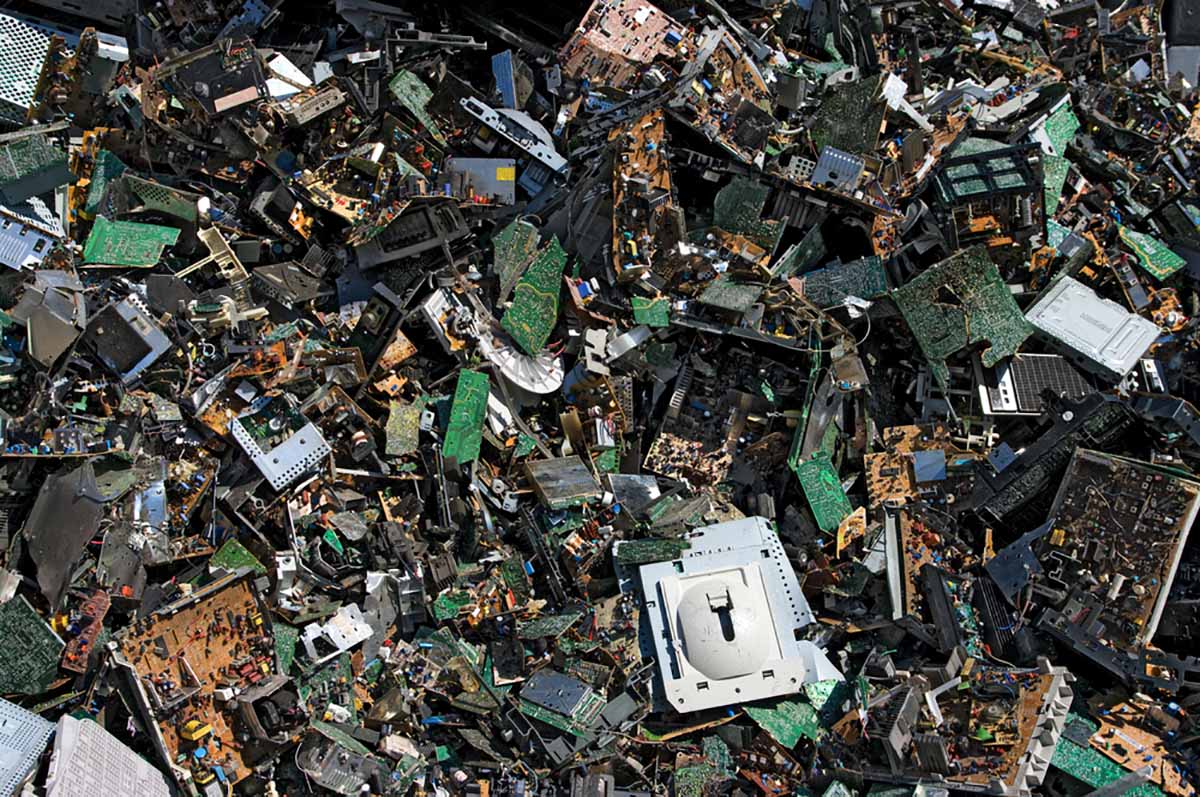
E-scrap piled for recycling
Researchers found that mobile shredding of hard drives and other small electronics exposes workers to airborne and surface metals dust, as is the case with in-plant shredding. | Huguette Roe/Shutterstock

Researchers have discovered that shredding e-scrap materials in trucks may expose employees to as much toxic metal dust as in-plant shredding, but mobile workers may not be as protected as their plant-based counterparts.

The first-of-its-kind study was conducted by Diana Ceballos from the Boston University School of Public Health and Michael Zhou and Robert Herrick, both from Harvard University’s T.H. Chan School of Public Health. Their paper was published in August in the Annals of Work Exposures and Health.

The researchers found that mobile shredding of hard drives and other small electronics exposes workers to airborne and surface metals dust, as is the case with in-plant shredding. But the mobile unit employees may face higher risks because they’re working in a remote and small space with no ventilation, Ceballos told E-Scrap News.

“Mobile shredding should have, at a minimum, the same protections that workers have when shredding e-waste in a facility,” she said.

Meanwhile, in a separate study Ceballos was involved in, scientists for the first time studied lead and noise exposure at registered e-scrap recycling facilities in China. Results of that work was published this month.

Mobile shredding project takeaways

The mobile shredding study involved taking air and surface samples during a 2019 shredding project at a mobile unit parked outside an unnamed e-scrap recycling facility in the Boston area. The unit consisted of a shredder inside of a semi-truck trailer. The shredder was powered by a diesel-electric generator mounted on the back of the tractor.

Samples were taken during a 65-minute shredding job, during which 200 hard drives and solid-state drives were hand-fed into the shredder. The trailer had no ventilation except for its open back door, and the employee didn’t use any personal protective equipment (PPE).

“In this initial assessment of metals and particulates exposure in a mobile e-waste shredding truck, both air and surface samples suggest that shredding inside a truck is an important source of exposure to toxic metals and particulates in workers,” according to the researchers’ paper.

The analysis showed that, during shredder operation, the concentrations of lead dust in the air were on par with levels found around e-scrap shredders in warehouses. If the concentrations were sustained over an entire work shift, lead exposure likely wouldn’t exceed current occupational limits but would exceed lower exposure limits currently under consideration in California, the study noted.

“Although, If we sampled the breathing zone of the worker, lead concentrations would likely be higher than the measured area samples as is typical in the e-recycling industry,” the paper states.

Surface contamination was highest, not surprisingly, on top of the shredder, where the levels were also comparable to those in warehouse-based shredders. On the shredder, where there was dust accumulation from previous jobs, the concentrations of arsenic, chromium, and lead exceeded recommended levels.

In terms of particulates in the air, they reached their peak within minutes of the shredder beginning operation, and they were highest near the worker. Those air pollution levels still hadn’t returned to background levels after 40 minutes of shredder inactivity.

Overall, the concern isn’t that the mobile shredders are emitting substantially more toxic metals than a plant-based unit but that the offsite workers may be working in poorly ventilated trailers without PPE, resulting in greater exposure.

“We recommend the industry adopts better controls for shredding inside trucks, such as local exhaust ventilation with proper filtration and use of personal protective equipment, to protect workers’ health and the environment,” according to the paper.

Boston University on Sept. 1 issued a press release about the research. Ceballos’ research on exposures to toxic metals and flame retardants has been covered several times by E-Scrap News, including work she did while she was at Harvard.

Exposures at regulated Chinese facilities

In a separate project, researchers found that workers at registered e-scrap facilities in eastern China were exposed to hazardous levels of airborne lead and noise. It was the first study of its kind at formal e-scrap facilities in the country.

Monitoring was conducted in 2017 over two shifts for a total of 168 employees. The results showed that employees dismantling CRTs and breaking glass were sometimes overexposed to lead and noise. Employees involved with plastic shredding were overexposed to noise.

“The simultaneous exposure to lead and noise at medium to high levels in Chinese electronics recycling employees is of concern, as the combined exposure can exacerbate hearing loss,” according to the paper, which was published in the September 2020 issue of the International Journal of Hygiene and Environmental Health.

For the project, Ceballos assisted the following researchers from Jiangsu, China: Wei Gong  and Liangliang Zhao, both from the Jiangsu Provincial Center for Disease Control and Prevention, and Baoli Zhu of the Nanjing Medical University School of Public Health.

 

IRT

Tags: Research
TweetShare
Jared Paben

Jared Paben

Related Posts

What Netflix’s ‘Plastic Detox’ gets wrong – and right

byKeith Loria
April 23, 2026

Advocates are excited about the attention brought on plastics by the documentary, but scientists say more nuance is needed.

Hawaii trials asphalt made with plastic debris and nets

Hawaii trials asphalt made with plastic debris and nets

byScott Snowden
April 20, 2026

Researchers at Hawaii Pacific University test asphalt made with fishing nets and plastic debris, with early results showing no increase...

Amazon, DOE partner on critical materials recovery

byScott Snowden
April 13, 2026

DOE and Amazon will study recovery of graphite from textiles and gallium from IT hardware, aiming to strengthen US supply...

Rice researchers use lemon juice to boost battery recycling

byScott Snowden
April 9, 2026

Rice researchers reported a battery recycling process that uses plasma and mild solvents to recover most metals from black mass...

Packaging sector sees shift from AI pilots to wider use

byScott Snowden
April 1, 2026

AI adoption is expanding across packaging operations as costs fall and use cases widen, though concerns around accountability, ROI and...

Report pegs fire losses at $2.5b in US and Canada recycling industry

byScott Snowden
March 27, 2026

A new fire report estimates $2.5b in damage across US and Canadian recycling facilities in 2025, with lithium-ion batteries still...

Load More
Next Post

Industry stakeholders say material is flowing again

More Posts

Birch Plastics gets FDA green-light for post-industrial PP

LyondellBasell upgrade to PreZero assets on hold

April 23, 2026
The independent ITAD at a crossroads

The independent ITAD at a crossroads

April 22, 2026
Towfiqu ahamed barbhuiya

Before the Bin: Breaking down food date labeling

April 20, 2026

Google pilots reuse kits to extend device life

April 21, 2026
EPR fees are a market signal. Here’s what they’re telling you.

Oregon DEQ flags 250 producers for RMA noncompliance

April 21, 2026
Industry group: Help us find the plastic bale volumes we need

PET bales sink further as other grades firm 

April 15, 2026

What Netflix’s ‘Plastic Detox’ gets wrong – and right

April 23, 2026
What is EPR and why it matters

What is EPR and why it matters

April 22, 2026

NERC launches hub to promote PCR demand 

April 15, 2026
Growth challenges drive M&A for packaging

Growth challenges drive M&A for packaging

April 20, 2026
Load More

About & Publications

About Us

Staff

Archive

Magazine

Work With Us

Advertise
Jobs
Contact
Terms and Privacy

Newsletter

Get the latest recycling news and analysis delivered to your inbox every week. Stay ahead on industry trends, policy updates, and insights from programs, processors, and innovators.

Subscribe

Welcome Back!

Login to your account below

Forgotten Password?

Retrieve your password

Please enter your username or email address to reset your password.

Log In

Add New Playlist

No Result
View All Result
  • The Latest
  • Analysis
  • Recycling
  • E-Scrap
  • Plastics
  • Policy Now
  • Conferences
    • E-Scrap Conference
    • Plastics Recycling Conference
    • Resource Recycling Conference
    • Textiles Recovery Summit
  • Magazine
  • About Us
  • Advertise
  • Archive
  • Jobs
  • Staff
Subscribe
This website uses cookies. By continuing to use this website you are giving consent to cookies being used. Visit our Privacy and Cookie Policy.