
Resource Recycling
  • The Latest
  • Analysis
    • All
    • Certification Scorecard
    • Industry Announcements
    • Opinion
    Feds to develop repairable computer donation program

    The whitebox blind spot in PC recycling

    Analysis: circular design still elusive in laptops

    PC shipments grew in Q1, but questions remain

    The independent ITAD at a crossroads

    The independent ITAD at a crossroads

    Certification Scorecard — Week of April 20, 2026

    Apple Watch on product box.

    Wearables are coming and ITAD isn’t ready

    Certification Scorecard — Week of April 13, 2026

    EV Battery Pack - Sergii Chernov-Shutterstock

    Redwood, Rivian deal fuels US infrastructure plans

    Bloom ESG and e-Stewards roll out critical metals metric

    Colorado regulators suggest mid-range EPR scenario

    Why collaboration on plastic waste still matters

  • Conferences
  • Publications

    Other Topics

    Textiles
    Organics
    Packaging
    Glass
    Brand Owners

    Metals
    Technology
    Research
    Markets
    Grant Watch

    All Topics

Subscribe
No Result
View All Result
Resource Recycling
  • The Latest
  • Analysis
    • All
    • Certification Scorecard
    • Industry Announcements
    • Opinion
    Feds to develop repairable computer donation program

    The whitebox blind spot in PC recycling

    Analysis: circular design still elusive in laptops

    PC shipments grew in Q1, but questions remain

    The independent ITAD at a crossroads

    The independent ITAD at a crossroads

    Certification Scorecard — Week of April 20, 2026

    Apple Watch on product box.

    Wearables are coming and ITAD isn’t ready

    Certification Scorecard — Week of April 13, 2026

    EV Battery Pack - Sergii Chernov-Shutterstock

    Redwood, Rivian deal fuels US infrastructure plans

    Bloom ESG and e-Stewards roll out critical metals metric

    Colorado regulators suggest mid-range EPR scenario

    Why collaboration on plastic waste still matters

  • Conferences
  • Publications

    Other Topics

    Textiles
    Organics
    Packaging
    Glass
    Brand Owners

    Metals
    Technology
    Research
    Markets
    Grant Watch

    All Topics

Subscribe
No Result
View All Result
Resource Recycling
No Result
View All Result
Home E-Scrap

E-scrap economics: Researchers aim to improve the indium equation

Colin StaubbyColin Staub
April 13, 2017
in E-Scrap
LCD recycling

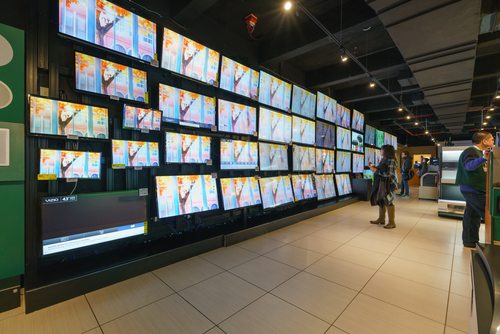
LCD devices contain many components that are commonly recycled, but the screen glass and the substance coating it are not among them.

The reason comes down to economics: The glass contains a soft metal called indium, which is concentrated at just one-tenth of the amount needed to make commercial recovery viable. LCD screens contain 200 parts per million of the element, versus the 2,000 to 3,000 parts per million commercial processors look for.

Newly completed research aims to improve the economics of recovering indium from LCDs through a process of separating it into a highly concentrated product.

“Really, we’re looking to bridge that gap,” said Tom Boundy, a graduate student in the Colorado School of Mines’ Department of Metallurgical and Materials Engineering. “The hope is that this process, as well as some other supplementary processes, would convert that material into a valuable material that’s no longer just landfilled or stockpiled, that people could do something with. Hopefully that’s positive for the recyclers, and it’s also positive for manufacturers and the clean energy sector in the U.S., and stabilizes indium supply.”

Boundy’s research partners were Marshall Boyton, an undergraduate student, and Patrick Taylor, a professor who is advising the students in their research. Their paper, titled “Attrition scrubbing for recovery of indium from waste liquid crystal display glass via selective comminution,” will be published in the June edition of the Journal of Cleaner Production.

The project received money from the Recycling Research Foundation, which is associated with the Institute of Scrap Recycling Industries (ISRI). The funding agency for the project was the Critical Materials Institute of the U.S. Department of Energy.

Thomas Boundy

Rarely recovered

Indium is generally obtained as a byproduct of mining for other metals, frequently zinc, since there are no deposits rich enough in indium to support a dedicated mine. According to the Royal Society of Chemistry, the top three producers are China, South Korea and Japan.

Its use has skyrocketed with the rise of consumer technology. According to the research team, indium consumption increased by more than 2,000 percent from 1985 to 2015. It is commonly used to make indium tin oxide, which is included in LCD screens, touch-screens and solar-panels because it conducts electricity, bonds well with glass and is transparent, according to the Royal Society of Chemistry. In LCD screen manufacturing, indium is applied as a coating on a glass plate to act as a semiconductor. The substance does not penetrate into the screen. Its recovery rate from consumer goods is less than 1 percent.

Indium in recent years has ranged from $250 to $750 per kilogram. Its viable recovery would add value to the LCD recycling process.

A new approach

Boundy’s team approached indium recovery by looking at physical separations, as opposed to hydrometallurgical (using water as a medium to dissolve a chemical of interest) or pyrometallurgical (using a furnace for smelting) methods. Those processes involve reagents and sometimes produce hazardous pollutants, whereas a physical approach uses no chemicals.

The researchers used an attrition scrubber for the task, a device Boundy described as a “glorified blender.” It has a chamber with a shaft with several impellers, rotators that move liquid. The impellers are aimed in opposite directions to force different fluid streamlines to converge on one another. The researchers used tap water in their experiment.

“You get particles forced into each other, which gives them that kind of abrasive action where they’re scratching each other and rubbing against each other, and allowing, hopefully, just that thin surface layer that’s indium-rich to be removed,” Boundy said.

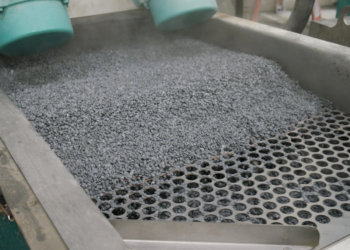
After scrubbing, the material is screened to separate the shredded screen pieces from the fine indium particles. What’s left is a very fine product that’s concentrated with indium, ideally to the point where it’s viable for commercial processing.

Initial success

Boundy said the attrition scrubbing method “shows promise” and is worth further investigation.

Although their results were positive, the research team was testing the process on a small scale using a lab-sized attrition scrubber, Boundy said. As the concept is scaled up, any number of issues could come up and present problems.

“We’re currently investigating some pilot-scale studies that would give us better insight into the real viability of this,” Boundy said. “But for now the results are interesting and it’s worth pursuing more in our eyes.”

As for the next steps, Boundy said he has a few years left in his graduate studies program, and he hopes to accomplish some of that scaling up and an expansion of this research during that time.



Tags: Processors
TweetShare
Colin Staub

Colin Staub

Colin Staub was a reporter and associate editor at Resource Recycling until August 2025.

Related Posts

Growth challenges drive M&A for packaging

Growth challenges drive M&A for packaging

byAntoinette Smith
April 20, 2026

Vertical integration can be one option for supply security or guaranteed demand, but comes with caveats, McKinsey consultants say.

Policy update: EPR, right to repair and more

TERRA expands certified e-scrap network to Ecuador

byScott Snowden
April 1, 2026

TERRA has added Vertmonde in Quito to its certified electronics recycling network, giving the organization a first member in Ecuador...

Greenway now takes e-scrap from Midwest businesses

Greenway now takes e-scrap from Midwest businesses

byScott Snowden
March 11, 2026

Chicago-based Greenway Metal Recycling ties the move to rising volumes of retired electronics and increasing compliance demands.

What the NAND flash crunch means for remarketing, refurbishment and residual values

What the NAND flash crunch means for remarketing, refurbishment and residual values

byDavid Daoud
February 26, 2026

AI infrastructure demand is consuming the world's flash memory supply. The secondary market and ITAD industry will feel the consequences.

PET bales stacked for recycling.

Evergreen closing RPET plants in Ohio, New York

byAntoinette Smith
February 24, 2026

The Ohio-based company attributed the closure to the unexpected actions of a lender even as Evergreen was in talks with...

WM opens new $90m MRF in south Florida 

WM opens new $90m MRF in south Florida 

byAntoinette Smith
February 23, 2026

The new facility is expected to process the most volume of recyclables in the hauler's MRF network.

Load More
Next Post
NAR

Why OEMs are bringing more recycled plastics into devices

More Posts

Birch Plastics gets FDA green-light for post-industrial PP

LyondellBasell upgrade to PreZero assets on hold

April 23, 2026
The independent ITAD at a crossroads

The independent ITAD at a crossroads

April 22, 2026
Towfiqu ahamed barbhuiya

Before the Bin: Breaking down food date labeling

April 20, 2026
Industry group: Help us find the plastic bale volumes we need

PET bales sink further as other grades firm 

April 15, 2026
EPR fees are a market signal. Here’s what they’re telling you.

Oregon DEQ flags 250 producers for RMA noncompliance

April 21, 2026
EPR fees are a market signal. Here’s what they’re telling you.

EPR fees are a market signal. Here’s what they’re telling you.

April 10, 2026

Google pilots reuse kits to extend device life

April 21, 2026
Battery recycler Ascend Elements files for bankruptcy

Battery recycler Ascend Elements files for bankruptcy

April 13, 2026
Data erasure firm expands wearable device capabilities

Apple hits 30% recycled content, debuts new recovery tech

April 17, 2026

NERC launches hub to promote PCR demand 

April 15, 2026
Load More

About & Publications

About Us

Staff

Archive

Magazine

Work With Us

Advertise
Jobs
Contact
Terms and Privacy

Newsletter

Get the latest recycling news and analysis delivered to your inbox every week. Stay ahead on industry trends, policy updates, and insights from programs, processors, and innovators.

Subscribe

Welcome Back!

Login to your account below

Forgotten Password?

Retrieve your password

Please enter your username or email address to reset your password.

Log In

Add New Playlist

No Result
View All Result
  • The Latest
  • Analysis
  • Recycling
  • E-Scrap
  • Plastics
  • Policy Now
  • Conferences
    • E-Scrap Conference
    • Plastics Recycling Conference
    • Resource Recycling Conference
    • Textiles Recovery Summit
  • Magazine
  • About Us
  • Advertise
  • Archive
  • Jobs
  • Staff
Subscribe
This website uses cookies. By continuing to use this website you are giving consent to cookies being used. Visit our Privacy and Cookie Policy.