
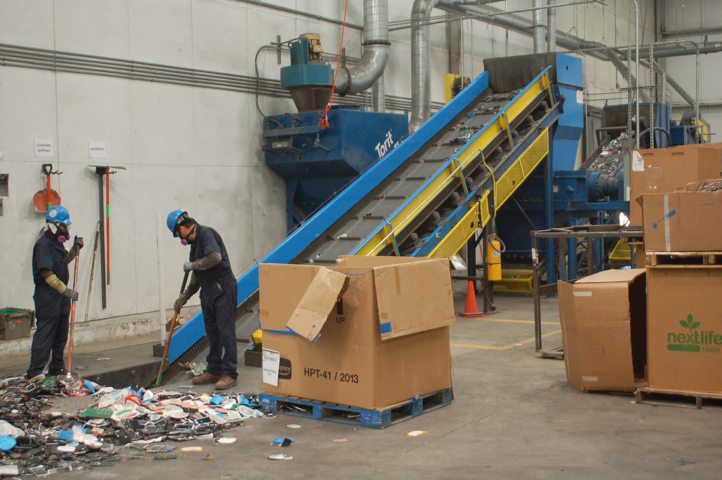
 In a paper published late last month in the journal Environmental International, Harvard University’s Diana Ceballos and colleague Zhao Dong found that the global formal e-scrap sector has ample room to improve when it comes to reducing environmental and occupational exposures.
In their review of recent research from around the world, Ceballos and Dong note that while the formal electronics recycling sector has lowered the risk of workplace and environmental exposures globally, a variety of issues persist.
Both in the U.S. and abroad, exposure to lead, mercury and other toxins has been well-documented in the industry. In addition, soil, dust and air sampling have also found high levels of chemical exposures. In one case in Ohio, children of a worker were found to have high blood lead levels.
Ceballos is a visiting scientist and JFB Environmental Fellow at Harvard’s T.H. Chan School of Public Health, and she previously worked extensively on environmental, health and safety issues in the e-scrap industry with the National Institute for Occupational Safety and Health (NIOSH).
She sat down with E-Scrap News to explore her recent study’s implications for the industry and to offer her advice on improving safety protocols.
E-Scrap News: What has your research suggested about the state of the formal electronics recycling industry?
Diana Ceballos: I believe that the formal electronics recycling industry is a key solution for the worldwide electronic waste problem. I have also found that every owner and manager I meet in this industry is passionate, committed and proud of the work they do. And it is very inspiring to work with folks like that.
I do, however, see that this industry is fairly new and struggles, like many other small- to medium-size enterprises, to keep up with health and safety demands. This is compounded by the outdated occupational legislation to guide the control of chemical hazards, specifically with lead. It is very challenging for these businesses to implement recommendations that are based solely on health and that go beyond legislation.
I want to believe my work has helped create awareness of the issues and provided some practical recommendations. For example, the two major industry certifications, e-Stewards and R2, implemented guidelines based on some of the work that was done when I was at NIOSH. However, the problems are challenging, and more research and programs are needed to help provide the needed solutions.
Question: What were the basic findings of your recent research?
Answer: Alongside a Harvard colleague of mine, Zhao Dong, I performed a review of the scientific literature to date on chemical hazards related to the formal electronics recycling industry. And we found that the challenges are the same worldwide and not unique to the U.S. sector. In our review we found that facilities in the formal sector commonly have levels of metals in the workplace that are known to affect the health of workers. Flame retardants, polychlorinated biphenyls and other chemicals are also commonly found in the workplace and also known to be transported outside of the facilities into the environment. We know much less, however, about other chemicals present in electronics. These facilities are far better than informal recycling operations, but more mitigation of the exposures is still needed.
Question: Is the industry aware of these challenges?
Answer: Businesses in this industry are savvy about their operations and are always creating solutions to new challenges. However, since the occupational health legislation is so outdated, it is common for these businesses to not be familiar with best practices for protecting the health of workers.
Question: You also discuss a two-tiered approach to improving the safety of the industry. Could you explain that?
Answer: First, we need to eliminate hazards from the source by developing a new generation of electronics free of harmful substances. We also would benefit from easy-to-disassemble components. Second, we need to improve the current recycling of electronics to reduce exposures to workers and the environment. … It is important for processors of electronics to work with academia and government to help find solutions and document outcomes so that they can be shared throughout the industry. I also think that it is important for processors to work collaboratively with manufacturers of electronics so that in the future challenges are prevented, anticipated or eliminated altogether.
Question: What are some topics or issues we still really don’t know enough about?
Answer: There is much to be learned about the health effects of complex mixtures typically present when processing electronics. Especially when you have different chemical groups that may affect the same organs, then there are many uncertainties of the mixed effects on health. For example, when metals and flame retardants are present from the processing of electronics, there could be a larger effect on the reproductive health of workers. However, these effects may be only measurable with research that follows workers in time so that health can be assessed in the long run. As we learn more, we will be more able to control exposures and prevent health problems.
Question: You’ll be speaking at the E-Scrap Conference later this month. What can members of the industry expect from your presentation?
Answer: I will summarize the findings of our review of the scientific literature in occupational and environmental health in the formal electronics recycling industry. I hope that it would be interesting for folks in the industry to learn what has been documented in other countries. Ultimately, I want to engage processors of electronics in a dialogue with academics so that we continue developing a research framework that effectively responds to the needs of the industry.