



Resource Recycling
  • The Latest
  • Analysis
    • All
    • Certification Scorecard
    • Industry Announcements
    • Opinion
    Partnership ups quality control on device-sales platform

    Certification scorecard — week of Oct. 5

    Industry announcements for January 2026

    Industry announcements for October 2026

    Paladin acquires R&L Recycling, enters European ITAD market

    Following the money in hardware circularity

    SK Tes on track to meet 2030 ITAD goal

    SK tes’ sustainability report offers window into ITAD

    Our top stories from February 2023

    ADS flexes new recycling capacity against resin spikes

    SCS launches chem recycling standard

    Certification scorecard — week of Sept. 28

  • Conferences
    • Resource Recycling Conference
    • Plastics Recycling Conference
    • E-Scrap: The Longevity Conference
    • Textiles Recovery Summit
  • Publications
    • E-Scrap News
    • Plastics Recycling Update
    • Policy Now
    • Resource Recycling
    • Other Topics
      • All Topics
      • Brand Owners
      • Critical Minerals
      • Glass
      • Grant Watch / RFPs
      • Markets
      • Organics
      • Packaging
      • Research
      • Technology
      • Textiles
Subscribe
No Result
View All Result
Resource Recycling
  • The Latest
  • Analysis
    • All
    • Certification Scorecard
    • Industry Announcements
    • Opinion
    Partnership ups quality control on device-sales platform

    Certification scorecard — week of Oct. 5

    Industry announcements for January 2026

    Industry announcements for October 2026

    Paladin acquires R&L Recycling, enters European ITAD market

    Following the money in hardware circularity

    SK Tes on track to meet 2030 ITAD goal

    SK tes’ sustainability report offers window into ITAD

    Our top stories from February 2023

    ADS flexes new recycling capacity against resin spikes

    SCS launches chem recycling standard

    Certification scorecard — week of Sept. 28

  • Conferences
    • Resource Recycling Conference
    • Plastics Recycling Conference
    • E-Scrap: The Longevity Conference
    • Textiles Recovery Summit
  • Publications
    • E-Scrap News
    • Plastics Recycling Update
    • Policy Now
    • Resource Recycling
    • Other Topics
      • All Topics
      • Brand Owners
      • Critical Minerals
      • Glass
      • Grant Watch / RFPs
      • Markets
      • Organics
      • Packaging
      • Research
      • Technology
      • Textiles
Subscribe
No Result
View All Result
Resource Recycling
No Result
View All Result
Home Recycling

Improving recycling access for underserved communities

Brian Clark HowardbyBrian Clark Howard
October 7, 2026
in Recycling
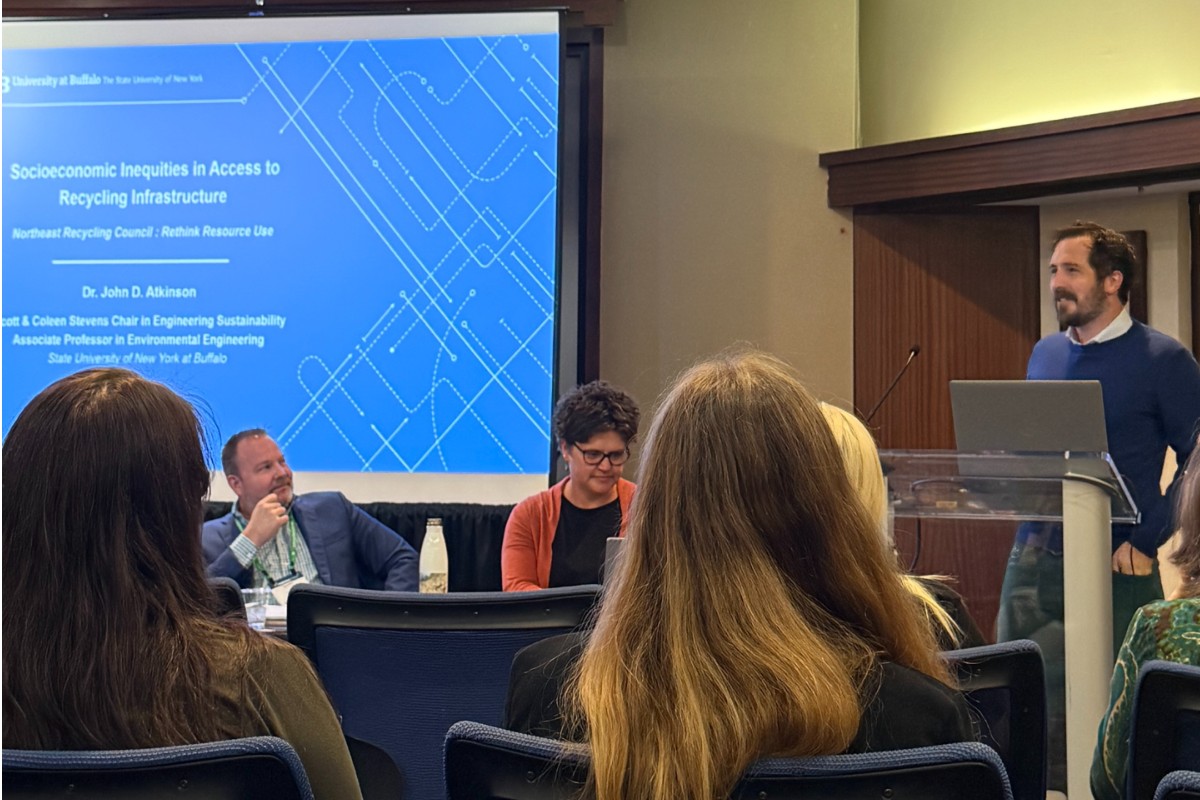
University at Buffalo Professor John Atkinson (right) speaks at the NERC conference in New Jersey.

University at Buffalo Professor John Atkinson (right) speaks at the NERC conference in New Jersey.

There are some universal lessons for those working to improve recycling access to underserved communities, panelists said at the Northeast Recycling Council’s (NERC) Annual Rethink Resource Use Conference in Plainsboro, New Jersey, outside Princeton on Tuesday.

Angie Lemar, a planner in Wisconsin with Foth Infrastructure and Environment, an engineering firm, said the key is to “understand the communities that you’re reaching out to.”

For instance, providing recycling education in languages that are most spoken in your community is key, said Lemar, as well as understanding the needs of your specific community.

Mark Dancy of WasteZero, a company that works with municipalities to increase recycling participation, added that “convenience is universal. So the more convenient everything is, the more effective it is.”

“For a long time the conversation has been how do we recycle better, and we’re trying to change that and think about well maybe we need to think more about who actually gets to recycle than just how to do it better,” said John Atkinson, professor of environmental engineering at New York’s University at Buffalo. Atkinson and his colleagues have been studying how to quantify that recycling inequality.

After crunching data from 84,000 Census tracts and 130 million buildings across the continental US, Atkinson and team found that plastic packaging waste generation is stable across socioeconomic groups. “Everybody generates the same amount of plastic waste,” he said.

Yet there’s a statistically significant relationship between MRF proximity and recycling rates—the communities closest to MRFs recycle more. And Atkinson and colleagues found that communities near MRFs are 30% to 55% wealthier and 14% to 19% more college educated than communities farther away from MRFs.

“The summary here is that wealthier, more educated states recycle more,” said Atkinson.

He added that the study is a first step toward better understanding recycling access around the country. The data could be used to help site future MRFs, he noted. “Ultimately what we are trying to do is create a more equitable system,” said Atkinson, whose study was published in Nature Communications Sustainability. The first author was Zeinab Mousania.

Balancing grants

Lemar of Foth Infrastructure and Environment talked about her team’s work with Ramsey County, Minnesota. Ramsey includes St. Paul and is the second most populous county in the state. The goal was to “create a more equitable dispersion of their recycling funds,” Lemar said.

So Foth applied the CDC’s EJI Explorer tool for environmental justice to Ramsey County, which ranks Census tracts on 36 environmental, social and health factors. Prior to that, the funding mechanism for recycling grants had been purely based on population. But after the tool was run, the county’s municipalities were divided into three tiers. Those places that the tool identified as most burdened in terms of health and environment were flagged to receive the highest payments per household. Communities are then able to spend the money on a range of recycling enhancement projects.

“We’re seeing communities that previously were not receiving very much money now actually be able to implement some programming because their funding dollars have gone from $1,500 to over $20,000,” said Lemar.

Dancy of WasteZero said roughly 15% of communities in the country are considered recycling deserts, with little to no access. These are especially clustered in the South. Some of those communities formerly had access but lost it due to budget cuts, excess contamination or other issues. Due to the inertia in government “it’s really hard to get them reinstated,” said Dancy.

One of the solutions WasteZero suggests is telling communities that have trash pickup service but not recycling to begin sorting high-value recyclables, such as aluminum cans, in separate bags within the regular waste stream. Then, those bags can be pulled out and sorted at the waste facility for a fraction of the cost of running separate recycling collection services.

Politics?

Atkinson said every reviewer that looked at his team’s paper said they needed to add a variable for politics, specifically red state versus blue state. “I don’t buy into that,” he said. “Recycling is an economics problem.”

He added that new technology can help improve access in rural areas. For instance, apps could alert a hauler not to come out to a specific house that’s remote if the bin is empty on a particular day.

Session moderator Caroline Mitchell, the director of community partnerships development with The Recycling Partnership, said additional funding for recycling provided through extended producer responsibility (EPR) systems in several states often includes earmarks for environmental justice.

“(EPR) does provide an amazing increase in resources and additional focus and clarity to help on a lot of our environmental justice fronts,” said Mitchell.

Atkinson added, “I think one of the things that our work shows is that people want to recycle, independent of where they live and how much money they make and what level of education they have.”

Tags: CollectionConferences & EventsEducation & OutreachEPRLocal ProgramsMRFs
TweetShare
Brian Clark Howard

Brian Clark Howard

Brian Clark Howard is managing editor of Resource Recycling and an award-winning journalist with 25 years of experience. He is the co-author of several books and previously served as an editor and writer at The Hill, National Geographic, The Daily Green, E/The Environmental Magazine and The Daily Mail. He has covered a wide range of topics, from the environment to politics.

Related Posts

How AI imaging is helping MRFs and a reclaimer

EPR demands push AI vision systems toward MRFs

byStefanie Valentic
October 6, 2026

AI audit systems could become a compliance tool under EPR, but who pays for them is still being worked out.

Top stories from March 2025

Study finds e-scrap reuse dismissed in UK

byPaul Lane
October 6, 2026

Researchers say many more devices can be put back into users’ hands than is happening now.

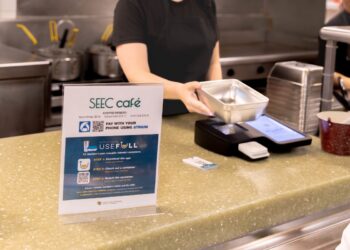
Usefull reusable dining container at SEEC cafe at the University of Colorado Boulder.

CU Boulder launches dining reuse program

byBrian Clark Howard
October 5, 2026

A partnership with Usefull brings reusable, stainless steel containers to university dining spots.

SC Johnson CEO: Recycling needs policy fix

byStefanie Valentic
October 5, 2026

Decades of voluntary packaging work have hit an economic wall. EPR and stronger regulation are what will move the needle.

News in Brief: ALPLA heads to Vegas, Alberta EPR

News in Brief: ALPLA heads to Vegas, Alberta EPR

byAntoinette Smith
October 5, 2026

The global packager and recycler will open a new plant in spring 2027, and Alberta expands its accepted materials list...

In My Opinion: Producer fees in packaging EPR programs

Making the money work for EPR

byStefanie Valentic
October 5, 2026

Battery fires are pushing recycling toward becoming "an uninsurable industry," NSAC founder Heidi Sanborn said.

Load More

2026 Buyers’ Guide

Equipment, services and technology suppliers serving the recycling industry.

Browse the Guide

More Posts

GM launches recycled EV battery line

GM launches recycled EV battery line

October 5, 2026
plastic bale

Underreported sales may cost bottle bill states up to 40%

October 5, 2026

SC Johnson CEO: Recycling needs policy fix

October 5, 2026
Our top stories from February 2023

ADS flexes new recycling capacity against resin spikes

October 1, 2026
Domestic e-plastics recovery picks up pace 

Domestic e-plastics recovery picks up pace 

September 30, 2026
APR, PROs appeal to Ottawa for help

APR, PROs appeal to Ottawa for help

October 6, 2026
How to perform chip harvesting

How to perform chip harvesting

October 1, 2026
Women in Circularity: Sanyukta Saptasagar

Women in Circularity: Sanyukta Saptasagar

September 29, 2026

How EPR and policy is reshaping WM’s facilities

October 5, 2026
Auto Draft

Canadian company delves into durable second-hand devices

October 1, 2026
Load More

About & Publications

About Us

Staff

Archive

Magazines

Work With Us

Advertise
Jobs
Contact
Terms and Privacy

Newsletters

Get the latest recycling news and analysis delivered to your inbox every week. Stay ahead on industry trends, policy updates, and insights from programs, processors, and innovators.

Subscribe

Welcome Back!

Login to your account below

Forgotten Password?

Retrieve your password

Please enter your username or email address to reset your password.

Log In

Add New Playlist

No Result
View All Result
  • The Latest
  • Analysis
  • Recycling
  • E-Scrap
  • Plastics
  • Policy Now
  • Conferences
    • E-Scrap Conference
    • Plastics Recycling Conference
    • Resource Recycling Conference
    • Textiles Recovery Summit
  • Magazines
  • About Us
  • Advertise
  • Archive
  • Jobs
  • Staff
Subscribe
This website uses cookies. By continuing to use this website you are giving consent to cookies being used. Visit our Privacy and Cookie Policy.