




Resource Recycling
  • The Latest
  • Analysis
    • All
    • Certification Scorecard
    • Industry Announcements
    • Opinion
    NJ’s PCR delay risks making its own excuse permanently true

    NJ’s PCR delay risks making its own excuse permanently true

    E-scrap magnet recycling company scales up

    Why only some rare-earth sources are economically viable

    e-Stewards to develop an ITAD-specific standard

    Certification scorecard — week of Sept. 21

    Who should pay for lithium-ion battery fire damage?

    America’s critical-materials buildout has a feedstock problem

    Certification scorecard – week of Sept. 14

  • Conferences
    • Resource Recycling Conference
    • Plastics Recycling Conference
    • E-Scrap: The Longevity Conference
    • Textiles Recovery Summit
  • Publications
    • E-Scrap News
    • Plastics Recycling Update
    • Policy Now
    • Resource Recycling
    • Other Topics
      • All Topics
      • Brand Owners
      • Critical Minerals
      • Glass
      • Grant Watch / RFPs
      • Markets
      • Organics
      • Packaging
      • Research
      • Technology
      • Textiles
Subscribe
No Result
View All Result
Resource Recycling
  • The Latest
  • Analysis
    • All
    • Certification Scorecard
    • Industry Announcements
    • Opinion
    NJ’s PCR delay risks making its own excuse permanently true

    NJ’s PCR delay risks making its own excuse permanently true

    E-scrap magnet recycling company scales up

    Why only some rare-earth sources are economically viable

    e-Stewards to develop an ITAD-specific standard

    Certification scorecard — week of Sept. 21

    Who should pay for lithium-ion battery fire damage?

    America’s critical-materials buildout has a feedstock problem

    Certification scorecard – week of Sept. 14

  • Conferences
    • Resource Recycling Conference
    • Plastics Recycling Conference
    • E-Scrap: The Longevity Conference
    • Textiles Recovery Summit
  • Publications
    • E-Scrap News
    • Plastics Recycling Update
    • Policy Now
    • Resource Recycling
    • Other Topics
      • All Topics
      • Brand Owners
      • Critical Minerals
      • Glass
      • Grant Watch / RFPs
      • Markets
      • Organics
      • Packaging
      • Research
      • Technology
      • Textiles
Subscribe
No Result
View All Result
Resource Recycling
No Result
View All Result
Home E-Scrap

Xscindo set to expand its data destruction tech

byPaul Lane
September 29, 2026
in E-Scrap
Auto Draft

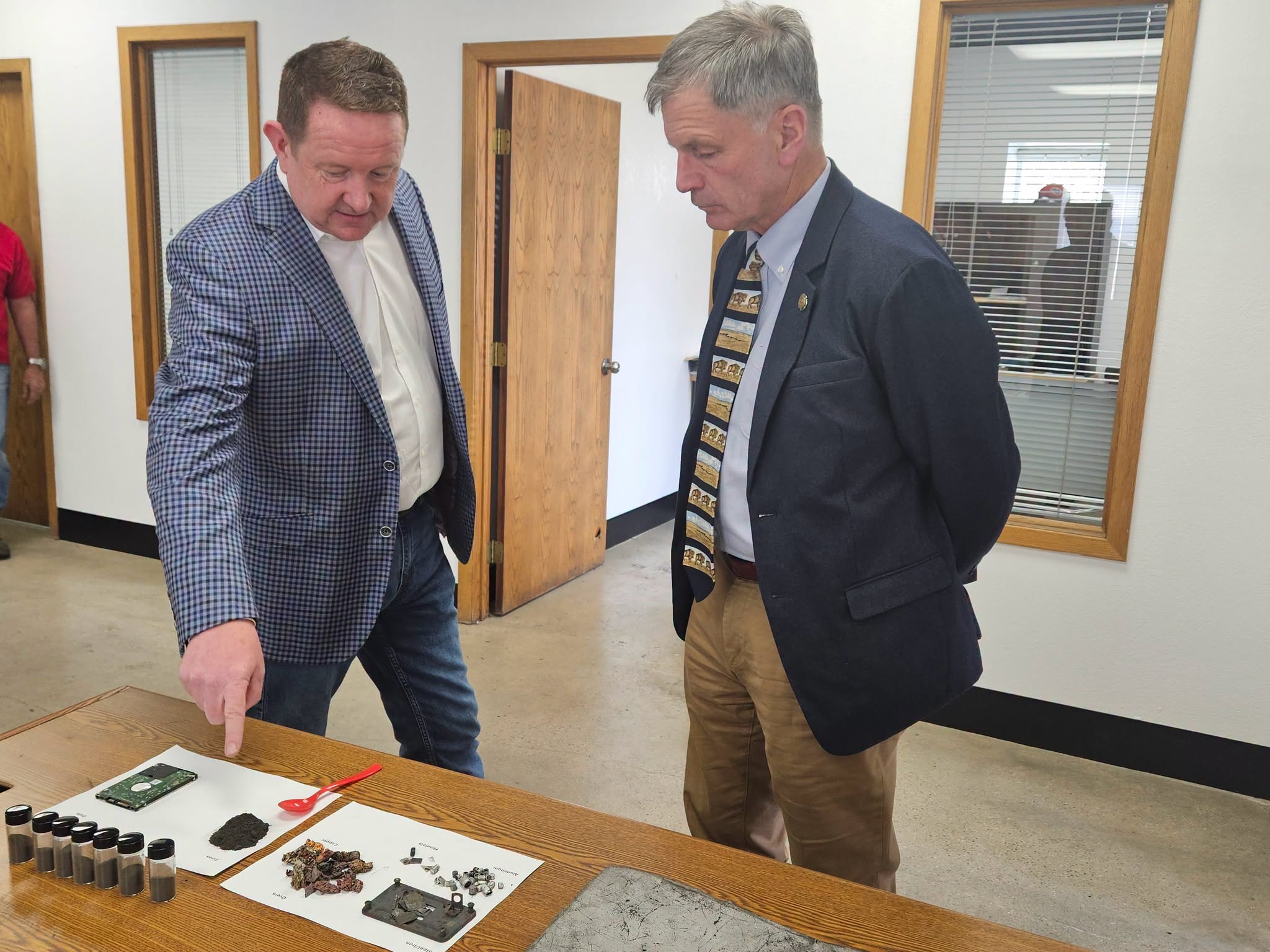
Xscindo founder Aiden Neary, right, takes Wyoming Gov. Mark Gordon on a tour of the company's Gillette facility. | Photo courtesy Gov. Mark Gordon/Facebook

With his technology proven through extensive testing, Aiden Neary is poised to offer the ITAD industry another option for data destruction that also allows for critical mineral recovery.

Neary launched Connecticut-based Xscindo in 2023 after a hacking incident involving a phone he traded in and thought was properly wiped. An investment banker by trade, he spent the next year researching and found that many people, due to concerns over their data getting retrieved post-disposal, either sent their devices for shredding — which isn’t a full-proof destruction method — or held them for lack of a better option.

Given the rise both in devices carrying sensitive data and potential bad actors looking to take advantage of retrieved information, he felt there could be another option.

So he compiled a team to develop a new method for Xscindo. That method puts devices through a sealed thermal process that Neary said destroys data-bearing components without shredding or wiping. Rather, the data-bearing components are turned into ores and fine powders, from which gold, copper and other minerals are pulled when the products are sent to domestic processors.

The plastics within the device are broken down and combusted at temperatures high enough to destroy PFAS and other potentially harmful ingredients; resulting emissions are mainly water vapor and carbon dioxide, along with trace constituents Neary said are well below permitted limits. Any remaining metals are likewise sent for processing. 

“None of what we do is intended as a criticism of the current process,” said Neary, company founder and CEO. “Road maps worked perfectly well until GPS came along and offered a different approach. Electronics recycling has evolved, but we believe there is an opportunity to rethink parts of the end-of-life process using new technology.”

A lot of customers may not have a need for Xscindo’s level of service, he said. But government organizations, health care leaders and others whose devices contain highly sensitive information would be well-served by his company’s extra level of care, Neary said — including having as few hands as possible actually handle the items.

“We are seeing data-sensitive organizations hold onto end-of-life devices for longer because of concerns around data security and chain of custody,” he said. “We’re not targeting your average person.”

The process takes place inside pods that have been tested at a facility in Gillette, Wyoming. That facility has been able to process one-third of a ton of e-scrap per day, Neary said, including some material taken from landfills where the devices would otherwise have been buried (only about half of US states have e-scrap landfill bans). 

Struck by the lack of transparency across the industry — many of the people he spoke to early in the process said they weren’t sure what happened to devices when disposed of —  Neary said Xscindo provides customers with information that can support Scope 3 reporting and offers zero-landfill certification for material processed through its system. The company also maintains a secure chain of custody and provides visibility into the downstream disposition of equipment and recovered materials.

Xscindo, he said, syncs intention and outcome.

“The risk associated with reselling a device may or may not be acceptable, depending on the organization” he said. “Some companies have very little appetite for data risk. We are focused particularly on data-sensitive organizations that want accurate, auditable reporting on where their end-of-life equipment and recovered materials ultimately go.”

The company is also focused on keeping minerals on shore, Neary said, amid several federal policy changes, including a ban on black mass exports and a presidential determination authorizing the restriction of critical mineral exports. Those changes have contributed to a recent expansion in US mineral processing and recycling operations.

Every company Xscindo works with is American, he said, meaning those minerals stay on shore and offer a quicker solution to the nation’s mineral needs: “You’re burying stuff with your left hand, and your right hand is out there mining it fresh. That doesn’t make a lot of sense.”

Gillette will be the site of Xscindo’s first broader, commercial-scale facility next year, at which time Xscinso plans to establish a European presence in the United Kingdom. 

Beyond that, expansion will depend on demand, Neary said. Xscindo plans to eventually operate these pods at facilities nationwide, building out near data centers, military bases and other locales with high volumes of sensitive devices — including landfills, which in some cases have allowed pickers to claim disposed-of electronics despite the inherent data-security risks and liability concerns should a device catch fire or otherwise create a hazard.

“People want to do the right thing,” he said. “I have yet to meet one landfill operator who wants to bury e-waste. They have no viable economic alternative.”

Policy changes combined with data concerns and the social responsibility efforts of companies should help companies like Xscindo carve a place in the ITAD marketplace, Neary said.

“We are not a silver bullet. We’re starting something,” he said. “A little becomes a lot. If we show how effective this approach to end of life can be, then more people will start taking it up.”

Tags: Critical MineralsEuropeITADTechnology
TweetShare
Paul Lane

Paul Lane

Paul Lane is an award-winning journalist who joined Resource Recycling in June 2026 after working for several years in corporate communications and at various local news outlets. He can be reached at paul.lane@resource-recycling.com.

Related Posts

Protected: How to perform chip harvesting

Protected: How to perform chip harvesting

byDan Wang, Toyoshima Green Tech
September 28, 2026

Chip harvesting has grown from a Taiwanese factory-floor workaround into a global business, but the U.S. is barely in the...

Cutting healthcare plastics could save $18B

Report provides path to reduce medical e-scrap

byPaul Lane
September 25, 2026

The European report found that circularity in medical devices is possible through several potential initiatives.

E-scrap magnet recycling company scales up

Why only some rare-earth sources are economically viable

byDavid Daoud
September 24, 2026

Rare-earth recycling economics depend on several factors, and there is no single price or date that makes the process pencil...

Bridge Green, Hartree partner on mineral processing deal

Bridge Green, Hartree partner on mineral processing deal

byPaul Lane
September 21, 2026

The agreement will see Bridge Green’s lithium carbonate sold to and marketed by Hartree.

America’s critical-materials buildout has a feedstock problem

byDavid Daoud
September 18, 2026

As the US invests in critical-minerals capacity will facilities have enough material to process?

Study assesses environmental cost of excess data storage

BAN paper says AI e-scrap estimates are low

byPaul Lane
September 17, 2026

The advocacy group said current estimates on the scrap resulting from data centers don’t account for the full picture of...

Load More

2026 Buyers’ Guide

Equipment, services and technology suppliers serving the recycling industry.

Browse the Guide

More Posts

Recyclers reeling from NJ PCR extension

Recyclers reeling from NJ PCR extension

September 23, 2026
Oregon state capitol building with state flag and blue sky.

NAW appeals Oregon EPR ruling

September 25, 2026
Bin to Better gets students involved in reuse, recycling

Bin to Better gets students involved in reuse, recycling

September 24, 2026
Analysis: Undersupply of PCR is ‘stifling’ brand goals

US lawmakers urge protection of domestic RPET

September 25, 2026
Bipartisan reps introduce bill on recycling claims

House passes bill to ease lithium-ion battery storage rules

September 24, 2026
Calif. Governor Gavin Newsom at podium.

Newsom signs battery EPR expansion, vetoes SB 54 fund bill

September 24, 2026

Who should pay for lithium-ion battery fire damage?

September 21, 2026
US packaging is evolving. The recycling system isn’t ready

US packaging is evolving. The recycling system isn’t ready

September 16, 2026
Industry announcements for January 2026

Industry announcements for September 2026

August 31, 2026
Newsom nixes recycled content claims bill

Newsom nixes recycled content claims bill

September 28, 2026
Load More

About & Publications

About Us

Staff

Archive

Magazines

Work With Us

Advertise
Jobs
Contact
Terms and Privacy

Newsletters

Get the latest recycling news and analysis delivered to your inbox every week. Stay ahead on industry trends, policy updates, and insights from programs, processors, and innovators.

Subscribe

Welcome Back!

Login to your account below

Forgotten Password?

Retrieve your password

Please enter your username or email address to reset your password.

Log In

Add New Playlist

No Result
View All Result
  • The Latest
  • Analysis
  • Recycling
  • E-Scrap
  • Plastics
  • Policy Now
  • Conferences
    • E-Scrap Conference
    • Plastics Recycling Conference
    • Resource Recycling Conference
    • Textiles Recovery Summit
  • Magazines
  • About Us
  • Advertise
  • Archive
  • Jobs
  • Staff
Subscribe
This website uses cookies. By continuing to use this website you are giving consent to cookies being used. Visit our Privacy and Cookie Policy.