




WM (Waste Management) (NYSE: WM) reported second-quarter 2026 revenue of $6.68 billion, up 4.0% year over year, from $6.43 billion in Q2 2025.
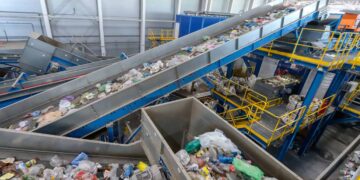
Combined adjusted operating EBITDA in the recycling and renewable energy businesses grew to $163 million, up 32.5% from $123 million a year earlier. This was driven by higher recycling volumes, automation-related efficiencies and increased renewable natural gas production, the company reported.
“Our recycling automation projects are driving a sustained 30% improvement in labor cost per ton compared to legacy facilities,” said CEO Jim Fish on the company’s Q2 earnings call.
The growth came even as the blended average price for single-stream recycled commodities fell to about $75 per ton, down from $84 per ton in Q2 2025.
WM COO Tara Hemmer said WM’s full-year outlook is tracking slightly ahead of expectations.
“We had started the year with a full year outlook at $70 a ton. We’re a bit higher in Q2,” she told analysts, adding that OCC prices are “creeping up” heading into the back half of the year and that the company is “starting to see a little bit of positive movement on plastics.”
Hemmer cautioned that any upside from stronger commodity pricing will likely be offset by operational disruption tied to a fire at one of WM’s Arizona recycling facilities.
President John Morris pointed to WM’s automation buildout as a key driver behind the segment’s performance.
“By combining AI, automation, and operational data at scale, we’re improving execution, reducing cost, and enhancing the customer experience,” Morris said.
The company has completed 38 of 39 planned recycling facility upgrades under its $1.4 billion capital program, with the final project slated for 2027.
Morris said the automated facilities are delivering a sustained 30% improvement in labor cost per ton compared with legacy plants.
The Houston-based hauler completed its new Denver East recycling facility and hauling site in Aurora, Colorado in the second quarter, adding about 60,000 tons of annual processing capacity, per the earnings release.
The $110 million campus includes an 84,000-square-foot recycling facility equipped with automated optical and AI-driven sorting technology, along with a hauling site supporting the company’s compressed natural gas collection fleet.
WM has also flagged plans to begin construction later this year on an adjacent renewable natural gas (RNG) facility at the neighboring Denver Arapahoe Disposal Site.
The company also completed three new renewable natural gas facilities during the quarter. The two RNG projects in South Carolina and one in Florida are expected to add 3.5 million MMBtu of annual run-rate production.
On the renewable natural gas side, Hemmer said WM’s hedging strategy has largely insulated the company from recent volatility in D3 Renewable Identification Number (RIN) prices, the credits generated under the EPA’s Renewable Fuel Standard for cellulosic biofuels like renewable natural gas, which have reached several 52-week highs in recent months.
“We have 90% of our volume locked up for 2026,” she said, “so very little impact from the rise in RIN prices in 2026.” She added that the higher pricing should be a tailwind in 2027, when roughly a third of the company’s RIN volume is already pre-sold, a level she said gives WM “a little bit of an opportunity to see some of the upside” as prices move.
CEO Jim Fish reported adjusted operating EBITDA grew 5.5%, or 9.1% when removing contributions from wildfire cleanup activities in 2025.
“Each of our operating segments contributed to growth in adjusted operating EBITDA and margin, led by the Collection and Disposal business and bolstered by our healthcare and sustainability businesses,” he said.
Healthcare Solutions, the segment built around WM’s 2024 acquisition of Stericycle, expanded operating EBITDA margin by 200 basis points to 19% in the quarter, with SG&A expense falling to 18% of segment revenue from as high as 24% to 25% at the time of acquisition.
“We feel like we’ve fixed the business now and integrated it,” Fish said, adding that cross-selling initiatives have generated $32 million in annual operating EBITDA toward a $50 million target the company expects to reach by early next year.
WM narrowed its full-year revenue outlook to between $26.275 billion and $26.475 billion, citing softer solid waste volumes and delayed pipeline connections for some renewable natural gas plants, partially offset by higher energy surcharge revenue.
The company raised its adjusted operating EBITDA margin guidance by 20 basis points, to a range of 31% to 31.2%, and kept its full-year free cash flow growth target at 29%, which would mark the third straight year of 20% to 30% increases.
Q2 2026 highlights:
- Revenue: $6.68 billion, up 4.0% year over year, from $6.43 billion in Q2 2025
- Adjusted operating EBITDA: $2.07 billion, up 5.5%, from $1.96 billion the previous year’s quarter
- Free cash flow: $1.10 billion, up 34.5%, from $818 million in Q2 2025
- Combined recycling and renewable energy adjusted operating EBITDA: $163 million, up 32.5%, from $123 million the previous year’s quarter