




Advertisement Header Ad
Resource Recycling
  • The Latest
  • Analysis
    • All
    • Certification Scorecard
    • Industry Announcements
    • Opinion

    Certification Scorecard for December 3, 2025

    Industry Announcements for Week of December 1

    News from Dynamic Lifecycle Innovations, Precision E-Cycle

    News from Northeast Recycling Council, Plastipak and more

    News from Northeast Recycling Council, Sortera Technologies and more

    News from MKV Polymers, Metallium Ltd. and more

    Certification Scorecard for November 19, 2025

    News from American Beverage, Inteplast Group and more

    News from Action Carting Environmental Services, International Paper and more

  • Conferences
  • Publications

    Other Topics

    Textiles
    Organics
    Packaging
    Glass
    Brand Owners

    Metals
    Technology
    Research
    Markets
    Grant Watch

    All Topics

Subscribe
No Result
View All Result
Resource Recycling
  • The Latest
  • Analysis
    • All
    • Certification Scorecard
    • Industry Announcements
    • Opinion

    Certification Scorecard for December 3, 2025

    Industry Announcements for Week of December 1

    News from Dynamic Lifecycle Innovations, Precision E-Cycle

    News from Northeast Recycling Council, Plastipak and more

    News from Northeast Recycling Council, Sortera Technologies and more

    News from MKV Polymers, Metallium Ltd. and more

    Certification Scorecard for November 19, 2025

    News from American Beverage, Inteplast Group and more

    News from Action Carting Environmental Services, International Paper and more

  • Conferences
  • Publications

    Other Topics

    Textiles
    Organics
    Packaging
    Glass
    Brand Owners

    Metals
    Technology
    Research
    Markets
    Grant Watch

    All Topics

Subscribe
No Result
View All Result
Resource Recycling
No Result
View All Result
Home E-Scrap

Mobile-shred workers uniquely vulnerable to toxic metals

byJared Paben
September 17, 2020
in E-Scrap
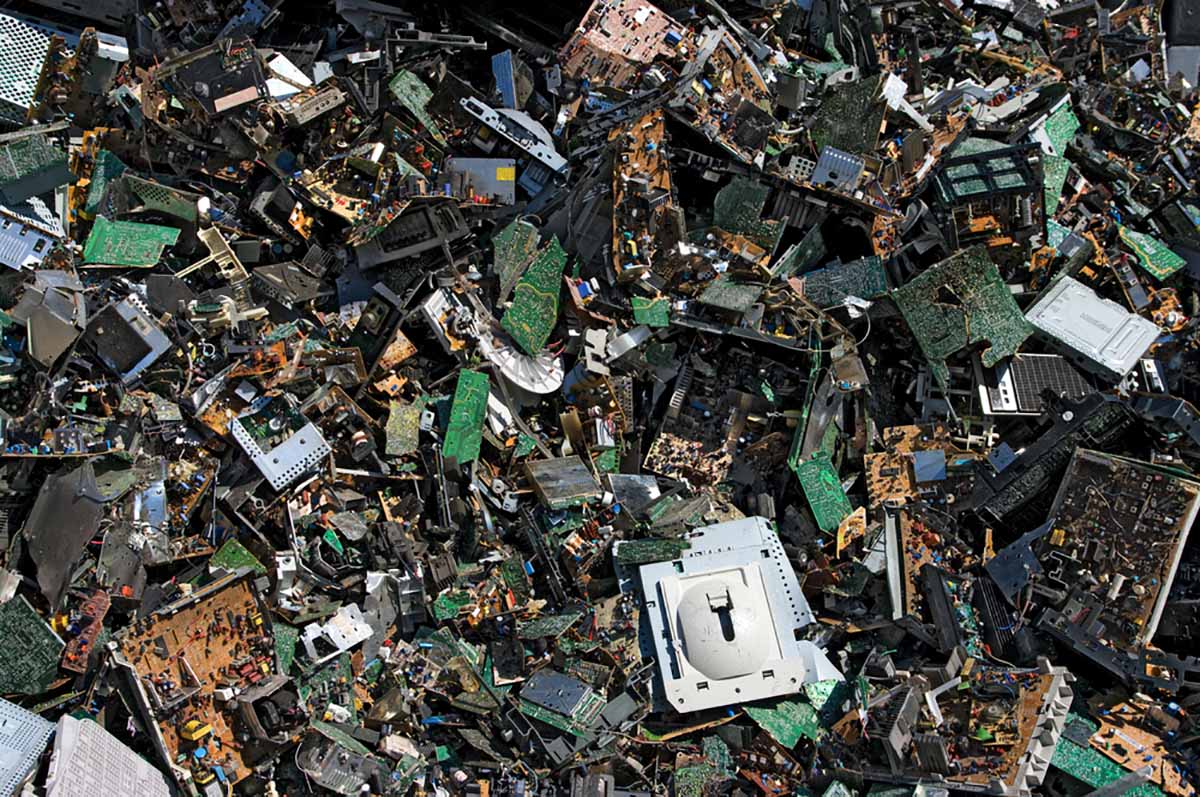
E-scrap piled for recycling
Share on XLinkedin
Researchers found that mobile shredding of hard drives and other small electronics exposes workers to airborne and surface metals dust, as is the case with in-plant shredding. | Huguette Roe/Shutterstock

Researchers have discovered that shredding e-scrap materials in trucks may expose employees to as much toxic metal dust as in-plant shredding, but mobile workers may not be as protected as their plant-based counterparts.

The first-of-its-kind study was conducted by Diana Ceballos from the Boston University School of Public Health and Michael Zhou and Robert Herrick, both from Harvard University’s T.H. Chan School of Public Health. Their paper was published in August in the Annals of Work Exposures and Health.

The researchers found that mobile shredding of hard drives and other small electronics exposes workers to airborne and surface metals dust, as is the case with in-plant shredding. But the mobile unit employees may face higher risks because they’re working in a remote and small space with no ventilation, Ceballos told E-Scrap News.

“Mobile shredding should have, at a minimum, the same protections that workers have when shredding e-waste in a facility,” she said.

Meanwhile, in a separate study Ceballos was involved in, scientists for the first time studied lead and noise exposure at registered e-scrap recycling facilities in China. Results of that work was published this month.

Mobile shredding project takeaways

The mobile shredding study involved taking air and surface samples during a 2019 shredding project at a mobile unit parked outside an unnamed e-scrap recycling facility in the Boston area. The unit consisted of a shredder inside of a semi-truck trailer. The shredder was powered by a diesel-electric generator mounted on the back of the tractor.

Samples were taken during a 65-minute shredding job, during which 200 hard drives and solid-state drives were hand-fed into the shredder. The trailer had no ventilation except for its open back door, and the employee didn’t use any personal protective equipment (PPE).

“In this initial assessment of metals and particulates exposure in a mobile e-waste shredding truck, both air and surface samples suggest that shredding inside a truck is an important source of exposure to toxic metals and particulates in workers,” according to the researchers’ paper.

The analysis showed that, during shredder operation, the concentrations of lead dust in the air were on par with levels found around e-scrap shredders in warehouses. If the concentrations were sustained over an entire work shift, lead exposure likely wouldn’t exceed current occupational limits but would exceed lower exposure limits currently under consideration in California, the study noted.

“Although, If we sampled the breathing zone of the worker, lead concentrations would likely be higher than the measured area samples as is typical in the e-recycling industry,” the paper states.

Surface contamination was highest, not surprisingly, on top of the shredder, where the levels were also comparable to those in warehouse-based shredders. On the shredder, where there was dust accumulation from previous jobs, the concentrations of arsenic, chromium, and lead exceeded recommended levels.

In terms of particulates in the air, they reached their peak within minutes of the shredder beginning operation, and they were highest near the worker. Those air pollution levels still hadn’t returned to background levels after 40 minutes of shredder inactivity.

Overall, the concern isn’t that the mobile shredders are emitting substantially more toxic metals than a plant-based unit but that the offsite workers may be working in poorly ventilated trailers without PPE, resulting in greater exposure.

“We recommend the industry adopts better controls for shredding inside trucks, such as local exhaust ventilation with proper filtration and use of personal protective equipment, to protect workers’ health and the environment,” according to the paper.

Boston University on Sept. 1 issued a press release about the research. Ceballos’ research on exposures to toxic metals and flame retardants has been covered several times by E-Scrap News, including work she did while she was at Harvard.

Exposures at regulated Chinese facilities

In a separate project, researchers found that workers at registered e-scrap facilities in eastern China were exposed to hazardous levels of airborne lead and noise. It was the first study of its kind at formal e-scrap facilities in the country.

Monitoring was conducted in 2017 over two shifts for a total of 168 employees. The results showed that employees dismantling CRTs and breaking glass were sometimes overexposed to lead and noise. Employees involved with plastic shredding were overexposed to noise.

“The simultaneous exposure to lead and noise at medium to high levels in Chinese electronics recycling employees is of concern, as the combined exposure can exacerbate hearing loss,” according to the paper, which was published in the September 2020 issue of the International Journal of Hygiene and Environmental Health.

For the project, Ceballos assisted the following researchers from Jiangsu, China: Wei Gong  and Liangliang Zhao, both from the Jiangsu Provincial Center for Disease Control and Prevention, and Baoli Zhu of the Nanjing Medical University School of Public Health.

 

IRT

Tags: Research
Jared Paben

Jared Paben

Related Posts

Global recycling patent trends may reflect legislative push

Global recycling patent trends may reflect legislative push

byAntoinette Smith
November 25, 2025

Patent applications for chemical recycling technologies have reached a record high globally with government initiatives among the factors driving innovation,...

Familiar roadblock restricts UK recovery rate growth

Familiar roadblock restricts UK recovery rate growth

byColin Staub
January 25, 2017

Research in the U.K. shows that uncertainty over recyclability of plastic products continues to prevent higher recovery rates among the...

Reclaimer argues for goal of 50 percent RPET bottles

Reclaimer argues for goal of 50 percent RPET bottles

byJared Paben
September 12, 2018

Some beverage brand owners are moving toward 100 percent RPET bottles, but one of the country's largest PET reclaimers says...

small electronics

Research provides higher e-scrap disposal estimate

byJared Paben
September 13, 2018

Yale University researchers estimate 3.5 million metric tons of electronics ended up in U.S. landfills in 2015, significantly higher than...

Research provides higher U.S. disposal estimates

byJared Paben
September 18, 2018

Yale University researchers estimate 230 million metric tons of MSW were landfilled in the U.S. in 2015, nearly twice the...

Smartphone

The factors behind used smartphone value

byJared Paben
September 20, 2018

Even if consumers say smartphone repairability is important to them, brand popularity may be a more important factor in prolonging...

Load More
Next Post

Industry stakeholders say material is flowing again

More Posts

Analysis: Q3 earnings confirm new industry priorities

Analysis: Q3 earnings confirm new industry priorities

November 13, 2025
Iron Mountain raises ITAD guidance on strong growth

Iron Mountain raises ITAD guidance on strong growth

November 13, 2025
ERCC outlines shift toward convenience benchmarks

ERCC outlines shift toward convenience benchmarks

November 13, 2025
Analysis: EU softens ESG rules as compliance pressure builds for US

Analysis: EU softens ESG rules as compliance pressure builds for US

November 20, 2025
Sector holds wide gaps in environmental standards

Sector holds wide gaps in environmental standards

November 20, 2025
From crawl to run: a clear roadmap for ITAD ESG

From crawl to run: a clear roadmap for ITAD ESG

November 20, 2025
New entrepreneurs bring renewed energy to e-cycling

New entrepreneurs bring renewed energy to e-cycling

November 20, 2025
The Re:Source Podcast Episode 1: E-Scrap look-back and 2026 outlook

The Re:Source Podcast Episode 1: E-Scrap look-back and 2026 outlook

November 21, 2025
ERI and ReElement partner on rare earth magnet recovery

ERI and ReElement partner on rare earth magnet recovery

November 26, 2025
Cyber risks confront ITAD work, contracts, coverage

Cyber risks confront ITAD work, contracts, coverage

November 26, 2025
Load More

About & Publications

About Us

Staff

Archive

Magazine

Work With Us

Advertise
Jobs
Contact
Terms and Privacy

Newsletter

Get the latest recycling news and analysis delivered to your inbox every week. Stay ahead on industry trends, policy updates, and insights from programs, processors, and innovators.

Subscribe

Welcome Back!

Login to your account below

Forgotten Password?

Retrieve your password

Please enter your username or email address to reset your password.

Log In

Add New Playlist

No Result
View All Result
  • The Latest
  • Analysis
  • Recycling
  • E-Scrap
  • Plastics
  • Conferences
    • E-Scrap Conference
    • Plastics Recycling Conference
    • Resource Recycling Conference
    • Textiles Recovery Summit
  • Magazine
  • About Us
  • Advertise
  • Archive
  • Jobs
  • Staff
Subscribe
This website uses cookies. By continuing to use this website you are giving consent to cookies being used. Visit our Privacy and Cookie Policy.