



Collaboration between all parts of the plastic value chain is necessary to advance sustainability goals, and four companies at the 2024 Plastics Recycling Conference showed how they’re embodying that idea.
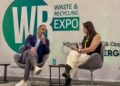
The session, “The New Era of Collaboration,” featured panelists Brian Carvill, vice president of research and development for Amcor Flexibles North America; Alan Schrob, director of mechanical recycling for Nova Chemicals; Adrianne Tipton, chief technology officer for Novolex; and Adriana Wolff, global senior manager of sustainable and circular packaging for McCain Foods. It was moderated by Maite Quinn-Richards, a contractor for Resource Recycling and Re-colab. The conference ran March 24-26 in Grapevine, Texas.
The panelists were not talking about hypothetical collaboration. All four companies are working together, some of them extensively.
Novolex and Nova are currently building a mechanical recycling facility in Connersville, Indiana, that will produce over 100 million pounds of recycled polyethylene after it starts up in 2025.
Schrob noted that while Nova is experienced in manufacturing virgin polyethylene “and running complicated and complex petrochemical hydrocarbon facilities,” the partnership with Novolex brings experience with mechanical recycling.
“The reason why we’re leaning heavily into mechanical recycling is because the technology that exists today is ready for being able to be put into the most stringent of applications that our customers play a role in, whether that’s e-commerce applications or heavy duty shipping sacks or even food contact applications,” Schrob said. “We believe that for the majority of applications, mechanical recycling is the way to go.”
In turn, Nova supplies Amcor and McCain Foods with resin. Wolff said when McCain Foods started looking into what it would take to use PCR in 10% of its food contact packaging by 2025, the Nova team helped them understand the whole process.
“They were very patient with us,” Wolff said, and provided everything needed.
“It’s still a project. It’s not finalized,” she added. “There are some challenges that we need to understand and we need to make a decision as a company.”
Solutions involve industry and policy
The challenges to recycling film and flexibles are well known, and the panelists focused on a variety of possible solutions – most of them centered on changing how people think about recycling and PCR.
Policy, including extended producer responsibility and PCR mandates, will play a role, Schrob said, but it’s not a silver bullet. Right now it’s too disjointed, he said, “as we see every state today having very different approaches.”
“Eventually we’ll get there, but there’s also a role for industry to play across the entire value chain to do this,” he said.
Of paramount importance is a healthy recycling industry, Schrob added, and part of that means bearing the cost of PCR as the market decouples from virgin resin.
“From the mechanical recyclers, through converters, through brands and retailers and the consumer in addition, they’re all going to have to take some pain in terms of being able to get value out of incorporating those recycled products,” he said.
Carvill echoed the need for “value for us and value for the customer” when it comes to adding PCR to products, but encouraged companies to think outside the box when it comes to defining value.
“The places we target adding things like PCR is where we don’t have the business today and we can get growth from it,” he said. “That’s a piece of value that we can count on,” one that could help offset the cost of transitioning to PCR.
“There are ways to tackle this depending on where you are and where you are with your customers,” Carvill added.
A more expansive view of the cost of virgin versus PCR is also helpful, Wolff added. For example, when you factor in existing or coming taxes on using virgin resin, CO2 emissions saved and natural resources conserved, the price difference between PCR and virgin resin is still there, she said, “but it’s getting closer.”
“You need the full view of what is going on,” Wolff said. “How you sell that within the company, that’s another thing, because that’s the rationale. The rationale is easier, but then procurement is going to come and say, why should I buy something that is more expensive? Oh, because it’s a nice thing to do? It’s the right thing to do? So that’s another conversation.”
Tipton said her approach is to sit down with customers and discuss goals – is it more important to reduce virgin resin use, increase PCR or lightweight, for example?
“It’s more about the partnership and just saying, ‘listen, we can help get to your goals and you can help us reach our goals if we do this together,'” she said. “It really can’t just be a conversation about price.”
Choosing to start with products where PCR fits the story can also help, Wolff suggested. For example, McCain Foods also invests in regenerative agriculture, so using PCR packaging for potatoes that were farmed using sustainable methods “makes sense with the product.”
“We all have some products that are premium in which we can start to add those recycled content and we can have a complete story,” she said.
Sometimes, companies will also look at their target percentage and try to immediately make one product have 25% PCR, Schrob said, but that’s not the most effective way, especially with the current state of the market and supply chain. Instead, starting with 5% or 10% spread across products may be easier.
“I think the entire value chain can manage that, and then over time we can increase the amount of these materials and everybody can reach their objectives,” he said. “At that point in time we start to see the separation between the thinking revolving around a virgin price versus a recycled price, and the value starts to erupt.”
Another conversation with brand owners is about adjusting expectations for PCR, Wolff said.
“Marketing is going to ask for a perfect material, perfect printing. I know that for sure,” she said. “But if we sit down with the whole chain – with the converters, with the raw materials, with the companies that are doing the recycling – and understand what it means, we all can give a little bit of what we want to happen and make sure that we can do that. If we all believe that this is going to be the perfect equation and we’re not going to sacrifice anything, this is not going to happen.”
On a brand side, that might mean redesigning graphics, or changing the film thickness, or any number of changes, she said, all of which necessitate an open conversation to “understand where the limits are.”
Tapping new sources for clean supply
The next challenge for Amcor is implementing a source-controlled feedstock stream to open up the possibility of getting food contact status, Carvill said.
“Ideally the system would work and separate all these things and provide the food contact films back to the recyclers, and I think ultimately we’ll get to a system like that,” he said. Until then, pilot projects are needed to “kick start the system and provide the demonstration that these things can have value and they can work.”
Schrob suggested looking to companies that generate very clean back-of-house stretch film but are currently untapped resources, such as Amazon warehouses, for example.
“This one facility generated over 300,000 pounds of stretch film,” Schrob said, referring to a past tour of an Amazon warehouse. “Think about just that leakage of really good material that has no right to go to the landfill and can absolutely be used in food packaging applications for another life and a life after that. That’s really the opportunity.”
However, getting streamlined collection from disparate warehouses is complicated and costly, he acknowledged, and the key is to make it easy for the retailers.
“The easier we can make it for them, the more apt they’re going to want to be able to recycle those feedstocks,” he said.
Novolex has been working with some big-name retailers on just that for more than a decade, Tipton said, but there are “so many untapped places.”
“We’ve been working with them to say, listen, if you could just not put those desiccant packets in with that stuff – can you keep that separate?” she said. “Or whatever it is, but working with them to say do you need balers? What is it that you need to be able to make this stuff easier to collect? And for us, easier to bring back to our facility and easier for you to manage?”
Looking five years into the future, Schrob said he hopes for a world where “ultimately there’s a home for every piece of flexible packaging,” with most of it mechanically recycled, some processed with chemical recycling and then “the last bit, the worst of the worst, definitely should have a home in energy.”
Carvill said from his perspective, the next five years are hard to predict because the pace of innovation is ramping up – and with buy-in from everyone in the supply chain, those changes can come even faster.
“Another part of the collaboration is we’re all signing up for things that don’t exist today,” he said. “Bring the great solutions, innovate with us, because I don’t think any of us can map out what the next five years look like.”