




Resource Recycling
  • The Latest
  • Analysis
    • All
    • Certification Scorecard
    • Industry Announcements
    • Opinion
    Sundry Photography / Shutterstock

    Iron Mountain adds ViaTeK Solutions to ITAD business

    ABTC gets black mass export exemption

    ABTC gets black mass export exemption

    smart glasses

    ITAD’s big wearables challenge

    Partnership ups quality control on device-sales platform

    Certification scorecard — week of Oct. 5

    Industry announcements for January 2026

    Industry announcements for October 2026

    Paladin acquires R&L Recycling, enters European ITAD market

    Following the money in hardware circularity

  • Conferences
    • Resource Recycling Conference
    • Plastics Recycling Conference
    • E-Scrap: The Longevity Conference
    • Textiles Recovery Summit
  • Publications
    • E-Scrap News
    • Plastics Recycling Update
    • Policy Now
    • Resource Recycling
    • Other Topics
      • All Topics
      • Brand Owners
      • Critical Minerals
      • Glass
      • Grant Watch / RFPs
      • Markets
      • Organics
      • Packaging
      • Research
      • Technology
      • Textiles
Subscribe
No Result
View All Result
Resource Recycling
  • The Latest
  • Analysis
    • All
    • Certification Scorecard
    • Industry Announcements
    • Opinion
    Sundry Photography / Shutterstock

    Iron Mountain adds ViaTeK Solutions to ITAD business

    ABTC gets black mass export exemption

    ABTC gets black mass export exemption

    smart glasses

    ITAD’s big wearables challenge

    Partnership ups quality control on device-sales platform

    Certification scorecard — week of Oct. 5

    Industry announcements for January 2026

    Industry announcements for October 2026

    Paladin acquires R&L Recycling, enters European ITAD market

    Following the money in hardware circularity

  • Conferences
    • Resource Recycling Conference
    • Plastics Recycling Conference
    • E-Scrap: The Longevity Conference
    • Textiles Recovery Summit
  • Publications
    • E-Scrap News
    • Plastics Recycling Update
    • Policy Now
    • Resource Recycling
    • Other Topics
      • All Topics
      • Brand Owners
      • Critical Minerals
      • Glass
      • Grant Watch / RFPs
      • Markets
      • Organics
      • Packaging
      • Research
      • Technology
      • Textiles
Subscribe
No Result
View All Result
Resource Recycling
No Result
View All Result
Home Plastics

Startup creates circular economy for lab plastics

Marissa HeffernanbyMarissa Heffernan
May 18, 2022
in Plastics
Startup creates circular economy for lab plastics
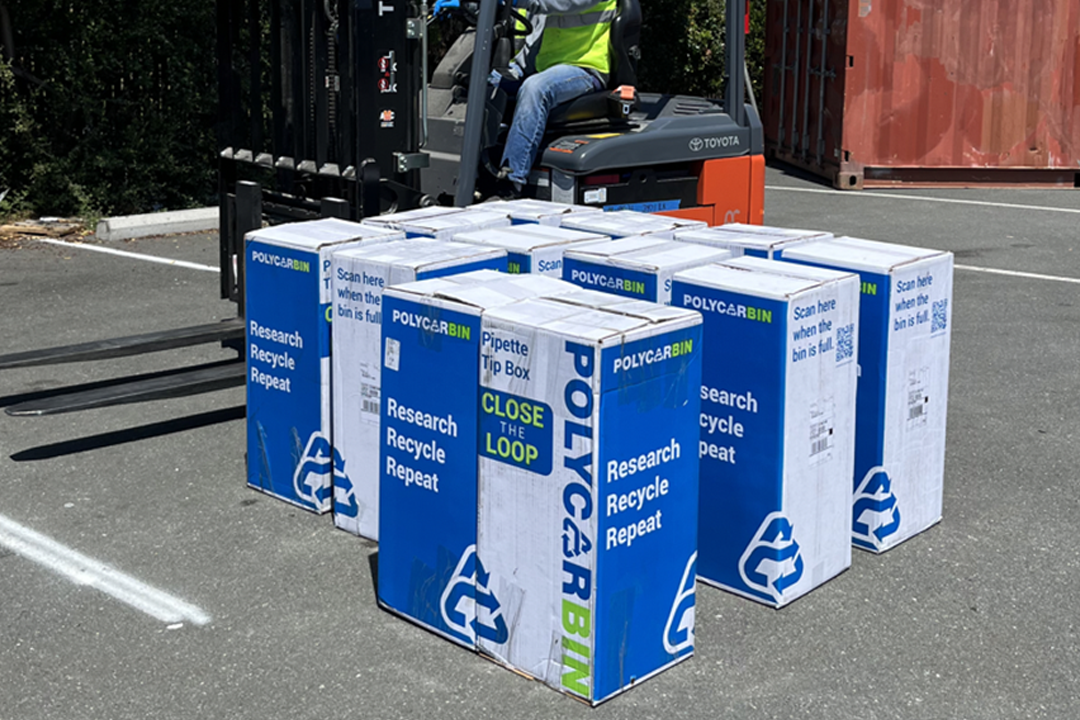
Polycarbin partners with area recyclers to process collected lab plastics, then Polycarbin brings the recycled plastic to several different contract manufacturers that mold it into lab products. | Courtesy of Polycarbin

The co-founders of Polycarbin met in medical school, on track to become plastic surgeons. That’s a point of irony now, they said, as their lab plastics recycling business continues to grow.

Noah Pyles, co-founder and chief operating officer, said he and James O’Brien, co-founder and CEO, wanted to create a way to close the loop on lab plastics after they met at the University of Pittsburgh. Polycarbin was their answer.

Headquartered on the West Coast, the company collects lab plastics from the San Francisco Bay Area, Southern California, New England and parts of the mid-Atlantic region, then recycles that plastic back into laboratory products. The company is handling between 40,000 and 80,000 pounds of material a month. 

“One of the key missions of our company is setting a new precedent for producer responsibility,” Pyles told Plastics Recycling Update. “I want scientists to know that Polycarbin is committed to bringing them sustainable products and then taking them on the back end and ensuring that they end up in the most sustainable destination possible.” 

After collecting the plastic, Polycarbin partners with area recyclers to process the material, then Polycarbin brings the recycled plastic to several different contract manufacturers that mold it into lab products. 

The company also strives for transparency, Pyles said, because many people “want to feel like we’re doing the right thing and we trust that when we recycle something it’s going someplace responsible, and we’ve found for decades now that a lot of the time it isn’t.”

Pyles said when he and O’Brien met in medical school, they had about 15 combined years of prior lab research experience. Pyles had been a research technician at Johns Hopkins School of Medicine, and O’Brien a research fellow at the Massachusetts Institute of Technology’s Koch Institute for Integrative Cancer Research before attending the University of Pittsburgh. They started calculating how much plastic they had produced in their time working in the labs. 

“Back when I was at Hopkins we used to measure our productivity and our efforts by the stacks of [quantitative polymerase chain reaction] plates we’d pile up on the table. Looking back on it, it’s like wow, that was actually just 10 pounds of waste, pure plastic waste that ultimately was incinerated or buried underground,” Pyles said. 

At first, the pair just wanted to find a better solution at the University of Pittsburgh, but they quickly saw that “even though there was a will among the scientific community to find a better solution, there wasn’t the infrastructure in place,” Pyles said. 

“So we decided that we’d try to build that infrastructure, locally at first, and then as we grew we kind of realized that this is a systemic problem that manifests as billions of pounds of plastic waste ultimately burned or buried every year,” he added. 

The company was incorporated in 2020, but Pyles said by late 2019 the pair had committed themselves to the idea. They worked with the University of Pittsburgh’s Vascular Medicine Institute to test their recycling system, building recycling boxes in a friend’s garage and putting them in labs. The pair found they could get a clean enough plastic stream from labs to make processing feasible. 

“Once we had that information, we were kind of like okay, the scientific community wants this, they deserve this, and so we’re going to try to build it for them,” Pyles said. 

Polycarbin’s business model seeks to both save labs money on the disposal side, because many labs pay a high price to dispose of lab materials, and then to use that plastic to create affordable, sustainable products for labs to purchase, Pyles said. 

“We view it as the responsibility of our company to take full responsibility for every piece of material that goes into products we produce,” Pyles said. “We view ourselves as stewards of this plastic and we don’t produce anything we cannot recycle ourselves.”
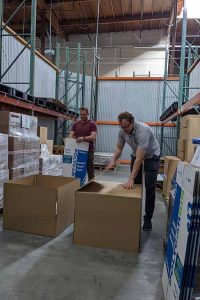
Polycarbin co-founders assembling boxes at the company facility.
Polycarbin’s co-founders Noah Pyles (left) and James O’Brien assemble boxes for shipment to labs.

Expanding the closed loop

Polycarbin offers a range of products, and Pyles said they are in the testing phases to add more. They take mixed-color polypropylene and make it into a black pipette tip box, and use clear polypropylene to make centrifuge tubes in both 50 milliliter and 15 milliliter sizes. He said they’re looking to use the clear PP for well plates and pipette tips in the near future.

“The quality of polypropylene coming from these laboratories is so high you can extract that in a pretty pure sense and put it right back into products,” Pyles said. 

Polycarbin prices the new products competitively, Pyles said, and so far “we have been able to meet nearly all of our customers where they are.” 

“We don’t view a green premium as something that is good for the mission of the company,” he said. “We want to ultimately supplant as much virgin material in the market as possible because that creates a more sustainable supply chain.”

Pyles said the company is “having a lot of luck and a lot of traction selling these products to the same communities that are ultimately giving us this plastic,” but not all labs that want to recycle are interested in buying the recycled products. 

“We have honestly been trying to keep up with demand for recycling services while at the same time promoting the sustainable procurement end,” Pyles said. “We like to communicate to our customers that in order to actually be part of the circular economy you have to be committed to buying products that are made sustainably.”

That’s vital, because Pyles said almost half of the indirect emissions associated with a laboratory come from the consumables labs are “buying on a daily basis in enormous quantities.” 

Looking forward, Pyles said he and O’Brien want to bring the company international. They’re also a couple months away from launching a collection and reuse system for polystyrene, making it into petri dishes. 

They’re also looking to get their carbon emission tracking system third-party certified, and Pyles said that should be possible after their next round of fundraising. The company recently raised $2 million in a seed round of funding. Polycarbin wants to share that certification data with customers, he said. 

“We can share it with our customers and make it available to anyone who wants to audit it because we believe in a future where if you play with all your cards facing up, you stand to at least set a new bar for the expectation of the customer,” Pyles said.
 

Tags: CollectionEPRPP
TweetShare
Marissa Heffernan

Marissa Heffernan

Marissa Heffernan worked at Resource Recycling from January 2022 through June 2025, first as staff reporter and then as associate editor. Marissa Heffernan started working for Resource Recycling in January 2022 after spending several years as a reporter at a daily newspaper in Southwest Washington. After developing a special focus on recycling policy, they were also the editor of the monthly newsletter Policy Now.

Related Posts

ABTC gets black mass export exemption

ABTC gets black mass export exemption

byPaul Lane
October 9, 2026

Company leadership said the move allows the minerals to be used while the nation’s processing infrastructure gets up to speed.

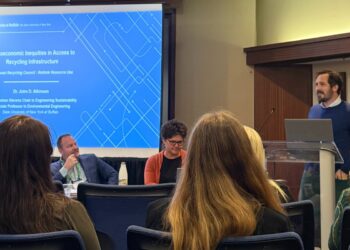
University at Buffalo Professor John Atkinson (right) speaks at the NERC conference in New Jersey.

Improving recycling access for underserved communities

byBrian Clark Howard
October 7, 2026

Panelists at the NERC conference in New Jersey talked about solutions to recycling access, from grants to research to technology...

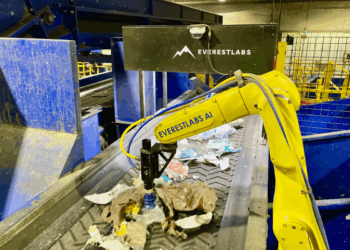
How AI imaging is helping MRFs and a reclaimer

EPR demands push AI vision systems toward MRFs

byStefanie Valentic
October 6, 2026

AI audit systems could become a compliance tool under EPR, but who pays for them is still being worked out.

Top stories from March 2025

Study finds e-scrap reuse dismissed in UK

byPaul Lane
October 6, 2026

Researchers say many more devices can be put back into users’ hands than is happening now.

SC Johnson CEO: Recycling needs policy fix

byStefanie Valentic
October 5, 2026

Decades of voluntary packaging work have hit an economic wall. EPR and stronger regulation are what will move the needle.

News in Brief: ALPLA heads to Vegas, Alberta EPR

News in Brief: ALPLA heads to Vegas, Alberta EPR

byAntoinette Smith
October 5, 2026

The global packager and recycler will open a new plant in spring 2027, and Alberta expands its accepted materials list...

Load More
Next Post

COVID-19 hurt TerraCycle's recycled materials sales in '21

2026 Buyers’ Guide

Equipment, services and technology suppliers serving the recycling industry.

Browse the Guide

More Posts

GM launches recycled EV battery line

GM launches recycled EV battery line

October 5, 2026
plastic bale

Underreported sales may cost bottle bill states up to 40%

October 5, 2026

SC Johnson CEO: Recycling needs policy fix

October 5, 2026
APR, PROs appeal to Ottawa for help

APR, PROs appeal to Ottawa for help

October 6, 2026

How EPR and policy is reshaping WM’s facilities

October 5, 2026
Our top stories from February 2023

ADS flexes new recycling capacity against resin spikes

October 1, 2026
Women in Circularity: Sanyukta Saptasagar

Women in Circularity: Sanyukta Saptasagar

September 29, 2026
How to perform chip harvesting

How to perform chip harvesting

October 1, 2026
Usefull reusable dining container at SEEC cafe at the University of Colorado Boulder.

CU Boulder launches dining reuse program

October 5, 2026
Industry announcements for January 2026

Industry announcements for October 2026

October 5, 2026
Load More

About & Publications

About Us

Staff

Archive

Magazines

Work With Us

Advertise
Jobs
Contact
Terms and Privacy

Newsletters

Get the latest recycling news and analysis delivered to your inbox every week. Stay ahead on industry trends, policy updates, and insights from programs, processors, and innovators.

Subscribe

Welcome Back!

Login to your account below

Forgotten Password?

Retrieve your password

Please enter your username or email address to reset your password.

Log In

Add New Playlist

No Result
View All Result
  • The Latest
  • Analysis
  • Recycling
  • E-Scrap
  • Plastics
  • Policy Now
  • Conferences
    • E-Scrap Conference
    • Plastics Recycling Conference
    • Resource Recycling Conference
    • Textiles Recovery Summit
  • Magazines
  • About Us
  • Advertise
  • Archive
  • Jobs
  • Staff
Subscribe
This website uses cookies. By continuing to use this website you are giving consent to cookies being used. Visit our Privacy and Cookie Policy.