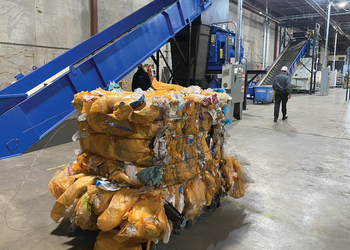







Some of the largest packaged goods and retail firms increased their use of recycled plastic in 2019, but they have work to do to hit 2025 targets, according to an Ellen MacArthur Foundation update.
In one notable increase, Walmart grew its recycled plastic use across product packaging lines from less than 0.5% in 2018 to 9% in 2019, representing nearly 22 million pounds of recycled plastic consumed last year.
The Ellen MacArthur Foundation recently published the 2020 progress report for companies that have signed onto the organization’s New Plastics Economy Global Commitment. This initiative lays out recycling and other sustainability criteria signatories pledge to meet.
Companies that have signed this pledge together make up more than 20% of the global plastic packaging market, according to the report.
The new publication covers changes between 2018 and 2019 for the reporting companies. It is the second annual report and represents the first opportunity to gauge progress, because the 2018 publication offered baseline figures.
According to the Ellen MacArthur Foundation, the group of signatories – which includes more than 500 businesses, governments and other organizations – showed progress in 2019, including in their usage of post-consumer resin (PCR).
“While progress varies significantly between signatories, average PCR for packaged goods and retail signatories increased by 22% year on year, collectively reaching 6.2% PCR for 2019,” according to the report.
Below are the figures reported by some of the largest packaged goods and retail companies, organized by weight of plastic packaging produced in 2019.
The Coca-Cola Co.
- PCR content: 9.7%, up from 9% in 2018.
- Target: 25% by 2025
- Plastic packaging produced in 2019: 2.98 million metric tons, up from 2.97 million the prior year
- Percentage reusable/recyclable/compostable: 99%, same as in 2018
- Additional comments from the company: “Averaged globally across our portfolio, by the end of 2019 we were using 10% recycled PET plastic in our bottles, with higher recycled content in areas with well-established collection and recycling infrastructure, as well as policies that enable the use of recycled materials in food-grade packaging. Incorporating 50% recycled materials [by 2030] will take time and changes in policy and technology, and we are working to help bring these changes about.”
PepsiCo
- PCR content: 4%, up from 3% in 2018.
- Target: 25% by 2025
- Plastic packaging produced in 2019: 2.30 million metric tons, same as in 2018
- Percentage reusable/recyclable/compostable: 79%, up from 77% 2018
- Additional comments from the company: “In Q1 2020, all Lipton beverage bottles in Belgium and the Netherlands have transitioned to 100 percent RPET. In Q2 2019, we relaunched Tropicana in Western Europe to use 50 percent RPET bottles. … In the United States, LifeWTR will transition to 100 percent RPET by the end of 2020. In Western Europe we plan to transition Tropicana to 100 percent RPET by 2025. PepsiCo will continue to advocate in key markets to improve collection and recycling capacity and to modify regulations to allow RPET to be used in food contact materials. We will continue to engage with enhanced recycling partners like Carbios and Loop to allow for a greater supply of recycled content in the future.”
Nestlé
- PCR content: 2%, same as in 2018.
- Target: 30% by 2025
- Plastic packaging produced in 2019: 1.52 million metric tons, down from 1.70 million in 2018
- Percentage reusable/recyclable/compostable: 66%, up from 65% 2018
- Additional comments from the company: “Most plastics are difficult to recycle for food packaging, leading to a limited supply of food-grade recycled plastics. To create a market, we announced in January 2020 that we will be sourcing up to 2 million metric tons of food-grade recycled plastics and allocating more than 1.5 billion [Swiss francs] to pay a premium for these materials between now and 2025. We will therefore increase the amount of recycled plastics in our packaging to 30% by 2025 (vs. 15% previously) and 50% for PET water bottles. By the end of 2020 we plan to achieve the use of 13% RPET on average globally for our water bottles. We are well on track to introduce shrink film with 50% rPE for 40% of our volumes in Europe by the end of 2020. We are also planning to introduce food grade rPP and rPE (through mass balance) for some of our key brands.”
Walmart
- PCR content: 9%, up from 0.5% in 2018
- Target: 17% by 2025
- Plastic packaging produced in 2019: 1.21 million metric tons, weight not listed for prior year
- Percentage reusable/recyclable/compostable: 36.23%, up from 36.04% in 2018
- Additional comments from the company: “We are working with different teams throughout Walmart and Sam’s Club US to set annual goals to achieve 20% recycled content by 2025. We have developed roadmaps by department to help us understand how to achieve our goals.”
Danone
- PCR content: 10.6%, up from 6.4% in 2018
- Target: 50% by 2025
- Plastic packaging produced in 2019: 800,000 metric tons, down from 820,000 in 2018
- Percentage reusable/recyclable/compostable: 66.9%, up from 65.5% 2018
- Additional comments from the company: “Beginning 2020, we decided to increase our global target on recycled content for plastic packaging to more than 50% by 2025.”
Tetra Pak
- PCR content: 0%, same as in 2018
- Target: 2% by 2025
- Plastic packaging produced in 2019: 721,000 metric tons, same as in 2018
- Percentage reusable/recyclable/compostable: 70%, same as in 2018
- Additional comments from the company: “During 2019, we started a strategic program on the integration of recycled and renewable polymers into our primary packaging as well as secondary packaging, together with industry partners. … As the first volumes become available, we are planning to launch the first primary packaging with recycled plastics. For the first time, we will also launch secondary packaging film with post-consumer recycled plastics into the market. (Secondary packaging made from paper is already on the market with recycled content).”
Unilever
- PCR content: 5%, up from 1% in 2018
- Target: 25% by 2025
- Plastic packaging produced in 2019: 700,000 metric tons, same as in 2018
- Percentage reusable/recyclable/compostable: 50%, same as in 2018
- Additional comments from the company: “In 2019, we estimate that we used around 35,000 tonnes of post-consumer recycled (PCR) plastic in our packaging. … We expect our use of PCR materials to accelerate rapidly over the next few years as the design processes begin to deliver at scale. Additionally, through our commitment to help collect and process more plastic packaging than we sell, we aim to kickstart more recycling of materials. … We want to use far more PCR plastic in the future and recapture our own packaging. The biggest challenge is the limited availability of high-quality recycled waste materials (owing to a high demand on the market), particularly in developing and emerging markets.”
The Global Commitment kicked off in October 2018, and it includes member organizations from around the world.
Recently, signatories in different parts of the world have begun working together through a network of regional plastics pacts. Through these initiatives, companies will work toward their targets while taking regional differences into account; the U.S. regulatory structure, for example, is much different from recycling regulations throughout Europe.
The U.S. Plastics Pact launched in August.
A version of this story appeared in Resource Recycling on November 10.