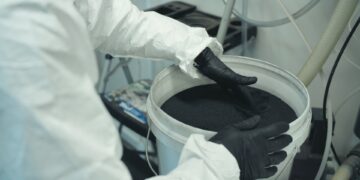

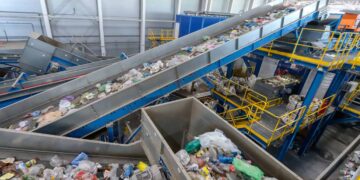



 During a series of tests aimed at optimizing PET thermoform recycling, researchers made a key discovery: the mechanical dryer they used wasn’t just drying out flakes. It was also beating them up, generating a huge amount of fines.
That is one of the challenges standing in the way of a more efficient thermoform recycling process.
U.K.-based nonprofit organization Waste and Resources Action Programme (WRAP) on Sept. 26 released a report summarizing the results of the trials. Conducted in conjunction with U.K.-based Axion Consulting, the in-depth trials explored the recycling of post-consumer pots, tubs and trays, all the way from near-infrared container sorting through granulation, washing, drying, flake sorting and extrusion.
According to WRAP, nearly 70 percent of local governments in the U.K. are now collecting pots, tubs and trays, generating about 155,000 metric tons of material each year for recycling.
Despite that widespread collection, challenges remain to recycling the packaging type. Among those: separating PET bottles from PET thermoforms and minimizing the generation of fines created in the drying step. In fact, researchers described the high level of fines (defined as material less than two millimeters in size) as a key issue to overcome.
“More work is needed to find a suitable drying technique that will minimise the production of fines material,” according to the report. “A very gentle drying process should be trialled and assessed, as this further optimisation will improve both the process yield and the economics of the process.”
The work built on an earlier WRAP effort to explore end markets for recycled PET thermoforms.
According to a separate report, North American reclaimers in 2015 managed to increase the amount of PET thermoforms they recycled, despite the challenges in processing the packaging.
Following is a summary of the WRAP trials and their results:
The feedstock
In performing the trials, which took place between January and June of 2016, researchers collected residual from a plastics recovery facility (PRF), which got its mix of materials from a materials recovery facility (MRF). Both sortation facilities had targeted PET and HDPE bottles. By weight, the material researchers were left with contained less than one-third pots, tubs and trays.
They emphasized it is important to recognize the composition of the material as a consequence of sortation facilities trying to remove thermoforms from higher-value PET and HDPE bottles.
“The results of this project need to be read within this context,” according to the report. “If more PET [pots, tubs and trays] were collected by local authorities and sorted as a target fraction by MRFs and PRFs, then the composition would change.”
Optical sorter testing
The trials took place at testing centers belonging to the following equipment companies: Tomra Sorting Solutions, Herbold Meckesheim and Gneuss. They replicated each step in a standard plastics-recycling process.
The first trials looked at optimizing Tomra Autosort NIR sorters to separate thermoforms from bottles. Three optimizations tests were conducted at a Tomra facility to find a balance between stream purity and recovery. Researchers settled on 61 percent purity and 77 percent recovery as an optimal outcome, and they sorted a total of 6.42 metric tons based on those settings.
The trials showed that NIR sorters can separate PET bottles from PET thermoforms, but it’s a tough sort to do.
“This is due to there being only subtle differences in the infrared spectra of the two types of PET,” according to the report. “The result is that the separation efficiency achieved is lower than expected when separating two different polymer types, for example HDPE and PET.”
Granulation, washing and drying
After testing the NIR sorters, researchers moved on to testing the granulation and washing stages. They did this at a Herbold Meckesheim testing facility, processing about 1.7 tons of material derived from the NIR trials.
Between wet and dry granulation, they found wet granulation to be more effective, according to the report. After that, the material went into two friction wash cycles.
From previous WRAP work, they expected the granulation and washing steps to generate a lot of fines. What they found, however, was those steps generated relatively few (less than 5 percent). They did encounter problems in the hydrocyclone separator, which they employed to remove PE and PP from the PET stream. The hydrocyclone separator became blocked by the thermoform flakes because they were longer and thinner than flakes from PET beverage containers.
Overall, the granulation, washing and hydrocyclone separation stages achieved a yield of 70 percent.
After granulation, the researchers encountered the real culprit creating a high level of fines: the drying stage. A high level of fines – 51.5 percent, by weight – were created in this step because the centrifugal mechanical dryer was too aggressive for thermoform material, despite the fact it is suitable for PET bottle flakes.
“This is a key learning from the trials – pinpointing the stage in the recycling process which is responsible for the high level of fines,” according to the report.
Those fines were not removed as residual but were incorporated into the product stream.
Flake sorting
Researchers then returned to the Tomra facility with 1,235 pounds of washed flakes from the earlier trials.
First, they screened out fines smaller than two millimeters because the flake sorter can’t handle them. More than 40 percent of the weight was screened out as fines. Then, they used a zig zag air separator to further dry material and an eddy current separator to remove residual aluminum contamination.
After that, they sent the flakes into the flake sorter, which sought to remove non-PET contamination, particularly PVC and PS. It achieved a yield of 72 percent, a lower yield than would be expected sorting bottle flake because there was black plastic and a greater percentage of non-target polymers than would be found in a bottle stream.
“Interestingly the fines had a very low PVC content, and this material was not flake sorted,” according to the report. “It could be the case that the PVC does not break up as much as the PET (pots, tubs and trays) and so is less likely to be recovered as fines. This also indicates that the fines material could be extruded without flake sorting.”
Extrusion testing
For the final trial, researchers used a Gneuss MRS extruder with an intrinsic viscosity (IV) jump reactor. The molten plastic leaves the extruder and is fed directly into the IV jump reactor, which remove volatiles and increases the IV to a level allowing the PET to be used in new thermoforms.
They used three different streams for the extrusion trial: two tons of post-industrial PET thermoform regrind, 1,100 pounds of the post-consumer PET thermoform flakes and 1,100 pounds of the post-consumer PET thermoform fines.
Some processing issues were encountered with the fines. Specifically, because of their high bulk density, they were overfed into the extruder, filling the vacuum extraction port with material and inhibiting devolatilisation efficiency. The design of the extruder could be modified to prevent that issue, according to the report.
The IV jump reactor was able to boost the IV of the post-consumer flakes nearly to the level of the post-industrial plastic. But the IV of the fines material was noticeably lower. The experts said that could be because of the continued presence of some non-PET contamination, such as PVC, as well as the reduce devolatilization efficiency because of the overfeeding issue.
“With additional time and material and an extruder more optimised to the processing of fines, it is likely that the IV could have been modified further by optimising the IV jump reactor,” according to the report.