




This article appeared in the October 2023 issue of Resource Recycling. Subscribe today for access to all print content.
Recycling companies say property insurance has become significantly more expensive and difficult to find as providers shy away from fire risk and other complications.
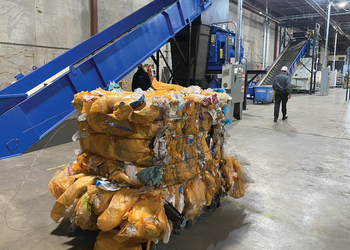
Resource Recycling spoke to MRFs and other operators across industry segments to understand cost implications and how companies are adapting.
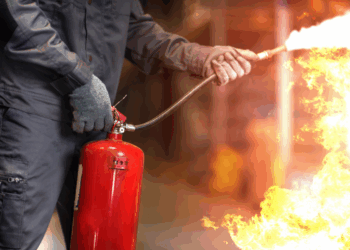
Fire suppression and monitoring tools were the top suggestion, with many facility managers noting that without those safeguards at a recycling site, insurers won’t even consider providing coverage. Long-term legislative policy solutions are also on the minds of some managers.
Harder to solve is the ongoing drift of insurers away from the recycling sector, leading to less competition and higher rates.
Premium increases of 40%
Kristin Poffenberger, senior vice president at Eureka Recycling, a mission-based hauler and MRF operator in Minnesota, said, “There’s a gap in what carriers have the capacity to cover and what industry needs are, and that’s also increased premium rates for everybody.”
She noted Eureka had enjoyed steady rates and small yearly increases for a long time, but despite the lack of major incidents, experienced a substantial surge in premium.
Eureka’s insurance broker has been seeing 30% to 40% rate increases on properties that have not had a claimed insurance loss in the last five years, Poffenberger said. Eureka has also been seeing rate increases on insurance for its fleet of trucks.
“It’s been a wild ride,” she said.
Millennium Recycling runs a MRF in Sioux Falls, S.D. A sister company, called Secure Enterprise Asset Management (SEAM), provides IT asset disposal and electronics recycling services in the area.
“Premiums are high and there’s only a few carriers to choose from,” said Shannon Dwire, president of Millennium Recycling.
“Those who have had fires tend to lose their coverage,” she said.
Jake Anderson, owner and CEO of both Millennium and SEAM, said he doesn’t yet “have a firm handle on how significantly it will impact us at Millennium, but we are expecting our rates to jump substantially.”
Long-term impacts of fire
Danny Edwards, an agent with BancFirst Insurance Services who works with Tulsa, Okla.-based American Waste Control, said fire concerns are at the center of the trend toward higher premiums for recycling firms.
“If you don’t have a narrative around fire and risk in general, it’s going to be really challenging” to get insured, Edwards said.
That’s a situation American Waste Control knows well.
A 2021 fire at the company’s recycling facility and transfer station, sparked by a lithium-ion battery that fell into a belly pan below a conveyor line, destroyed one line and caused over $2 million in electrical damage.
It took nearly a year for the site to get back up and running, and the incident upended Tulsa’s recycling program in the meantime.
Edwards added that as more insurance companies reevaluate coverage options, some providers are asking MRFs to pay to bring in a specialist to conduct a risk assessment before offering insurance terms. MRFs are also layering insurance, buying policies from different companies to cover different aspects of the business.
This strategy spreads out the burden placed on any one insurance company in the case of a loss, but it brings its own host of complexities.
“That leads to more cost, higher deductibles generally, and then come claim time, you’ve got six insurance companies to deal with instead of one, and that is a little bit cumbersome,” Edwards said. “It tends to result in a longer payout process.”
Interruption coverage, which would cover a MRF’s losses when it cannot operate, is also becoming less common, Edwards said, both because insurers are leaning away from it and because of the price point. He said some facilities “are just taking the risk because that’s gotten so problematic and expensive.”
The problem doesn’t just affect MRFs handling residential or commercial recyclables.
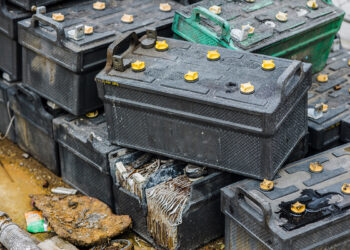
Batteries, the source of so many recycling fires, are inherently a concern for electronics recycling companies. As the electronics ecosystem evolves, more and more device types contain batteries, and they can sometimes be hard to identify and remove without damaging.
FCM Recycling, a Montreal-based electronics recycling company with seven facilities across Canada, saw premiums in Canada skyrocket before COVID-19, with some big insurance companies exiting the Canadian recycling market entirely.
FCM’s premium more than tripled, according to Andrew Rubin, president of FCM Recycling.
“The second you said ‘recycling,’ they wanted nothing to do with you,” he said.
Poffenberger of Eureka in Minnesota estimated that around 80% of insurers that had covered the waste and recycling class left the sector in the last five to seven years.
“There’s a lack of competition in that space and there have been some really big losses in the industry,” she said, “so the rates are increasing.”
Rumpke Waste & Recycling, a large privately owned garbage and recycling company based in Ohio, has noticed rising insurance premiums for a variety of reasons, said Amanda Pratt, director of corporate communications.
“It’s happening nationwide, as natural disasters such as hurricanes, tornadoes and wildfires are definitely impacting costs, along with the risks associated with our industry,” she said.
Edwards, the risk management advisor, has been in the insurance space for almost 24 years. He said over the last several years, property in all industries has become more difficult to insure, and he also pointed to severe weather.
It’s the smaller companies that truly struggle, he added, since larger companies usually have enough resources and reach to still secure coverage. But the issue remains a challenge for all operators.
“If a facility does not have and has not invested in some proactive measures to mitigate fire risks, they are probably not buying insurance or are paying a lot more for it,” Edwards said.
Proactive steps
All the companies reached by Resource Recycling said they’ve found success by taking preventative measures and showing insurance companies they are prepared to handle fires and other incidents.
Edwards said in Tulsa, American Waste Control installed fire suppression systems that remove oxygen from small electrical rooms when a hot spot is detected. That can stop a fire while protecting the circuitry from damaging water or foam.
American Waste Control also decided to install Fire Rover, a system that remotely monitors for hotspots using infrared cameras and can target a blast of either foam or suppression liquid to the base of a fire, once detected.
“Those two steps were the keys for us to overcome having a 10-plus million dollar loss and insurance claim,” Edwards said.
The MRF is also investing more in prevention, and it’s checking all electrical components regularly, preventing material from piling up and distributing handheld infrared cameras so employees can check for hot spots.
Poffenberger said Eureka also has a Fire Rover system installed.
“There’s just more capacity for carriers to look at you if you have Fire Rover, ” she said. “There are some that wouldn’t look at you if you didn’t have it.”
The technology is expensive to install, however, and Poffenberger said that cost can be a barrier to smaller businesses that need it in order to be considered for coverage.
In terms of fire risk, Rumpke works closely with fire departments, fire suppression and alert system manufacturers, and its own team to remain aware and prepared to mitigate fire risks, Pratt said. Rumpke also conducts extensive outreach to the public to educate residents about proper battery disposal.
“Fortunately, Rumpke’s robust and proactive investments in fire suppression technology and training have positioned us well and we continue to evaluate technology to reduce fire risks,” she said.
FCM, the electronics recycling company, also found that investments in fire protection technologies brought insurers back to the table.
The company invested hundreds of thousands of dollars in technologies, including heat detection cameras that are connected to a computer and can automatically shut down the processing line if they detect temperatures above a set threshold.
FCM also installed sprinkler lines along the conveyors, as well as large Class D fire extinguishers throughout the building. For areas that aren’t easily accessible, the company installed a system that dumps carbon dioxide into the room, smothering fires but forcing all workers to evacuate as well.
Finally, FCM installed a trap door in the roof that automatically opens and limits smoke damage during a fire. That “was a really big one that [insurers] liked,” Rubin said.
Those investments, coupled with the fact that FCM hasn’t had any fire claims, opened up insurance options and lowered premiums noticeably, he said. But the bigger financial benefit is simply avoiding lost operating time that would come in the wake of a major blaze.
“I would say our return has been far more on the lost time savings than the insurance premiums,” Rubin said.
Addressing the root issues
Preventative measures help, but they don’t address the overall problems plaguing the recycling insurance industry.
That’s where policy could help, Poffenberger suggested. She’s keeping an eye on various legislative options.
One of those is a bill Iowa recently passed that caps non-economic claims for commercial trucks at $5 million. By offering insurers the certainty they would not be required to pay out a massive claim, it would theoretically allow for lower premiums.
Poffenberger would also like to see legislation aimed at curbing the influx of lithium batteries into MFFs. Robust regulations that mandate responsible disposal methods, stringent labeling requirements and comprehensive recycling programs would collectively contribute to minimizing the volume of lithium batteries entering these facilities, reducing potential hazards.
“We might see some changes in legislation saying what coverages have to be offered, but that’s more on the vehicle side, not as much property,” she said. “I think it’s going to get so smaller organizations can’t afford it, and you’ll see more group collaboration or buying out each other if you can’t self-insure.”
Edwards said he hopes more education can reduce fires and that “the fire suppression technology that we’re all investing in will hopefully pay some dividends in less fires – or fires that get extinguished.”
Marissa Heffernan is the staff reporter at Resource Recycling. She can be contacted at marissa@resource-recyclng.com.
Jared Paben is the associate editor of Resource Recycling. He can be contacted at jared@resource-recycling.com.
This article appeared in the October 2023 issue of Resource Recycling. Subscribe today for access to all print content.