






This article appeared in the August 2022 issue of Resource Recycling. Subscribe today for access to all print content.
Like much of the recycling world, export has long been a key component of the electronics recycling equation. And also like the rest of recycling, e-scrap export realities have evolved rapidly in recent years.
Over the last several months, a pair of e-scrap processors – evTerra and GreenChip – have laid out growth strategies that highlight how international policy shifts, supply chain complications and corporate ESG priorities have coalesced to create an environment in which there may be significant profits to be gleaned from deeper levels of domestic processing.
Supplying a smelter
A firm that was only launched a year ago, evTerra has plans to soon be running four plants across the U.S., part of a strategy to ensure a steady stream of material to a secondary smelter slated for Savannah, Ga.
The smelter venture is being developed by Igneo, evTerra’s parent company.
The first evTerra facility is a roughly 100,000-square-foot site in Atlanta that began shredding low- and mid-grade e-scrap in 2022 (the company also has a Tampa, Fla. sales office).
Igneo (formerly called WEEE Metallica) operates a secondary smelter in France that processes exclusively e-scrap, as opposed to other smelters/refineries that take in a wide variety of virgin mined and scrap resources.
A White Plains, N.Y.-headquartered company, Igneo uses a pyrolysis technology to process low-grade electronic scrap into a copper concentrate, which is shipped to refineries for further processing into precious and base metals fractions. Igneo last fall announced plans to build an $85 million secondary smelter at the Port of Savannah using its technology, and it received a significant funding boost in July when global metals company Korea Zinc bought a majority stake in Igneo.
Jeff Gloyd, an e-scrap industry veteran and the newly hired president of evTerra, said the Igneo facility is slated to open in the first quarter of 2024.
In the meantime, evTerra is working to grow in different areas of the country to be ready to supply the smelter. Gloyd said ownership by a precious metals recovery company and its focus on electronics that may otherwise be landfilled – as opposed to higher-grade scrap or reusable devices – makes evTerra unique.
“Really, I think the differentiator for us is that the focus is truly on low- and mid-grade material,” Gloyd said. “We’re talking about a lot of material that electronics processors [are] not interested in.”
“There’s a lot of companies saying, ‘We don’t want this stuff.’ Even shredding companies,” he added.
Gloyd explained that the vision is for evTerra to serve as a feedstock collection and preparation operation to supply circuit boards to the smelter, which will also purchase printed circuit boards from other e-scrap companies.
Cloning the approach
The processor is looking to source material such as printers, laptops, computer peripherals, small appliances, toys, A/V equipment, flat-panel TVs, monitors and other items with circuit boards.
The goal is to provide value to companies, government agencies and nonprofit organizations, such as Goodwill, to incentivize them to send e-scrap to evTerra rather than dispose of it, thereby boosting recovery rates even in states where e-scrap landfilling is legal, Gloyd said.
Now, evTerra is planning to copy and paste the Atlanta headquarters facility to several other U.S. locations.
First, Gloyd explained, the company is working to open a plant in Henderson, Nev., which is outside of Las Vegas. Pieces of the processing system have arrived but haven’t been assembled yet. That plant is expected to open in the next couple of months.
Next, evTerra is going through the process of closing on leases for spaces near Chicago and San Antonio, he said. The expectation is the Chicago facility will open in the third quarter of 2022 and the San Antonio facility in the fourth quarter of 2022.
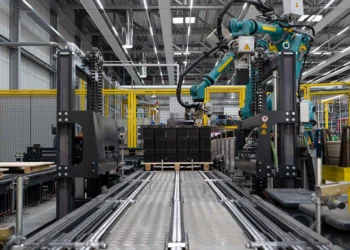
Each will be around 100,000 square feet and have identical shredding and separation systems, facility layouts and certifications, which will include NAID, e-Stewards and R2 certifications, Gloyd said. The processing systems will be SSI Quad Q145 shredding and separation systems with magnetic sorting equipment, he said. Staff are currently reviewing and testing options for optical sorters.
Having clones of a facility allows for universal training and equipment parts, making it easier to transfer people and repair parts between plants.
“There’s a lot of efficiencies we think that are coming from that,” Gloyd said.
Company leaders think there’s enough e-scrap available to feed the Atlanta, Chicago, Las Vegas and San Antonio facilities with roughly 50-60 million pounds per year each, although they recognize it’ll take time to reach those levels, he said.
Eyes on an eco-campus
While evTerra’s focus is on building out a handful of processing sites that all look the same, GreenChip is pushing ahead with sites that are getting progressively larger, and its ultimate vision is a unique operation spread across 20 acres.
GreenChip has operated out of a 35,000-square-foot e-scrap processing facility in Brooklyn, N.Y. for a decade, and in 2020, the company opened a 65,000-square-foot site with shredding capabilities in Fredericksburg, Va.
In June, the company finalized the purchase of roughly 20 acres of property at the King George Industrial Park – located just outside of Fredericksburg, which is around 50 miles from Washington, D.C. – where it plans to develop an “eco-campus” for a deeper sort of commodities recovered from electronics.
“A large part of the future of the industry is employing the latest technologies as far as metals and plastics go to give us that clean output of material,” Bill Monteleone, GreenChip’s managing partner, said in an interview.
He added that over the last five years, the company has seen significant alterations in the global flow of scrap commodities, with logistics issues making it harder to send materials overseas and corporate entities in North America increasing their desire for circular supply chains.
“We think we can help customers meet their goals and be a part of the future of creating feedstock and commodity streams domestically,” Monteleone noted.
The company’s eco-campus vision involves building out space in the coming years to add additional layers of sortation, with the goal of creating homogenous loads of commodities ready for remanufacturing.
A press release from the King George Economic Development Authority, which manages the property that will be home to the eco-campus, notes GreenChip purchased lots 7, 8 and 10 in the industrial park. Additional materials from the authority indicate those three lots total 20.8 acres and were listed at a total price of just over $716,000.
GreenChip is now in the design-and-plan phase for building out the property, which includes a rail spur. Monteleone said it’s too early to determine an overall investment figure for the project.
The eco-campus initiative follows moves from other industry stakeholders to engage in more extensive processing of e-scrap materials within North America.
The Igneo smelting project is one shining example, but there are others. Aurubis, one of the world’s largest copper producers, last November laid out plans for a $345 million smelter in Georgia to process printed circuit boards, cables and other scrap materials into an intermediate copper product. And in April, Germany-headquartered copper giant Wieland acquired Totall Metal Recycling, a 29-year-old e-scrap company with two neighboring locations in Granite City, Ill., near St. Louis.
Meeting various needs
For GreenChip, the move to sort deeper and work to keep material in domestic markets is the latest development in a period of company growth.
In opening its Virginia processing site in 2020, the company essentially tripled its processing footprint and set itself up to meet the needs of OEMs and corporate clients all the way down the East Coast (the company also operates a sales office in Florida).
The Virginia site runs a shredder with a footprint of around 20,000 square feet, and the facility is certified to both e-Stewards and R2. The company’s New York facility is certified to R2 and is in the process of becoming certified to e-Stewards.
The company also recently added Chris Kaasman, formerly of Samsung, as its vice president of compliance.
“I have nothing but good things to say about my time in Samsung,” Kaasman said. “I’ve been in recycling for 12 or 13 years, but I’ve never gotten my hands dirty with what is happening at the ground level. Bill’s passion and the things they are doing was attractive to me.”
GreenChip currently employs around 50 people across its two facilities.
Monteleone said the business benefited from spending its first 10 years solely focused on the New York site, noting the staff was able to dial in processes and learn to provide strong customer service to clients.
“We’ve always looked up to the big recyclers – the ERIs and the URTs,” he said. “We’ve always admired how they put a lot of time into technology and their people. We feel they set the tone, and we see ourselves doing the same things now.”
Jared Paben is the associate editor of Resource Recycling and can be contacted at jared@resource-recycling.com. Dan Leif is the managing editor of Resource Recycling and can be contacted at dan@resource-recycling.com.
This article appeared in the August 2022 issue of Resource Recycling. Subscribe today for access to all print content.