





Since the European Commission unveiled its Circular Economy (CE) package last December, there has been significant discussion around the proposed legislation. And perhaps the most vexed topic to date has been how best to calculate recycling rates in the EU and whether to include reuse activities in that determination.
As discussed in last month’s column, EU member states can currently calculate their recycling rates using four different methods, each at different stages of the recycling process. In addition to making it impossible to compare performance across member states, the use of varying calculation methods undermines the validity of reported recycling rates.
In an attempt to address this problem, the new methodology being proposed is intended to “harmonize” the way countries calculate recycling by moving the point of measurement to the output of a final preparation for reuse or recycling process, after the sorting phase.
The Commission’s move to calculate recycling rates based on what is actually used to replace virgin materials is well intended and is a step in the right direction. That being said, further improvements to the methodology need to be made if it is going to ensure truly accurate estimates.
Accounting for contamination
While the growing trend toward single-stream collection has resulted in higher participation rates and greater volumes of recyclables collected both in the U.S. and in Europe, it has also produced unintended negative consequences, including higher contamination rates of incoming materials.
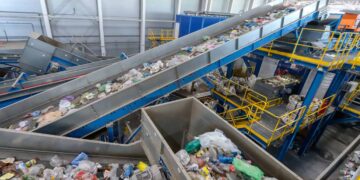
Contaminated materials create many problems for recycling companies, such as higher costs, lower yield rates, and increased equipment downtime and maintenance. Contamination is also a problem when it comes to measuring performance, because if recycling rates are reported without first removing contaminants, the rates will be inflated.
And herein lies the first problem with the new calculation method: It includes the weight of materials sent to disposal or energy-from-waste facilities, as long as such activity does not account for more than 10 percent of the output.
In other words, the proposed output calculation method actually would count some level of contamination as recovery.
Not only is the provision of a maximum threshold difficult to justify, it is inherently arbitrary, and it remains unclear how the Commission came to such a number. We know that with plastic PET bottles, yield losses can range anywhere from 23 to 30 percent. Downstream loss rates reported by the glass industry depend on the collection system and processing equipment used. Glass in Europe is typically collected separately from other recyclables and is cleaner than the glass from single-stream systems in North America.
The information related to contamination is fairly easy to get from recycling facilities because they are generally interested in sharing information about the characteristics of incoming contaminants in an effort to further communicate upstream and find solutions for improvement.
While most would agree that garbage should not be included in the recycling calculation, many of the EU’s top-performing Member States are reluctant to change their current accounting system, claiming that the new methodology would cause their recycling rates to decline. Given the fact that the Commission has also proposed to increase recycling targets, this puts significant pressure on the negotiations.
Separate Reuse and Recycling Targets for Packaging
While it is true that removing garbage (i.e. contamination) from the calculation could negatively impact Member States’ recycling performance, it is also true that combining reuse and recycling activities, as the EC has proposed, could have the opposite effect, by artificially boosting recycling rates beyond what they are intended to measure.
One of the main arguments put forward by Member States against the new calculation methodology and its output-based approach is that it will make it difficult to meet targets. However, if preparation for reuse is to be counted together with recycling it is quite possible that many countries are already meeting the recycling targets today. In fact, estimates from the plastics industry shows that inclusion of the weight of reuse would increase the current EU-wide rate by 14 percentage points alone.
Although it is easy to understand the political reasons behind this move – to help countries that will see their rates decline as a result of the new methodology – it is a bad idea.
Aside from the fact that these two activities are completely different by definition, combining recycling and preparation for reuse targets does little, if anything, to push ahead greater reuse and will potentially weaken the overall level of recycling. There is also the fact that combining reuse and recycling into one target runs counter to the waste hierarchy, as it places them on the same level.
Reuse should not simply be there to artificially increase the performance of recycling rates. Rather, separate, stand-alone reuse targets should actually stimulate an increase in the share of reusable packaging placed on the market and exponentially prevent the generation of waste.
Getting the math right
Stakeholders in the business sector and members of Parliament and Council have all been left scratching their heads trying to figure out how to better calculate recycling, and while no one actually has the answer yet, everyone can agree that it is not practical to discuss the new targets until the calculation method is revised. With the package now on the table, the focus should be on getting the numbers right. Only then can we proceed to set targets that make sense.
Dispatches from Europe is a monthly column that will keep you posted on developments around the EU’s Circular Economy Package as well other interesting policy developments related to waste reduction in Europe.
Clarissa Morawski is based in Barcelona and serves as the managing director of the Reloop Platform, which brings together industry, government, and non-governmental organizations in Europe to form a network for advances in policy that create enabling system conditions for circularity across the European economy. Clarissa is also principal of Canada-based CM Consulting Inc.