








Resource Recycling
  • The Latest
  • Analysis
    • All
    • Certification Scorecard
    • Industry Announcements
    • Opinion
    HP receives ocean plastics certification

    HP Inc. earnings point to memory inflation challenge

    Certification scorecard for the week of Feb. 23, 2026

    Umicore highlights strength in recycling, catalysis

    Apto, Tusaar partner on rare earths recovery

    Apto, Tusaar partner on rare earths recovery

    Certification scorecard for the week of Feb. 16, 2026

    Sims Lifecycle leverages hyperscale decommissioning

    Sims Lifecycle leverages hyperscale decommissioning

    The electronics recycling industry is undergoing a transformation from labor-intensive manual operations to highly automated, AI-driven facilities that use advanced robotics, cleaner chemistry and digital tracking systems to extract critical materials.

    The cyber-physical MRF: AI and robotics reshape e-waste recovery

    Certification scorecard for the week of Feb. 9, 2026

    Meta-Corning deal signals IT hardware retirement wave

    Meta-Corning deal signals IT hardware retirement wave

  • Conferences
  • Publications

    Other Topics

    Textiles
    Organics
    Packaging
    Glass
    Brand Owners

    Metals
    Technology
    Research
    Markets
    Grant Watch

    All Topics

Subscribe
No Result
View All Result
Resource Recycling
  • The Latest
  • Analysis
    • All
    • Certification Scorecard
    • Industry Announcements
    • Opinion
    HP receives ocean plastics certification

    HP Inc. earnings point to memory inflation challenge

    Certification scorecard for the week of Feb. 23, 2026

    Umicore highlights strength in recycling, catalysis

    Apto, Tusaar partner on rare earths recovery

    Apto, Tusaar partner on rare earths recovery

    Certification scorecard for the week of Feb. 16, 2026

    Sims Lifecycle leverages hyperscale decommissioning

    Sims Lifecycle leverages hyperscale decommissioning

    The electronics recycling industry is undergoing a transformation from labor-intensive manual operations to highly automated, AI-driven facilities that use advanced robotics, cleaner chemistry and digital tracking systems to extract critical materials.

    The cyber-physical MRF: AI and robotics reshape e-waste recovery

    Certification scorecard for the week of Feb. 9, 2026

    Meta-Corning deal signals IT hardware retirement wave

    Meta-Corning deal signals IT hardware retirement wave

  • Conferences
  • Publications

    Other Topics

    Textiles
    Organics
    Packaging
    Glass
    Brand Owners

    Metals
    Technology
    Research
    Markets
    Grant Watch

    All Topics

Subscribe
No Result
View All Result
Resource Recycling
No Result
View All Result
Home Recycling

REMADE funds plastics and e-scrap recycling research

Colin StaubbyColin Staub
July 17, 2018
in Recycling

Projects advancing plastics and scrap electronics recovery will receive funding through a federal initiative to save energy and support U.S. manufacturing.

The REMADE (Reducing Embodied-Energy and Decreasing Emissions) Institute announced July 11 its first round of projects to receive funding. The REMADE Institute launched in early 2017 and has been working through the selection process since last summer.

REMADE is funded partially through the U.S. Department of Energy, and its goal has been to develop technologies reducing energy usage and greenhouse gas emissions in manufacturing by improving recycling, remanufacturing and reuse.

A handful of projects selected during the first funding round are related to plastics and electronics recycling. Resource Recycling queried REMADE for more information and compiled the following roundup of seven of the recycling-related projects.

All told, the 17 projects have a combined value of $10 million, which comes from $4 million in federal funding and the remainder in cost-share contributions. The REMADE effort has partnerships with 30 organizations that will be completing the projects.

Capturing hard-to-recycle plastics

Targeting film and flexible packaging: A project by the American Chemistry Council (ACC), Idaho National Lab and Resource Recycling Systems (RRS) seeks to advance recovery of flexible packaging and plastic film. Titled “Determining Material, Environmental, and Economic Efficiency of Sorting and Recycling Mixed Flexible Packaging and Plastic Wrap,” the project will examine barriers along every stage of the recovery process. Its goal is to gather data on the efficacy of new types of sortation equipment, the impact that equipment has on quality of other commodities processed in the MRF, the market potential for recovered film and flexible packaging, and more. ACC and RRS are already working on a project called Materials Recovery for the Future (MRFF), which involves optimizing MRFs’ ability to sort flexible packaging.

Breaking down barriers to multi-layer film recovery: The project will examine the primary challenges for recycling multi-layer film, which currently is not recycled in large volumes, according to REMADE. The recovery challenges include effectively separating low bulk density film using existing processing equipment and sorting laminated films into separate streams. They also include a lack of markets for the end products, which are “heterogenous blends with altered properties.” The project, titled “Scalable High Shear Catalyzed Depolymerization of Multilayer Plastic Packaging,” seeks to address the issue that there is a lack of cost-effective and energy-efficient conversion technologies for these materials. The project is a collaboration between the ACC, Michigan State University, National Renewable Energy Laboratory, Unilever and the University of Massachusetts-Lowell.

Bring circular economy into systems analysis: A third plastics recycling-related project seeks to incorporate circular economy concepts into other analysis tools. According to the REMADE project description, “Few conceptual models exist for the evolving plastics circular economy. Attempts to envision/assess impacts of a future plastics circular economy are lacking.” This project, titled “Systems Analysis for PET and Olefin Polymers in a Global Circular Economy,” will be carried out by the ACC, Idaho National Lab and Michigan Technological University.

Focus on electronics

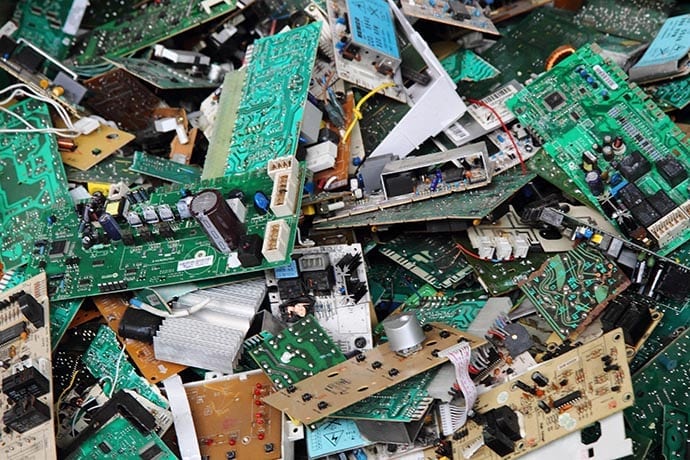
Looking at e-scrap on a systems level: This project will be completed by Idaho National Lab and electronics recycling company SunnKing. The project, called “Evaluation of logistics Systems for Collection, Reprocessing, and Production of Secondary Feedstocks from e-Waste,” will examine inefficiencies within the logistics of the current electronics recycling system. “Two reasons for difficulty in accessing residential e-wastes are ineffective placement of collection facilities and low-economic incentives,” REMADE wrote in a project overview. “This results in low availability of raw feedstocks, therefore causing higher costs due to competition between recyclers.” The project proposes to help provide a systems-level understanding of the sector, aiming to help individual players see how their operations are connected to the wider “ecosystem” of e-scrap recovery.

New approach to foster circuit board reuse: Completed by Caterpillar, CoreCentric and the Rochester Institute of Technology, this project will focus on removing the coating material that’s applied to circuit boards during their production. The coating is usually made from silicon or epoxy and is applied to protect the circuit board, but it creates a barrier to reusing circuit boards at end-of-life. The boards are often damaged during removal of the coating. According to REMADE, this project, titled “Epoxy/Silicon Potting Material Removal for Greater Recovery of Circuit Boards,” will rectify “a lack of knowledge of how to effectively and cost-efficiently remove silicon and epoxy potting material without damaging the circuit board,” REMADE wrote.

Deeper dive into device condition: This project, which is being undertaken by the same organizations as the circuit board reuse venture, aims to expand device testing to measure finer details that don’t show up during functional testing. Although functional testing is the industry norm, “there are no technologies available to measure or detect latent defects in used printed circuit boards,” according to REMADE. As an example, the project points to solder joint degradation in circuit boards. This wear-and-tear is responsible for roughly 13 percent of device failures, according to the project overview, but functional testing does not reveal the solder joint condition. Manual inspection of these components is often cost- and time-prohibitive, so the goal of this project, titled “Condition Assessment of Used Electronics,” is to explore technologies that could perform that task in an efficient manner.

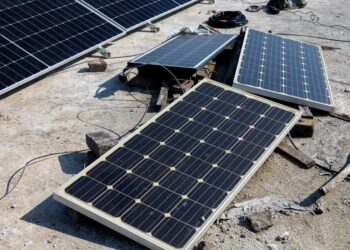
Shifting design for an emerging stream: Solar panels are growing as a portion of the end-of-life stream. According to the REMADE description, the “Development of an Industrially Relevant RE-SOLAR Design Framework” project will examine how to improve design-for-recycling. The project will look at the life cycle impact of different materials and manufacturing choices, as well as the economics of various types of end-of-life recovery. “This is an imminent and critical challenge as previously installed solar modules are now creating a surge of electronic waste,” REMADE wrote. “The installation of new systems is also rapidly being scaled up and may create tremendous amounts of e-waste at the end of their lifespan.”

Photo credit: Andrii Zhezhera/Shutterstock
 

CPM

Tags: Hard-to-Recycle MaterialsPlasticsResearch
TweetShare
Colin Staub

Colin Staub

Colin Staub was a reporter and associate editor at Resource Recycling until August 2025.

Related Posts

State policy is redefining plastics recycling in the US

State policy is redefining plastics recycling in the US

byKate Bailey
February 19, 2026

This year marks the midpoint of a decade defined by major shifts in plastics and recycling policy. Here’s what to...

Texas sues over dumped wind turbine blades

Texas sues over dumped wind turbine blades

byScott Snowden
February 10, 2026

The state attorney general sued Global Fiberglass Solutions over alleged illegal storage and disposal of all turbine blades at two...

UT Austin spinout Supra launches to recover rare earths

byScott Snowden
February 3, 2026

Supra Elemental Recovery launched today, aiming to recover gallium and scandium from US waste streams to help reduce import dependence...

Solarcycle starts up Georgia recycling plant

Solarcycle starts up Georgia recycling plant

byScott Snowden
January 30, 2026

Solarcycle has begun operating its Cedartown solar panel recycling facility, clarifying the status of a long-planned project that was previously...

VW investing millions in auto recycling in Germany

byAntoinette Smith
January 28, 2026

The German vehicle manufacturer plans to invest up to €90 million in its Zwickau plant, in efforts to supply its...

Leveraging materials testing for procurement efficiency

byDr. Pradyumna Gupta
January 23, 2026

In real-world application, variations in resin properties translate into budget risk, from increased scrap rates and production downtime to premature...

Load More
Next Post

Dual-stream collection regains appeal in some areas

More Posts

WM opens new $90m MRF in south Florida 

WM opens new $90m MRF in south Florida 

February 23, 2026
PET bales stacked for recycling.

Evergreen closing RPET plants in Ohio, New York

February 24, 2026
Battery fire risk isn’t going away. Insurance is responding

Battery fire risk isn’t going away. Insurance is responding

February 24, 2026
Study links tagging tactics to lower contamination rates

Arizona, Reynolds reach settlement on Hefty bag lawsuit

February 23, 2026
Chinese processing group details goals for US visit

AMP lays out vision of next-generation, AI-driven MRFs

July 24, 2024
How will 2026 unfold for plastics recycling?

How will 2026 unfold for plastics recycling?

February 19, 2026
Recycled plastic lumber firms report diverging results

Trex CEO to retire after 23-year run

February 25, 2026
Polyolefins producer provides PCR updates

Economic downturn forces LyondellBasell to trim sustainability goals

February 23, 2026
Minnesota publishes prelim EPR assessment

Minnesota publishes prelim EPR assessment

February 20, 2026
State policy is redefining plastics recycling in the US

State policy is redefining plastics recycling in the US

February 19, 2026
Load More

About & Publications

About Us

Staff

Archive

Magazine

Work With Us

Advertise
Jobs
Contact
Terms and Privacy

Newsletter

Get the latest recycling news and analysis delivered to your inbox every week. Stay ahead on industry trends, policy updates, and insights from programs, processors, and innovators.

Subscribe

Welcome Back!

Login to your account below

Forgotten Password?

Retrieve your password

Please enter your username or email address to reset your password.

Log In

Add New Playlist

No Result
View All Result
  • The Latest
  • Analysis
  • Recycling
  • E-Scrap
  • Plastics
  • Policy Now
  • Conferences
    • E-Scrap Conference
    • Plastics Recycling Conference
    • Resource Recycling Conference
    • Textiles Recovery Summit
  • Magazine
  • About Us
  • Advertise
  • Archive
  • Jobs
  • Staff
Subscribe
This website uses cookies. By continuing to use this website you are giving consent to cookies being used. Visit our Privacy and Cookie Policy.