













Resource Recycling
  • The Latest
  • Analysis
    • All
    • Certification Scorecard
    • Industry Announcements
    • Opinion

    Certification scorecard for the week of Feb. 16, 2026

    Sims Lifecycle leverages hyperscale decommissioning

    Sims Lifecycle leverages hyperscale decommissioning

    The electronics recycling industry is undergoing a transformation from labor-intensive manual operations to highly automated, AI-driven facilities that use advanced robotics, cleaner chemistry and digital tracking systems to extract critical materials.

    The cyber-physical MRF: AI and robotics reshape e-waste recovery

    Certification scorecard for the week of Feb. 9, 2026

    Meta-Corning deal signals IT hardware retirement wave

    Meta-Corning deal signals IT hardware retirement wave

    Malaysia clamps down on illegal e-waste imports amid probes

    Malaysia clamps down on illegal e-waste imports amid probes

    URT builds alliance to remake electronics plastics at scale

    ICYMI: Top 5 e-scrap stories from January 2026

    The electronics recycling industry is undergoing a transformation from labor-intensive manual operations to highly automated, AI-driven facilities that use advanced robotics, cleaner chemistry and digital tracking systems to extract critical materials.

    Certification scorecard for the week of Feb. 2, 2026

    Auditors warn EU may fall short on critical metals

    Auditors warn EU may fall short on critical metals

  • Conferences
  • Publications

    Other Topics

    Textiles
    Organics
    Packaging
    Glass
    Brand Owners

    Metals
    Technology
    Research
    Markets
    Grant Watch

    All Topics

Subscribe
No Result
View All Result
Resource Recycling
  • The Latest
  • Analysis
    • All
    • Certification Scorecard
    • Industry Announcements
    • Opinion

    Certification scorecard for the week of Feb. 16, 2026

    Sims Lifecycle leverages hyperscale decommissioning

    Sims Lifecycle leverages hyperscale decommissioning

    The electronics recycling industry is undergoing a transformation from labor-intensive manual operations to highly automated, AI-driven facilities that use advanced robotics, cleaner chemistry and digital tracking systems to extract critical materials.

    The cyber-physical MRF: AI and robotics reshape e-waste recovery

    Certification scorecard for the week of Feb. 9, 2026

    Meta-Corning deal signals IT hardware retirement wave

    Meta-Corning deal signals IT hardware retirement wave

    Malaysia clamps down on illegal e-waste imports amid probes

    Malaysia clamps down on illegal e-waste imports amid probes

    URT builds alliance to remake electronics plastics at scale

    ICYMI: Top 5 e-scrap stories from January 2026

    The electronics recycling industry is undergoing a transformation from labor-intensive manual operations to highly automated, AI-driven facilities that use advanced robotics, cleaner chemistry and digital tracking systems to extract critical materials.

    Certification scorecard for the week of Feb. 2, 2026

    Auditors warn EU may fall short on critical metals

    Auditors warn EU may fall short on critical metals

  • Conferences
  • Publications

    Other Topics

    Textiles
    Organics
    Packaging
    Glass
    Brand Owners

    Metals
    Technology
    Research
    Markets
    Grant Watch

    All Topics

Subscribe
No Result
View All Result
Resource Recycling
No Result
View All Result
Home Resource Recycling Magazine

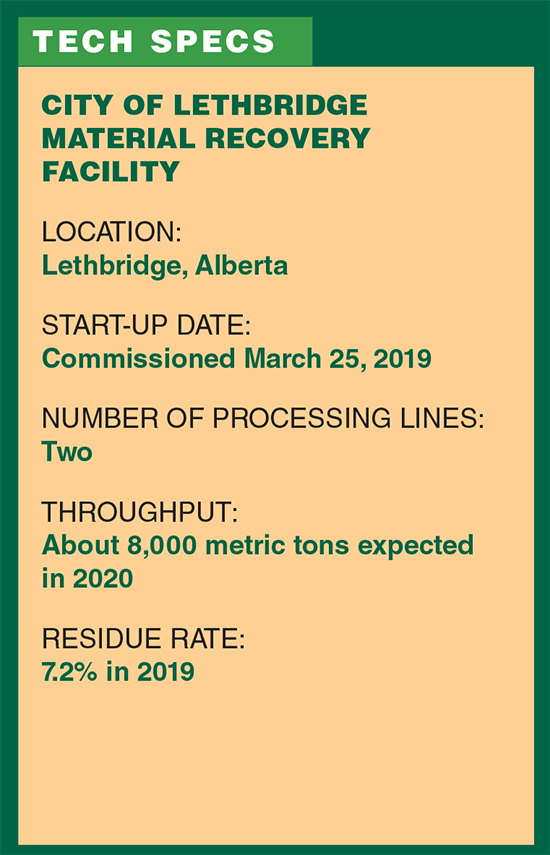
Facility Focus: City of Lethbridge Material Recovery Facility

byJared Paben
August 17, 2020
in Resource Recycling Magazine
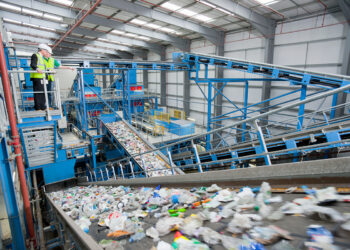
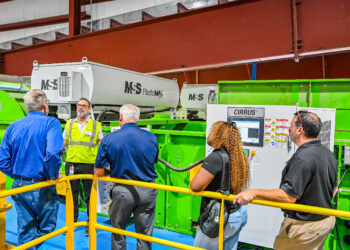
The Lethbridge MRF sorts and bales recyclables from 30,000 single-family houses and over 2,500 multi-family units.

A MRF in Canada’s Alberta province was built with future growth in mind.

Opened last year, the single-stream facility was designed to sort up to 8 metric tons per hour. The operation was built with the understanding it would initially use only about half of the capacity and handle more tons over time, said Mandi Parker, corporate sustainability manager for the city of Lethbridge.

Lethbridge has a population of around 93,000.

Lethbridge’s multi-family housing sector could help drive that future volume growth, in addition to growing commercial volumes and material from neighboring cities. The MRF sorts and bales recyclables from 30,000 single-family houses and over 2,500 multi-family units. But Lethbridge, which is located in southern Alberta, has another 4,000 apartment and condo units that aren’t yet served.

The 46,235-square-foot recycling facility sits close to Old Man River and was commissioned on March 25, 2019. A grand opening ceremony attended by local fourth- and fifth-grade students was held May 8. Less than a week later, the first curbside load arrived. The MRF’s opening coincided with the launch of the citywide curbside recycling collection program.

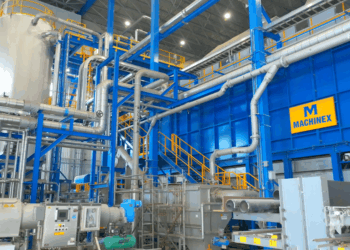
Nearly 90% of the city-owned facility’s square footage is devoted to equipment, most of which was supplied by Quebec-based recycling equipment company Machinex. The remainder includes the office, loading dock and service platform. The MRF cost about $7 million Canadian (around $5.2 million U.S.).

The main processing line is made up of over a dozen pieces of equipment, all supplied by Machinex except for the magnet and wire-tie system.

First, a back feeder drum feeds material into the system at a steady rate using a drum with teeth rotating over a flat pan steel belt. A chain roller conveyor then carries material to a climate-controlled presort area (daytime temperatures can stay near freezing in the winter and get up to 80 degrees Fahrenheit in the summer in Lethbridge).
After presort, material heads into a series of disc screens, including a MACH OCC separator, fines screen, and a Mach separator, which uses three adjustable decks to provide the primary 2D/3D separation. Then, the final separation between fiber and containers is done by a ballistic separator, which uses metal slats with openings mounted on eccentric bearings.

From there, a Steinert magnet removes ferrous metals and an eddy-current separator ejects aluminum. A blower system conveys the non-ferrous metals from the eddy current to the product bunker.

Commodities are baled in a two-ram, 75-horsepower hydraulic ram baler applying 5,000 pounds per square inch maximum pressure. An Accent Wire Tie machine is used to tie bales with metal bands. The baler produces bales measuring 5 feet by 4 feet by 2.5 feet.

For residue, the MRF uses two compactors to compress the fraction in 40-cubic-yard bins prior to disposal at a landfill. The facility’s residue rate was 7.2% in 2019.

In terms of fiber products, the main line produces bales of OCC, mixed paper, and sorted residential paper and news (SRPN). For plastics, it sorts into streams of HDPE color, HDPE natural, PET and mixed plastics Nos. 3-7.

The MRF also has a direct-to-bale line for OCC, SRPN and mixed paper, among other materials.

One of the facility’s main challenges is plastic bag contamination. Bags are removed in presort, but the MRF hasn’t found a viable market for the material, Parker said. “We are also getting lots of fiber with the inbound stream and some of this carries over to the container line, where it can make recovering some of the more valuable items challenging at higher throughput rates,” she said.

The City of Lethbridge Material Recovery Facility employs 18 staff on one shift Monday-Friday.

This article appeared in the July 2020 issue of Resource Recycling. Subscribe today for access to all print content.
Tags: MRFs
TweetShare
Jared Paben

Jared Paben

Related Posts

Greyparrot positions waste intel as key to effective EPR

Greyparrot positions waste intel as key to effective EPR

byAntoinette Smith
January 9, 2026

Company co-founder Rish Mitra says data collected from a growing number of MRFs globally can help fine-tune emerging EPR policy...

Softness in bale pricing adds to hauler headwinds

Softness in bale pricing adds to hauler headwinds

byStefanie Valentic
November 18, 2025

The nation's largest waste haulers delivered strong third-quarter earnings and expanded EBITDA margins despite lower recycled commodity values.

Weak bale pricing compounds hauler headwinds

Weak bale pricing compounds hauler headwinds

byStefanie Valentic
November 18, 2025

The nation's largest waste haulers delivered strong third-quarter earnings and expanded EBITDA margins despite lower recycled commodity values.

CurbWaste targets growth amid multi-million funding round

CurbWaste targets growth amid multi-million funding round

byPaul Lane
November 3, 2025

An eight-figure investment will help a New York City waste management software company take the next steps toward its founder’s...

New MRF guide aims to boost infrastructure

byStefanie Valentic
October 21, 2025

Closed Loop Partners’ Center for the Circular Economy and American Beverage have published a best practices guide for MRFs in...

Federal Recycling expands Denver operations

byStefanie Valentic
October 7, 2025

Federal Recycling & Waste has moved its Denver MRF to a new location, bolstering capacity and its ability to process...

Load More
Next Post

Data Corner: Shifts in export and domestic processing for scrap plastics

More Posts

Chinese processing group details goals for US visit

AMP lays out vision of next-generation, AI-driven MRFs

July 24, 2024
Malaysia clamps down on illegal e-waste imports amid probes

Malaysia clamps down on illegal e-waste imports amid probes

February 6, 2026
Bipartisan reps introduce bill on recycling claims

Bipartisan reps introduce bill on recycling claims

February 12, 2026
NERC: Blended average prices fell 40% in third quarter

HDPE, PP bales rise as paper fiber and cans stabilize

February 12, 2026

APR, industry create proactive guidance for PET caps

February 12, 2026
Oregon’s Recycling Modernization Act faces injunction

Court partially blocks Oregon EPR law, dismisses bulk of lawsuit

February 10, 2026
Republic Services waiting on fourth Polymer Center

Republic Services waiting on fourth Polymer Center

February 18, 2026
The electronics recycling industry is undergoing a transformation from labor-intensive manual operations to highly automated, AI-driven facilities that use advanced robotics, cleaner chemistry and digital tracking systems to extract critical materials.

The cyber-physical MRF: AI and robotics reshape e-waste recovery

February 12, 2026

Origin Materials to reduce staff in reorg

February 13, 2026
Textile clothing bins

Report details how to make CA textile recycling work

February 16, 2026
Load More

About & Publications

About Us

Staff

Archive

Magazine

Work With Us

Advertise
Jobs
Contact
Terms and Privacy

Newsletter

Get the latest recycling news and analysis delivered to your inbox every week. Stay ahead on industry trends, policy updates, and insights from programs, processors, and innovators.

Subscribe

Welcome Back!

Login to your account below

Forgotten Password?

Retrieve your password

Please enter your username or email address to reset your password.

Log In

Add New Playlist

No Result
View All Result
  • The Latest
  • Analysis
  • Recycling
  • E-Scrap
  • Plastics
  • Policy Now
  • Conferences
    • E-Scrap Conference
    • Plastics Recycling Conference
    • Resource Recycling Conference
    • Textiles Recovery Summit
  • Magazine
  • About Us
  • Advertise
  • Archive
  • Jobs
  • Staff
Subscribe
This website uses cookies. By continuing to use this website you are giving consent to cookies being used. Visit our Privacy and Cookie Policy.