





This article appeared in the May 2020 issue of Resource Recycling. Subscribe today for access to all print content.
What does it take to truly transform a specific material type from “recycling problem” to recycling-friendly? Building end markets for the material can help, of course. So can the development of new recycling technologies.
But, often, the key to making an item more compatible with recycling infrastructure is a substantial change in product design. That fact has been underlined in recent industry work around black plastic packaging.
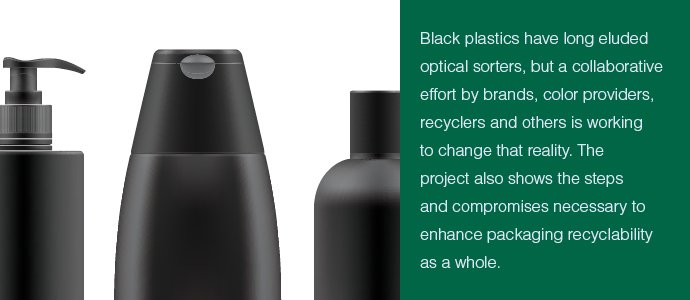
As near-infrared (NIR) optical sorters have become a bigger part of how materials recovery facilities (MRFs) separate plastics recovered in the municipal stream, black plastics have emerged as an issue. These items are usually colored in a way that makes the packaging undetectable to optical units.
And though black plastics make up a relatively small percentage of the plastics that move through MRFs, the recycling challenges associated with them have recently grabbed the attention of big brand owners, many of which have pledged to make all their plastic packaging recyclable in the coming years.
After coordinating with some of the large companies that supply color options for plastic resin and undergoing testing with equipment suppliers, brands have now reached a point where they can market black packaging that is in fact sortable by the NIR systems in place at MRFs today.
“We’re now doing cross-industry collaborating with other [brand owners] to set a standard for what a black plastic should be to be detectable everywhere,” said Melissa Craig, senior manager for packaging sustainability at consumer packaged goods giant Unilever. “It feels right; it’s where we should be. Everyone is working on the same thing but different, and that makes it a nice collaboration.”
Brand identity versus recycling pledges
It makes sense that Unilever would be in the middle of an initiative to improve the recyclability of black plastics.
The brand owner is a partner in the Ellen MacArthur Foundation’s New Plastics Economy, a global program that calls for packaging design changes and recovery infrastructure investments to dramatically boost the recycling of plastic packaging around the world. In line with that effort, Unilever in early 2017 committed to ensuring all of its plastic packaging will be fully reusable, recyclable or compostable by 2025.
But Unilever also has two major personal care lines that are very much defined by black packaging: Axe and TREsemmé. “Black-colored packaging is a part of the DNA for those brands,” Craig noted. “It would not be a simple color change.”
The dedication to black and the dedication to recyclability stood at odds because MRF plastic sortation systems are not well-aligned with the way black plastic packaging has traditionally been colored. Most black plastics on the market use a color formulation called carbon black, which offers a rich, dark hue. Sometimes this color is referred to as jet black.
However, while jet black packaging may stand out on shelves, it stymies the many recycling operations that use optical sortation based on NIR to efficiently separate different types of plastic resins coming down the conveyor belt.
“In an NIR unit, you shine light on a plastic part and infrared energy is reflected that is based on the polymer,” said John Standish, technical director for the Association of Plastic Recyclers (APR). “But when you use carbon black plastic, nothing is reflected. There’s no signal.”
The APR Design Guide for Plastics Recyclability, in fact, specifically notes that if an NIR unit cannot positively detect a black plastic part, that plastics material is rendered not recyclable.
Those facilities that do capture any black plastics currently must rely on manual sortation. At Minneapolis-area MRF Dem-Con Companies, for instance, black polypropylene and black PET items both regularly appear on the container line.
Bill Keegan, Dem-Con’s president, said the black PP holds particular value because it can be included in a typical PP bale made up of containers of all different colors (black PET, on the other hand, degrades the value of clear PET so the sortation incentive there is to keep black items out of the clear stream).
Currently, manual sorters stationed on Dem-Con’s container line are trained to distinguish black PP from other plastics and to pick that PP material. However, as with nearly every other element of MRF operations, a move toward automation for this kind of task could allow more material to be recovered in an increasingly cost-efficient manner.
“The advent of technology to recognize black plastics would be helpful in our facility,” Keegan said.
‘Like moving a mountain’
Knowing that operators like Dem-Con need help on the black plastics front, industry stakeholders began putting their heads together several years back.
Packaging companies and others essentially had two options if they wanted to make black items more recoverable via automation: push for equipment innovation that could somehow detect carbon black resin, or create black plastics in a way that would be detected by existing technology.
It quickly became clear that reformulating the pigment of the resin would be the easier option.
“While there are all kinds of experimental tech that could allow you to recycle a package that includes carbon black, it would be like moving a mountain trying to get all of these different and unrelated recycling facilities to use it,” said Alan Barcon, associate director of marketing and technology for PolyOne, a company that provides colorants and other services for polymer production.
To understand how brands approached the issue of creating NIR-friendly black plastics, it’s helpful to know the color-related steps that occur whenever a new packaging concept moves into implementation.
Typically, the packaging development department at a brand owner will work with the company’s marketing team to pinpoint the color characteristics they want to see in the product. A packaging engineer will then reach out to color companies, such as PolyOne or Ampacet, giving them the specifics on the resin to be used and asking them to bid on the project. Once a color provider has been selected, the masterbatch from the color company is mixed with the resin at the point of blow molding.
Therefore, once brands decided they wanted to move toward sort-friendly blacks, they needed to engage the color suppliers and ask for solutions.
Craig of Unilever said her company started taking that step, first in Europe, in 2018. “Did we do anything someone else could not have done?” Craig said. “No. But the upfront ask to color houses, saying, ‘This is what we want, what can you do?’ That to me is probably the bigger thing.”
The color companies began creating new formulations and then working alongside optical sorter manufacturers to determine what would work with the equipment that is currently in use at recycling facilities.
“The biggest challenge for us was to move beyond static scanning into dynamic material sorting environments,” said Wes Houghton, senior technical service engineer at Ampacet. “Since we’re not in the sorting or recycling business, we found skilled partners to help navigate that part of development.”
Another priority was developing color solutions that would also allow brands to maintain the general color feel they were accustomed to.
“We needed to explore different types of pigment chemistries and learn how to formulate with them,” said Barcon of PolyOne. “And because the exact technology didn’t exist, we had to work with numerous parts of the value chain to get to a solution, so we involved many of our suppliers.”
As is typically the case when innovative processes are just being developed, these new formulations have come at a cost that is higher than the average carbon black options.
For Unilever, at least, the recyclability component is worth it.
“We know that sustainability comes at a cost,” said Craig, “and we won’t achieve it if we don’t absorb that cost. We pay for it.”
Colors come to market
Now the polymer-services companies are starting to bring their NIR-friendly black colorants to the wider market.
Ampacet brands its solution REC-NIR Black, and it was launched in mid-2018. Last year, the product won the Product Technology Innovation award at the Plastic Recycling Show Europe.
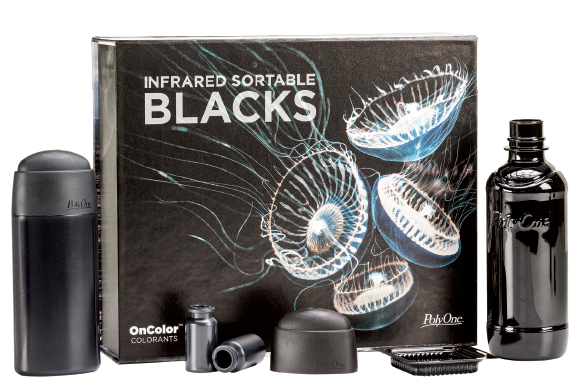
PolyOne, meanwhile, calls its offering OnColor Infrared Sortable Black. It was first made available in July 2019 and gives brands eight different shades of NIR-friendly dark colors from which to choose – the hues have names like iris bloom, obsidian and ultramarine.
“They’ve really given this some marketing panache and excitement,” said Standish of APR.
With black colorant solutions dialed in, the next step is setting up a system of standardization and verification so that end users will be able to easily choose sort-friendly options and communicate the recyclability of their products.
A working group has been established inside APR to develop protocols in line with the APR Design Guide that would essentially outline the the tests that need to be completed to prove a black plastic application is recyclable in today’s sortation environment. The aim is to create a situation in which a brand could obtain an APR-backed letter that certifies the recyclability of their packaging.
This could be used to satisfy a regulatory body or allow a brand to mark its packaging as “widely recyclable” through third-party frameworks like How2Recycle.
“My vision is we would get to the point where a color company could do experiments where they would certify that if you use X color with Y resin, you’ll get this specific color and performance property and we ascertained that using these specific tests,” said Standish. “One of those properties would be ‘this is sortable using NIR at standard settings.’ We are on the threshold of this.”
Such a verification system would also likely integrate guidance on the types of labeling, caps and other elements to be used in the product.
“If you put a green label on there that covers 80% of the bottle, that might make all the color work kind of pointless,” said Felix Hottenstein, sales director at MSS Optical Sorters, a company that has worked with stakeholders to test the recyclability of the newer black plastic colorants. “The final product needs to stay sortable.”
‘Requires some compromise’
While the recent work by brands and color companies has led to important breakthroughs, the industry has by no means solved the black plastic quagmire.
For one thing, because the new colorant solutions come at a cost premium, it’s only the handful of brands that have made recyclability pledges (and are fully committed to them) that are likely to adopt the technology.
“The others that say, ‘I just want black and it’s got to be cheaper,’ they will continue using carbon black,” said Standish. “Until there’s a value proposition for everyone to switch to these colorants, it’s going to be limited.”
There’s also the complication of integrating more sort-friendly colorants with another important plastic sustainability characteristic: the use of post-consumer resin (PCR).
The deep hue of carbon black can help cover up some visual impurities in resin and thus has worked well in conjunction with PCR. To use both PCR and NIR-compatible black coloring has presented obstacles.
But stakeholders say they’ve been able to work together to start to overcome those difficulties.
“PCR ranges in color and consistency so it requires some compromise on behalf of brand owners,” acknowledged Hougton of Ampacet. “Some of that compromise relates directly to color vibrancy that translates into higher inclusion rates. As a result, we’ve defined a high chromaticity color palette that delivers the best aesthetics and validated a portfolio of additives that counter yellowing and degradation.”
Noted Craig of Unilever: “I always say sustainability comes with compromise. We’ve seen better black colorant that is sortation friendly – it’s deeper and rich. But the expectation is not that we’ll have the same deep, rich color you see with carbon black.”
That sense of give-and-take is itself becoming an industry trend. And that’s not surprising, considering the plastics packaging environment stakeholders are currently attempting to navigate.
“We are definitely seeing more collaboration,” said Keegan of Dem-Con, the MRF operator. “Five years ago we had very little, if any, communication happening. But the consumer pressure on brand owners and visibility around the economic challenges of recycling are forcing things to change.”
Dan Leif is the managing editor of Resource Recycling and can be contacted at dan@resource-recycling.com.