








This article originally appeared in the August 2019 issue of Resource Recycling. Subscribe today for access to all print content.
With so much uncertainty around export markets for recyclables, it’s become clear the industry needs to open more pathways to end users in North America.
But how to do that? For starters, strengthening domestic markets will require bolstered relationships between the materials recovery facilities selling MRFs bales and the manufacturers on the other side who are looking for specific attributes in the incoming feedstock.
Brian Gaughan seems well-suited to make those MRF-to-market connections.
A 28-year industry veteran, Gaughan recently stepped into the role of vice president of business development at IntegriCo, a Louisiana manufacturer of composite rail ties and a consumer of mixed plastic bales from residential and commercial recycling programs (the company notes it uses 25 million to 35 million pounds of recovered plastic each year at its 145,000-square-foot facility).
At the same time, Gaughan has plenty of experience on the processor side.
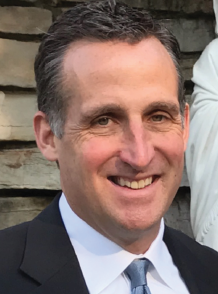
He was a founding partner of Greenstar North America, a company that operated 12 MRFs before being acquired by Waste Management in 2012. And immediately prior to joining IntegriCo, he was general manager of Georgia-Pacific’s plastic division, moving recovered polymers to market.
Resource Recycling recently spoke with Gaughan to get a better understanding of how IntegriCo is positioning itself in today’s tumultuous materials market and to get his thoughts on what needs to happen to strengthen U.S. recycling in a way that benefits the full range of stakeholders.
The following interview transcript has been edited for clarity.
Resource Recycling: What drew you to this job at IntegriCo?
Brian Gaughan: In my position at Georgia-Pacific (GP) we were supplying IntegriCo with raw material. In the course of doing that, I had the opportunity to visit the facility and get to know [IntegriCo CEO] Scott Mack. I started doing a decent amount of research on the business as a whole, looking at demand on the finished goods side, the demand for ties and related products, and I started to become very interested.
It sounds like you saw opportunity for growth.
Part of what I was interested in was taking recycled plastics and making a product. I’m a firm believer that that’s the most economically advantageous way to go about it. There’s an awful lot of people who take plastics and make pellets, and I’m not saying that’s a bad business – there’s a lot of people who have done well doing that. But my brain just kind of went to: You want to be the guy that takes raw material and makes a product.
At this point, what products are being manufactured by IntegriCo?
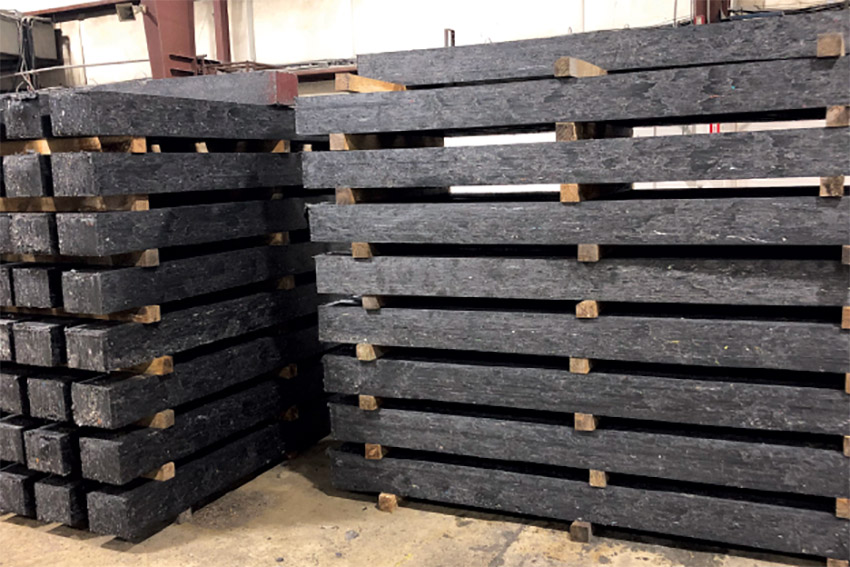
We make railroad ties, and we make construction matting. When you go to drill a well, that well needs containment around it to preserve the substrate but also to stabilize all the movement that happens around the rig; there are a lot of uneven surfaces. So what people do is put matting around the well and that’s what we are making. And there are countless other products you could make from that raw material that would be beneficial in some application, whether that’s a parking bumper or fence posts or other things. Fundamentally, when you’re making a tie or a mat, you’re taking material and getting it into a form you can mold. You can have a lot of different molds.
And what are the types of plastics you are taking in?
Really there are three principal things we bring in to make our finished product. One is mixed residential plastics (MRPs), the bulky pieces that single-stream plants are taking off the front end of their system and baling it up. Then you have plastics Nos. 3-7. Then we use some regrind material, a PE-based material we introduce into our system. When we process the 3-7s and MRPs, they go through a shredder and then granulator, and then to silos. Those silos are fed into our compounder unit that converts that into patties we use to press into our molds. The technology in the compounding space is patented, and I think it really represents the uniqueness of the overall operation. (Editor’s note: In a follow-up email, IntegriCo noted “compounding essentially transitions the recycled plastics into a moldable form via the heat generated solely by friction. It’s a very efficient process from the energy consumption standpoint.”)
Are you hearing from lots of MRFs that are anxious to move their 3-7 bales?
Quite a few facilities actually don’t make 3-7s any more; they make No. 5s now because the price you get paid for No. 5 is quite a bit higher than the price you get paid for 3-7. But I’ll make the economic argument that if you get paid a penny per pound for your 3-7s, it’s better than getting paid 10 cents a pound for your polypropylene because the PP percentage in a 3-7 is not very high. At one time, everyone was making 3-7s and those materials were abundant. That’s not so much the case anymore, so that presents a little bit of a challenge.
“The crazy thing about this business we’re in is that when prices are low, the quality demands are higher. And when the prices are higher, the quality demands are lower.”
What about the MRP side of things?
That is a material that’s out there, and we provide a very nice home for that for folks. So we feel fairly confident we can procure it at levels we need.
Some of the plastic types you take in used to go to Asia in large quantities. Have you all been able to get material at lower prices since there is presumably much more of it that needs a home?
Certainly, when China was aggressively buying, the price was quite a bit higher than it is today. That all being said, we have to provide an incentive for people to take the time to sort it and sell it to us. We always need to balance trying to bring in quality raw material at the lowest price we can while also being a good customer and trying to give people a solid incentive to produce products at the quality we need consistently. I’ve found in my 28 years in this business that win-win deals are sustainable, whereas if I’m getting a really good deal and the other side is getting a really bad deal, or vice versa, that generally doesn’t last.
When you look at the wider municipal recycling ecosystem right now, what are your thoughts? How do you see businesses getting through these challenging times?
With the price of fiber at the levels it’s at, that is very challenging for MRFs – $35 corrugated and zero dollar mixed paper is very challenging for those operators. When it’s all said and done, there’s a certain cost to operate a single-stream MRF, and I don’t think it’s fair to ask the MRF to subsidize the program. I can appreciate the municipalities that were one time getting paid when the blended raw material price was $150 [per ton]. It used to be there was a check coming every month and now they’re getting a bill, and I understand the challenges with that. But there’s a cost to that infrastructure that needs to be covered by the municipalities.
And I imagine it must be hard for facilities to invest in their own businesses when revenues are so tight.
It’s interesting, though. You actually do see a decent amount of investment by MRFs right now. If you look at statements from Waste Management and Republic, they are spending money on recycling, they are making investments and trying to get better. And that’s happening on the private side too. Those MRF operators are continuing to try to invest in technology, whether it’s robotics, or additional opticals, to continue to try to get more efficient and bring the cost down of operation. The crazy thing about this business we’re in is that when prices are low, the quality demands are higher. And when the prices are higher, the quality demands are lower. You’re at a very low point in the commodity price cycle, and you’re being asked to produce a higher-quality material than you’ve ever been asked to produce.
Let’s shift things back to IntegriCo. How would you characterize the company’s overall strategy for the next five years? I see the company has a goal of producing 1 million rail ties annually by 2020 and currently your output is around 100,000. What needs to happen to significantly lift output?
Well, we’re going to need additional facilities. In a lot of ways, you can look at the facility in Louisiana as a beta facility. It’s proving some things and dis-proving some things, and if we had a crack at doing it again, we’d design things slightly differently. We believe the market will certainly allow us to do that. It’s a function of trying to find the right location and dynamics on both the finished goods and the raw material side. IntegriCo has gained an awful lot of knowledge over the past five years, and so I think being able to go and build a second facility, we’d find a lot of efficiencies.
What will your strategy be in terms of finding new sources of raw material?
I was a MRF guy for a lot of years. I was always looking for stability. I always wanted to get paid the highest price, but it was just as important that the material was moving consistently and I was being paid consistently. And so we want to be that type of avenue for these MRFs. And we want to continue to innovate and see if there are other things out there that are challenged commodities that we could potentially make work for our facility.
Are you sourcing from across the nation, or are you more regionally focused?
I am focused on trying to exhaust every local source I can find because that is most advantageous to us in terms of freight. And then we will start to expand that footprint a little bit, to find the right raw materials we can buy consistently that meet our quality standards. So we can go further than surrounding states for sure. But it’s true freight has become very challenging, not just from a cost perspective but then just finding available drivers. At one time I could have pulled stuff off East Coast no problem, but now the transportation rates are two or three times where they were 18 months ago. So that’s not an option.
It sounds like you feel you’ll continue to both get the feedstock you need and find buyers of your end products.
I think we’re in a good space. The demand for the finished products looks very strong. And I hope our ability to take certain things that have not been all that easy to move traditionally makes us attractive to the generators of raw materials. We just want to continue to be innovative. We know if we stop innovating, someone will innovate past us, so we need to stay focused on that.
Dan Leif is the managing editor of Resource Recycling and can be contacted at [email protected].