











This article originally appeared in the May 2019 issue of Resource Recycling. Subscribe today for access to all print content.
Over most of the past couple of decades, the plastics packaging sector was able to assume the municipal recycling structure would evolve alongside it. Innovations in material use would hit the market, and though some of the new items caused troubles for materials recovery facilities and others, local programs were by and large amenable to expand their lists of accepted materials.
However, when China closed its doors to almost all post-consumer plastic imports at the start of 2018, the equation changed dramatically. Programs in some cases began limiting the plastic packaging they’d accept, and the American public was hit with countless mainstream news stories outlining the chaos in markets for recovered resins.
At the same time, documentaries, articles and calls from environmental groups have brought the issue of plastic marine debris into the collective consciousness in powerful new ways. In some cities and states, bans on single-use plastic items have resulted.

How is the wider plastics industry responding to all this? And in what ways are plastics stakeholders looking to re-engage with recycling and other division concepts to try to get a better handle on proper end-of-life management of their materials?
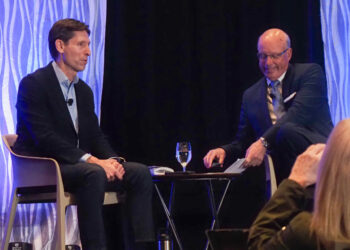
To get some answers, we talked with Haley Lowry, global sustainability director for packaging and specialty plastics at Dow. The following interview was edited for clarity and brevity.
Resource Recycling: Dow is a huge petrochemicals company. Can you briefly explain your touchpoints with plastics, packaging and recycling?
Haley Lowry: We sell plastic pellets or different types of materials that actually go into packaging applications, but we don’t make packaging. We are a materials science and data-driven company. We have a lot of technical research and R&D capabilities, and we’re trying to figure out how to design better products for recycling. That could be enhancing recycled content that is included, or it could be something like our compatibilizer portfolio. This allows you to compatibilize two different types of material to allow for better recyclability.
The conversation around marine debris and plastic pollution has really been elevated over the past couple of years. What is Dow’s strategy to address pollution concerns?
Our strategy is really threefold. One, we don’t believe that plastics in the environment are acceptable. We have to figure out ways to get plastic out of the environment. Then the second pillar is: How do we make plastics more circular? How do we make sure there’s a value associated with them, that they’re not just sitting on the ground? And the third one is really increasing our impact overall with more partnerships. We can’t do this alone; it’s a big issue to tackle globally. So it’s going to take all types of different players.
Can you offer some specific examples of how you’re trying to move forward in those areas?
When it comes to making sure there’s value, a big question is: How do we create end market demand for some of these materials? We have an example with our road technology. In Freeport, Texas [where Dow operates a manufacturing facility], we just launched a new road where we incorporated PCR [post-consumer resin] in the road. So it’s a certain amount of used plastic that can now be built into the road to make the road with higher performance. It’s an end application that can help drive demand. It’s about 2,600 feet of road and used 1,600 pounds of used plastic, equivalent to 120,000 plastic grocery bags. That’s awesome – to be able to say one small part of a road incorporated 120,000 plastic bags. In India, Indonesia and Thailand, we’ve built 40 kilometers of roads with used plastic material. It shows you can have a sustainable economic business model in developing countries as well.
Dow recently helped found the Alliance to End Plastic Waste, which includes nearly 40 companies that have collectively pledged $1.5 billion to address the issue. But we haven’t heard too many details on the plan to deploy that money.
The reason you haven’t heard too many specifics is that the CEO of the group hasn’t been put into place yet. That person is being hired, hopefully in the next few months. And the group will be run as a nonprofit – as a separate organization with governance and an entire body of how decisions are made and what projects will be invested in. Once a CEO is announced, we’ll see a lot more coming out of it. But really their pillars are focused on infrastructure, cleanup, innovation and education. I personally expect to see a lot of the investment first coming in areas like Southeast Asia.
Given the massive scope of the marine debris issue, is $1.5 billion enough to make significant impact?
It is a big challenge and a big problem and will take a lot of investments to actually go solve. But this is the first effort really across the entire private sector where companies are saying, “We want to solve this.” And there are other things going on, like Circulate Capital. That’s an investment of $100 million specifically for Southeast Asia to really advance the circular economy and recycling infrastructure. Six companies [including Dow] are founding partners of that. You could say, “Is $100 million enough?” And the answer is no. But we have to catalyze the investment such that it spurs on investment, and right now some of those investable opportunities are smaller – it’s a few million here and a few million there. So, going back to the larger discussion, it’s all an effort to make a first step.
Dow has also helped drive a materials collection effort in South Africa called Project Butterfly. Can you talk about that?
We’re a big partner with an NGO in South Africa called WildTrust. They developed a program where they have “wastepreneurs,” and it’s the coolest thing. They essentially pick people within a community who may be in a poverty situation and they say, “If you go out and collect this many bottles or this much film, we will pay you a certain amount.” And it’s not just them getting cash – they will give people a bank account. WildTrust goes and picks up the material from the collectors, and they convert that into school desks that are used in the local community. Also, they have just invested in a pyrolysis machine, so they can take material back to a fuel source. The project is making sure there’s a demand for the product and also has an emphasis on creating jobs.
Why is Dow focused on work in South Africa?
We have an office in Johannesburg and a big presence. Africa is really the next Asia – it’s where a lot of the growth will be coming from in terms of overall demand, so we wanted to look at how we could invest not only in the business we are operating but in the communities we are participating in.
Let’s bring things back to North America. In 2016, Dow helped launch the Hefty EnergyBag program, which targets wrappers, pouches and other plastics not accepted in most local recycling programs. Residents are asked to put those in a separate bag that is collected with recycling, and the bag is separated from the rest of the stream at the MRF. The material goes to waste-to-energy applications.
We have been successful in three different cities: Omaha, Boise and Atlanta. So we’ve already touched 100,000 households with 245 tons of waste being diverted from landfill. That’s equivalent to about 1,000 barrels of oil. We want to expand that to another 100,000 households this year. So we’re really trying to expand systems that already exist or that need to be created to get it back.
What accounts for the momentum in that program?
Really, the drivers have been the cities. The cities are saying: “We are tired of all this material going to landfill. We want options to be able to collect it and turn it back into value.” You often see cities putting out landfill reduction targets. Here’s a program you could actually implement today that will help you get there.
By earmarking that material for pyrolysis or other types of waste-to-energy, is there a danger that we may be short-circuiting efforts to develop actual mechanical recycling solutions?
Two things I would argue on that. One, you’ve got to collect it first. So putting a collection program in is not a bad thing, regardless of where the material goes. Now what end markets you choose to put it in – that can be evolved over time. Secondly, I personally believe you’re going to need waste-to-fuel as a viable option. You are going to need all of these options when we’re talking about trying to solve plastics ending up in the environment. The final goal is to make plastics completely circular, but I think we need all options. Putting collected material into road applications or brick applications or building products or to fuel – all are solutions we need to take into consideration.
Do you think the emerging collection of technologies sometimes called chemical recycling fits into that? A number of companies are trying to scale up systems that bring recovered plastics down to the monomer level or process material in other ways that can create feedstocks for new plastics.

We believe these technologies are absolutely going to be critical to a circular economy. That is one of the issues with plastics. They aren’t recycled and recovered as they could be. Part of that is collection and another part is you need to make sure you can utilize that material. If you can mechanically recycle things, that’s great. But if you can’t, what are your other alternatives? If you can make a new plastic material that is incorporating the waste but has the same properties as a virgin material and you can sell it into food applications, that is absolutely huge. That’s a game changer for our entire industry. It’s something we are looking heavily into and have a plan and approach for. We’re at an inflection point for the [plastics] industry to reinvent itself and figure out how you can participate in the recycling market.
That perspective is certainly indicative of actions we’ve seen from a number of virgin resin manufacturers – plastics giants are investing in recycling in many ways. I’m wondering, though, if there might be a tension in those businesses. Dow and other companies have been designed to cost-effectively bring prime plastics to the market, so are they really in the best position to prioritize recycled content and recycled resin technology?
I think it’s another opportunity for another product offering. If you’ve got an offering that’s got recycled content in it, the market needs all of these solutions. So I don’t look at it as a tension. Some of the questions out there are maybe performance-based, like, “Can we use the recycled content or PCR-type of material in all our different types of applications?” The answer today is no – you can’t from a quality standpoint. But could you tomorrow? This is what we pride ourselves on at Dow: material innovation and technology. So to be able to take some of those challenges and handle them through technology and innovation? That’s who we are.
Does that sense of innovation carry through to developing answers for ocean plastics?
I think of some of the technologies Dow has had like Recycle Ready, a technology we’ve had to simplify structures and make them more recyclable. That’s a platform we’ve had for several years and we’re just starting to see a lot more demand for it. … You’ve seen the brands launch all their goals. That has sent a ripple effect through the whole industry, saying, “We have the demand and we want these types of products.” To me, plastics ending up in the environment is an issue that is solvable. We know how to solve this. It’s going to take money and it’s going to take scale and it’s going to take further investment and resources, but it is a problem that’s solvable. That’s one of the most exciting things for me personally to work on – to be able to watch our entire value chain go through an inflection point where we say we can be part of the solution. So not only can you solve a social and environmental problem but also you can make money, you can have a product offering.
Those two things coming together is a really cool opportunity.
Dan Leif is the managing editor of Resource Recycling and can be contacted at [email protected].