This story originally appeared in the May 2016 issue of Resource Recycling.
Subscribe today for access to all print content.
After spending 25 year working to influence consumer recycling behavior on behalf of municipalities, haulers and recyclers, one thing has become crystal clear: Recycling is a brand. In fact, it’s probably one of the most well-known and supported brands in the U.S.
Are you furrowing your brow? Let’s back up and talk a little about branding.
Simple, memorable and motivates action
A brand is the way a company, issue or product is viewed by the public. Brands are built primarily through the everyday interactions that people have with them and secondarily through the communications people receive about the brand. Strong brands are simple and memorable – they invoke an emotional response from their target audiences, they motivate action and engagement, they are trusted and deliver value, and they are distinct from their competition.
Let’s look at each of these attributes through the lens of recycling. Recycling is a simple concept that people understand and remember and, in fact, almost every person in this country knows what recycling is.
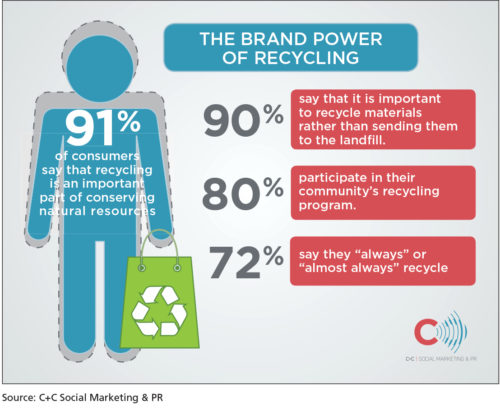
In addition, most people have a positive emotional response to recycling. They feel good when they participate in the process because recycling is tied to their emotional desire to do their part to protect the environment. In this way, recycling programs motivate action and offer a daily opportunity for people to engage with the recycling brand. According to a 2014 Cone Communications survey, 72 percent of Americans say they “always” or “almost always” recycle. Most brands have much less frequent interactions with their consumers.
Recycling also reaffirms how individuals see themselves. People want to save resources and do not want to be viewed as wasteful. They trust that recycling helps them achieve these aspirations. A recent SurveyUSA poll concluded 91percent of Americans felt recycling was an important way to conserve our natural resources.
Finally, recycling encounters almost no direct competition. The closest things to competition are other waste reduction efforts or other conservation efforts such as water and energy efficiency. Recycling is a specific activity that people understand, actively engage with and stand behind.
Not only is recycling a brand – it’s a really, really valuable one. By interpreting some of the statistics mentioned above, we could say that the recycling brand has recognition and trust levels exceeding 90 percent and engagement levels of more than 70 percent. Private sector brand with these kinds of numbers are valued in the billions of dollars – think of companies like Apple, Coca-Cola and Google.
This begs some questions: How was the recycling brand was built, who owns it and how should it be protected?
A collective asset
The recycling brand was built by the collective efforts of municipalities and the recycling industry working together over the past 40 years. While this may have not been all that deliberate or coordinated, the end result is a brand position that many a private company would envy.
The recycling brand and the status it has achieved are important for everyone working in the industry. Because consumers know what recycling is, value participating and trust that materials diversion is positive, it is easier to create, run and expand recycling programs. We all get to take advantage of the strong recycling brand value.
 In essence, this means the recycling brand is collectively owned by everyone that helps create and implement programs. And to continue to benefit from this brand value, recycling needs to be collectively managed and protected.
The biggest risks to the recycling brand today are consumer confusion and the introduction of “recycling doubt” into the consumer psyche. Consumer confusion is the product of many different factors. Due to the introduction of more and more materials in programs, constantly changing rules about what’s allowed, and the tendency to over-communicate in outreach, consumers are rightfully more confused than ever. According to the 2014 Cone Communications survey, about 26 percent of consumers put items they are unsure about in the recycling bin. This has driven up the contamination in U.S. recycling bins to more than 30 percent in many markets, causing lots of problems for the entire recycling chain.
The key to protecting the brand can be found through smart education.
We need to be aware that most people think they do a good job recycling. This means they are unlikely to pay close attention to any recycling message because in their minds, they are performing the correct actions. To get people to actually take in messages, the industry needs to first define the problem and point out that people’s actions are not consistent with their beliefs.
One example would be messaging that tells residents, “Did you know half of what is in our community’s garbage is actually recyclable?” This calls attention to the reality of what is happening at the curb.
Strength in simplification
We need to also focus on the simple recycling behaviors that matter. Most recycling education materials are so densely populated with information that only the most engaged environmentalist actually spends the time to decipher it all.
We should focus on what is most important – what materials do we really want in the bin and what contaminants do we really not want in the bin? Then outreach can be effectively employed to tell people just one thing at a time. C+C is working with Waste Management on the hauler’s “Recycle Often. Recycle Right.” campaign, which tries to keep a clear focus on getting top problem contaminates out and key recyclables in. [Editor’s note: C+C is the author’s firm].
We also need to resist the urge to constantly add materials and change the rules. Recycling habits stick. The person that learned 15 years ago that an envelope with a plastic window is not recyclable still believes that adamantly today. If you have to constantly re-educate about rule changes, you divert your resources away from the important messages and outreach that will increase diversion and decrease contamination.
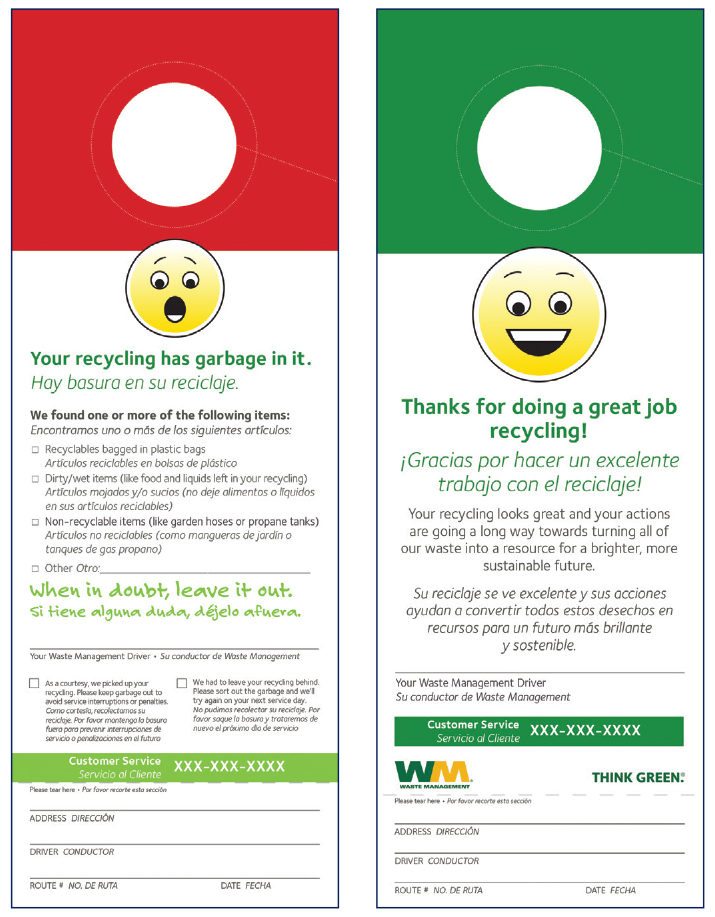
In addition, we need to educate as close as we can to the actual behavior whenever possible. One great method in this regard is the use of cart tags as a feedback mechanism to correct bad recycling behavior and reinforce good recycling behavior – yes, positive tags should be part of your mix. However, for this to work, the tags must be specific and accurate to what is seen in the cart.
There is a growing base of evidence that tagging influences behavior. A 2013 pilot project in Washington’s King County showed a 43 percent reduction in contamination in recycling carts after two months of positive and negative tagging.
Not to be lost amid the positive and negative reinforcements is the purpose for action in the first place. Most people recycle because they feel it is important to save natural resources and keep materials out of landfills. While many in the industry feel that these messages are old and overused, they are still what drives many residents to care about recycling and should not be abandoned for things like “zero waste” messages that most consumers do not completely understand.
Finally, it’s important to tailor outreach to include the changing demographics in this country – message, visuals and tools need to be adapted to reach multi-cultural audiences that may relate to recycling in ways influenced by residents’ culture, language or practices from their countries of origin. For specific tips in this area, see the article “Do you speak recycling?” in the March 2016 edition of this publication.
Continue the drumbeat
Now, what to do about the doubt that some members of the public have about the cost-effectiveness or overall value of materials recovery?
Brand trust is built over time. When trust is challenged or eroded in a brand, it can be 10 times harder to build it back up. Articles and messages that appear challenging the value of recycling or questioning whether materials are actually being recycled serve to erode the high levels of trust that have developed toward recycling.
As an industry, stakeholders need to work together to push back when doubt is introduced. One way to do this is to continue the drumbeat about the value that recycling provides in terms of resources saved and environmental protection. Again, though industry veterans may be sick of these messages, consumers are not, and they need ongoing positive reinforcement that their efforts to recycle are worth it and make a difference.
If the industry starts thinking about recycling as a valuable brand asset, the way decisions are made about recycling programs and education will change. If we all work to protect the brand, we will be able to continue to collectively benefit from the value the brand is providing to our communities, programs and businesses.
Julie Colehour is partner at C+C, a social marketing and public relations firm. She can be contacted at jcolehour@cplusc.com.