Resource Recycling
  • The Latest
  • Analysis
    • All
    • Certification Scorecard
    • Industry Announcements
    • Opinion
    Feds to develop repairable computer donation program

    The whitebox blind spot in PC recycling

    Analysis: circular design still elusive in laptops

    PC shipments grew in Q1, but questions remain

    The independent ITAD at a crossroads

    The independent ITAD at a crossroads

    Certification Scorecard — Week of April 20, 2026

    Apple Watch on product box.

    Wearables are coming and ITAD isn’t ready

    Certification Scorecard — Week of April 13, 2026

    EV Battery Pack - Sergii Chernov-Shutterstock

    Redwood, Rivian deal fuels US infrastructure plans

    Bloom ESG and e-Stewards roll out critical metals metric

    Colorado regulators suggest mid-range EPR scenario

    Why collaboration on plastic waste still matters

  • Conferences
  • Publications

    Other Topics

    Textiles
    Organics
    Packaging
    Glass
    Brand Owners

    Metals
    Technology
    Research
    Markets
    Grant Watch

    All Topics

Subscribe
No Result
View All Result
Resource Recycling
  • The Latest
  • Analysis
    • All
    • Certification Scorecard
    • Industry Announcements
    • Opinion
    Feds to develop repairable computer donation program

    The whitebox blind spot in PC recycling

    Analysis: circular design still elusive in laptops

    PC shipments grew in Q1, but questions remain

    The independent ITAD at a crossroads

    The independent ITAD at a crossroads

    Certification Scorecard — Week of April 20, 2026

    Apple Watch on product box.

    Wearables are coming and ITAD isn’t ready

    Certification Scorecard — Week of April 13, 2026

    EV Battery Pack - Sergii Chernov-Shutterstock

    Redwood, Rivian deal fuels US infrastructure plans

    Bloom ESG and e-Stewards roll out critical metals metric

    Colorado regulators suggest mid-range EPR scenario

    Why collaboration on plastic waste still matters

  • Conferences
  • Publications

    Other Topics

    Textiles
    Organics
    Packaging
    Glass
    Brand Owners

    Metals
    Technology
    Research
    Markets
    Grant Watch

    All Topics

Subscribe
No Result
View All Result
Resource Recycling
No Result
View All Result
Home Resource Recycling Magazine

EPA’s food waste mission

byMathy Stanislaus
February 13, 2016
in Resource Recycling Magazine

This story originally appeared in the January 2016 issue of Resource Recycling.

Subscribe today for access to all print content.

As you may have heard, EPA is helping lead the charge to meet America’s new wasted food goal: a 50 percent reduction in food loss and waste by 2030. This goal is recent, but EPA’s commitment to sustainable management of food is well-established, and we are hoping that by expanding and building on our current programs, we can make real progress.

EPA’s program for the sustainable management of food was developed out of our broader Sustainable Materials Management (SMM) work. SMM is a systematic approach to using and reusing materials more productively over their entire life cycles. It challenges organizations to really think about the materials they use or manufacture. Could something be made in a different, perhaps more efficient, way? Could a product, or previously perceived waste, be used for another purpose or reused once its intended use is complete?

As you can imagine, when you buy less, you waste less. Source reduction really goes to the heart of the way that organizations do business. Through efficient inventory and purchasing and by recording what is being used and what is ultimately going out as waste, organizations can save money on the front end through thoughtful procurement and at the back end in disposal costs. Source reduction should not require major changes in business practices but may influence significant changes in purchasing practices.

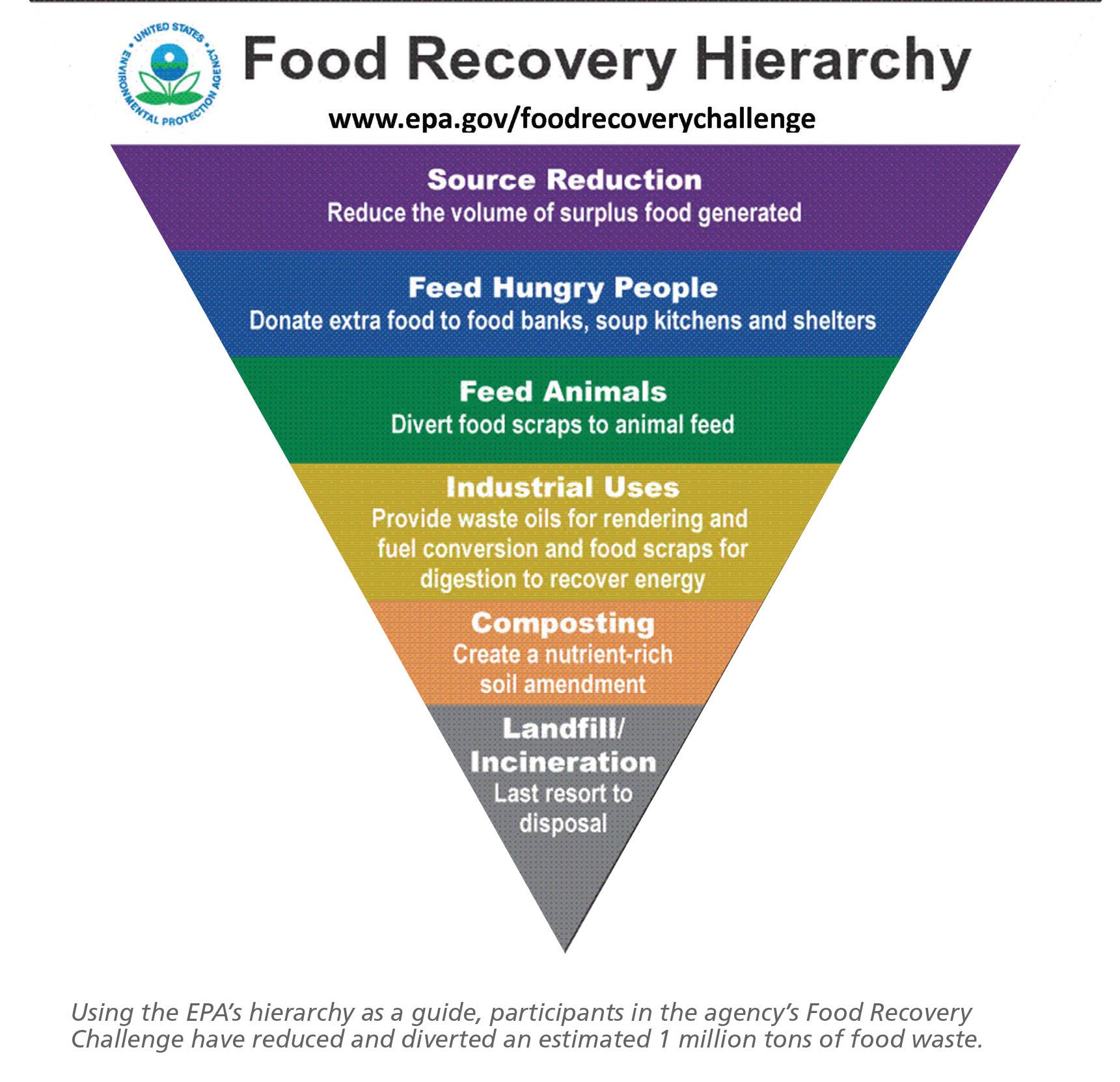
So at the core of our sustainable management of food initiative is the Food Recovery Hierarchy. The hierarchy illustrates sustainable management options for food, placing the highest value on producing less wasted food, progressing to using food for beneficial purposes (such as feeding people, feeding animals, producing energy or creating products to feed the soil), and finally – the least preferred option – disposing of what cannot be recovered. Organizations and consumers using the hierarchy ask themselves, “What leftover food can be put to use to avoid disposal?”

Too much to landfills

Wholesome, nutritious food that could be put to a higher use is too often sent to landfills. More food reaches American landfills and incinerators than any other single material in our everyday trash, accounting for 21 percent of the American waste stream. This wastes money, energy and landfill space.

In 2011, EPA launched the Food Recovery Challenge (FRC) to assist organizations in reducing wasted food. Organizations that join the challenge pledge to improve their management practices and report their results. Since the challenge began, FRC participants and endorsers (now totaling over 800) have reduced and diverted more than 1 million tons of wasted food. In 2014 alone, participants reduced 606,000 tons of wasted food. Increasing participation in the FRC, amplifying our message of reducing wasted food though partner actions and sharing best practices are all ways we are striving to reach our goal.

EPA has launched several tools for FRC participants to use, including a wasted food and packaging toolkit that teaches users to weigh out their kitchen preparation waste as well as their wasted prepared food. The Waste Reduction Model (WARM) allows users to see the greenhouse gas and energy benefits from source-reducing or composting their wasted food rather than landfilling it. Many other tools and pieces of technical assistance are available for organizations interested in measuring their baseline of wasted food and understanding where improvements can be made.

Additionally, in 2013, EPA and USDA jointly launched the U.S. Food Waste Challenge, encouraging all organizations and groups along the food supply chain from farmers to consumers to identify what they can do to reduce their wasted food. When the U.S. Food Waste Challenge was launched, USDA and EPA set a goal to have 3,000 participants by 2020. To date, we have over 4,000 participants, all of whom are doing great things to improve the wasted food problems.

Taking the lead locally

Many local communities are also leading the way with novel strategies to reduce waste while building communities. For example, MB Financial Park in Rosemont, Ill., one of the 2015 Food Recovery Challenge winners, developed the “Green for a Reason” program, in which 1,000 employees and
1.6 million visitors diverted more than
150 tons of organic materials.

The nationwide effort to address wasted food is truly gaining momentum. From Nov. 16-18, leaders from industry, nonprofit groups, trade associations, academia, charities and local, state, tribal and federal governments gathered to address the issue of wasted food and the 2030 goal with a spirit of conviction, commitment and innovation.

I kicked off that event, the 2015 Food Recovery Summit in Charleston, S.C., by challenging the 250 attendees to identify necessary changes within the food system needed to reach our national goal. Best practices identified at the Food Recovery Summit included businesses and other organizations donating excess wholesome food to food banks, shelters and soup kitchens; composting in urban settings; and using wasted food to produce electricity. The audience at the summit provided a great launch to our food efforts – but we challenged them to extend beyond their normal networks and amplify our message to create action.

Successes, like those outlined above, allowed the federal government to set the aggressive domestic goal of 50 percent reduction of food loss and waste by 2030. We continue to challenge ourselves and our public and private partners to reach this goal by making changes and commitments to reduce wasted food.

Currently, we are working on a roadmap of actions that EPA can take and measures that can be employed to meet this goal. With help from all involved in the food system, this goal can be met.


Mathy Stanislaus is assistant administrator for the Office of Land and Emergency Management at the U.S. Environmental Protection Agency.


Tags: Policy Now
TweetShare
Mathy Stanislaus

Mathy Stanislaus

Related Posts

Oregon’s battery EPR bill officially charged for implementation

byStefanie Valentic
April 10, 2026

Oregon Governor Tina Kotek signed HB 4144 into law on April 7, setting into motion the mechanics for an extended...

AF&PA states disappointment over Oregon EPR decision

byStefanie Valentic
April 8, 2026

The American Forest & Paper Association is responding after a federal judge blocked the trade group's bid to intervene in...

MRF equipment firm Machinex wins patent fight with rival

Judge blocks four groups from joining Oregon Recycling Act injunction

byStefanie Valentic
April 7, 2026

A judge has shut the door on four industry groups seeking to join NAW's Oregon EPR injunction and clarified who's...

UBC stakeholders report on recycling progress

Trump’s Section 232 tariff overhaul provides mixed results for recycling industry

byStefanie Valentic
April 7, 2026

A sweeping overhaul of the Section 232 steel and aluminum derivatives tariff program took effect April 6, slashing duty rates...

Oregon’s Recycling Modernization Act faces injunction

Why EPR’s biggest obstacle might not be legislation

byStefanie Valentic
April 6, 2026

A miscommunication around the Oregon injunction has some of the industry operating on bad information, and it's raising bigger questions...

Minnesota State Capitol

Minnesota watches Oregon as EPR implementation advances

byStefanie Valentic
April 6, 2026

Minnesota's Packaging Waste and Cost Reduction Act passed in 2024 and is still in early implementation, making the infrastructure decisions...

Load More
Next Post

The path toward progress

More Posts

Birch Plastics gets FDA green-light for post-industrial PP

LyondellBasell upgrade to PreZero assets on hold

April 23, 2026
The independent ITAD at a crossroads

The independent ITAD at a crossroads

April 22, 2026
Towfiqu ahamed barbhuiya

Before the Bin: Breaking down food date labeling

April 20, 2026
Industry group: Help us find the plastic bale volumes we need

PET bales sink further as other grades firm 

April 15, 2026
EPR fees are a market signal. Here’s what they’re telling you.

Oregon DEQ flags 250 producers for RMA noncompliance

April 21, 2026

Google pilots reuse kits to extend device life

April 21, 2026
EPR fees are a market signal. Here’s what they’re telling you.

EPR fees are a market signal. Here’s what they’re telling you.

April 10, 2026
Battery recycler Ascend Elements files for bankruptcy

Battery recycler Ascend Elements files for bankruptcy

April 13, 2026
Data erasure firm expands wearable device capabilities

Apple hits 30% recycled content, debuts new recovery tech

April 17, 2026

NERC launches hub to promote PCR demand 

April 15, 2026
Load More

About & Publications

About Us

Staff

Archive

Magazine

Work With Us

Advertise
Jobs
Contact
Terms and Privacy

Newsletter

Get the latest recycling news and analysis delivered to your inbox every week. Stay ahead on industry trends, policy updates, and insights from programs, processors, and innovators.

Subscribe

Welcome Back!

Login to your account below

Forgotten Password?

Retrieve your password

Please enter your username or email address to reset your password.

Log In

Add New Playlist

No Result
View All Result
  • The Latest
  • Analysis
  • Recycling
  • E-Scrap
  • Plastics
  • Policy Now
  • Conferences
    • E-Scrap Conference
    • Plastics Recycling Conference
    • Resource Recycling Conference
    • Textiles Recovery Summit
  • Magazine
  • About Us
  • Advertise
  • Archive
  • Jobs
  • Staff
Subscribe
This website uses cookies. By continuing to use this website you are giving consent to cookies being used. Visit our Privacy and Cookie Policy.