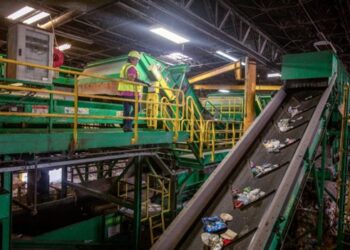




Recycling facilities and haulers that invested early in AI-driven optical sorters are pulling ahead of competitors running manual lines. The same divide is now opening across every industry, an AI strategist told attendees at WR Expo.
Chris Carr, founder and CEO of the Philadelphia-based consulting firm Dynamics AI, delivered the keynote on the state of AI adoption and what he called the widening divide between companies experimenting with the technology and those rebuilding their operations around it.
He said the gap between “substitutionary” AI use, or automating tasks that could already be done manually, just faster, and “transformational” AI use, which unlocks capabilities that didn’t previously exist, is growing at a rate most business leaders and companies underestimate.
“Anything past five [years], I think you’re kidding yourself,” Carr said of long-term planning in the current environment, saying that AI’s rate of improvement has outpaced prior technology shifts. He added that commercial internet took roughly 13 years to reach mainstream adoption. ChatGPT crossed that threshold in under two years.
AI literacy, not technical expertise, is the deciding factor in which companies close the gap.
Roughly 20% of a company’s workforce, and not necessarily its most technical employees, but its most systematic thinkers, typically ends up building the tools the rest of the organization uses, Carr indicated. He cautioned against spending resources trying to convert employees resistant to adopting the tools, recommending empowering that smaller group to build systems the wider staff can use.
There are three functions most AI-forward companies are building into daily operations:
– retrieval-augmented generation, which lets AI systems draw on a company’s own document history to flag relevant precedent in real time;
– natural language processing, which he demonstrated using a mocked-up field call-in system for daily job site reports, letting workers dictate updates rather than filling out forms; and computer vision; and
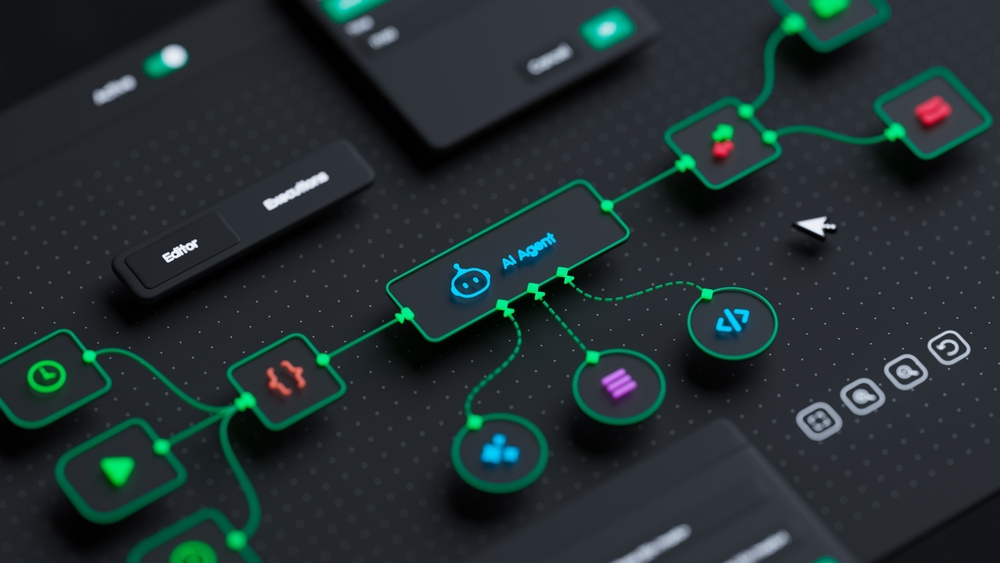
– “agentic AI,” or automated systems that complete tasks such as reviewing incoming contracts against a preset checklist, as the next phase beyond AI tools that simply draft or summarize text.
On the environmental footprint of AI data centers, Carr said the same companies building large-scale AI infrastructure are actively working on energy and water-use solutions, though he did not name specific commitments or timelines.
On implementation, Carr laid out three paths companies typically take: training one internal employee to teach the rest of staff, a model he said works only for small teams; hiring a dedicated AI staffer, which he estimated costs upward of $250,000 a year and typically supports 30 to a few hundred employees or bringing in an outside consultant.
He recommended building a running list of tasks across departments that could be automated, then having staff vote on which ideas to prioritize, an approach he said works best when coupled with incentives, such as extra vacation days, for employees who contribute strong ideas.
“It’s just not optional,” Carr said of AI adoption. “You’re either going to do it, you’re going to get on board or you’re going to be obsolete.”