







Right-to-repair rules are moving from fringe cause to market force, and electronics recyclers will feel the effects along the entire lifecycle, speakers told attendees at E-Scrap Conference 2025.
Consultant Chris Bross of Tierrabyte and iFixit sustainability director Liz Chamberlain outlined how fast-changing laws are reshaping design, service and end-of-life decisions.
“Basically, if you bought it, you own it and you should be able to repair it. Those are the tenets of right to repair,” Bross said. He added that the same laws enabling kitchen-table fixes are also starting to change conditions for refurbishers, ITAD firms and e-scrap operators.
Chamberlain traced the movement’s roots to a 2012 Massachusetts auto repair law that required carmakers to give independent garages access to the same parts, tools and documentation as dealers. That model inspired campaigners to push for similar access in electronics, farm machinery and other equipment with embedded software.
Since the first electronics bills appeared in 2014, state lawmakers have passed measures in California, Colorado, Connecticut, Maryland, Minnesota, Nevada, New York, Oregon, Texas and Washington. Chamberlain said that by population, “over a third of the country” now lives in a state with some kind of right-to-repair law, and that bills in Ohio and Pennsylvania could still move in current two-year sessions.
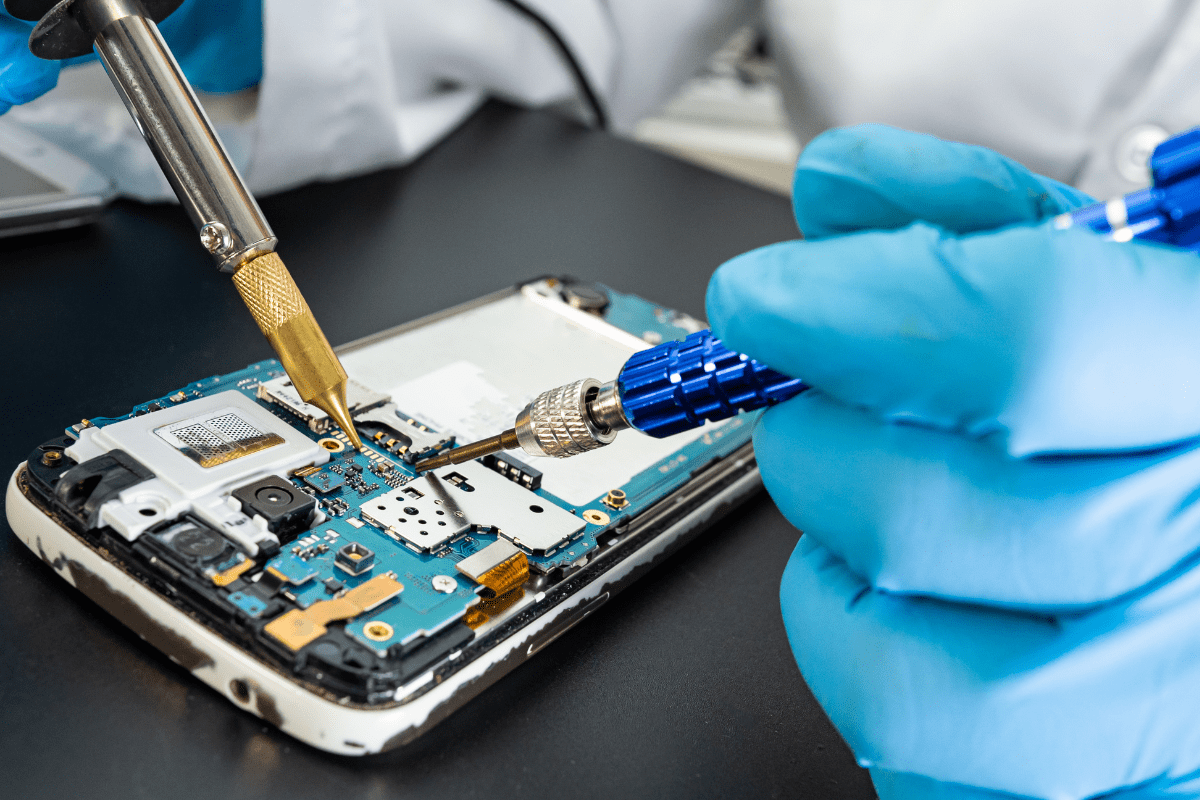
Despite differences among states, Bross said the statutes share three core requirements. Manufacturers must release repair documentation, sell spare parts to the public and make hardware and software tools available beyond their own authorized networks. That last piece reaches into factory-grade equipment that was never intended for a home garage.

Chamberlain said those rules have already pushed most major phone and laptop brands to launch parts programs and publish at least some manuals. Yet she noted that entire categories remain untouched, including many wearables, smart rings and smart glasses. Farm equipment is covered only in one Colorado law that John Deere is contesting in court, while video game consoles are excluded in most states and sit in a gray area under New York’s statute.
A major flashpoint is “parts pairing,” where tiny chips link components such as batteries and screens, to a specific logic board. Chamberlain showed how Apple’s iPhone evolved from pairing a single security component to pairing nearly every major part. Independent shops told iFixit that even with legal access to parts, they were still losing customers because warning messages and degraded features followed non-authorized repairs.
To explain the issue to policymakers, advocates briefed the New York Times, which produced a detailed feature on pairing and its effect on independent shops. That coverage helped them convince lawmakers in Oregon and Colorado to restrict the practice and require manufacturers that use cryptographic pairing to give consumers access to the same re-pairing software tools that authorized shops use.
Bross described how Apple’s Repair Assistant now lets owners complete a repair on some newer phones, even with harvested original parts, but he said the experience can still scare buyers. He recalled helping an 83-year-old neighbor set up a refurbished iPhone that threw multiple warnings about replaced components on first boot, prompting her to return the device and keep her older Samsung instead.
Not every large brand is resisting, the panelists said. Bross pointed to Google, which has worked with iFixit to make parts available globally for phones and the Pixel Watch and Chamberlain highlighted modular products such as the Fairphone and Framework laptop as design-for-repair examples.
Fairphone commissioned research from the Fraunhofer Institute that found the climate cost of making a replacement part can be paid back within days or weeks of extended use.
“If we as Americans kept our phones for one year longer, it would be the carbon equivalent of taking 636,000 cars off the road,” Chamberlain said.
Bross contrasted that potential with current recovery performance.
Depending on which numbers are used, “Approximately 18% of electronic waste is actually recycled, recycled with intent and some compliance,” he said. He added that Europe’s combination of collection mandates and design rules has pushed recycling rates over 50% for many products, creating “a lot of growth opportunity” for US systems.
The policy fight is not confined to statehouses, and Chamberlain pointed to renewed federal attention on the 1975 Magnuson-Moss Warranty Act, which already bars companies from voiding warranties simply because a product has been opened or serviced. The Federal Trade Commission has recently fined brands including Harley-Davidson and Weber for manuals that wrongly told customers opening a product would void warranty coverage.
Another federal barrier is Section 1201 of the Digital Millennium Copyright Act, which restricts bypassing technological protection measures. Chamberlain noted that advocates have won temporary exemptions that allow owners to bypass protections on some devices, such as farm tractors and even McDonald’s ice cream machines, but the law still blocks sharing tools or publishing details of successful hacks.
Advocates are also tracking proposals tied to the annual defense spending bill that would require repairable equipment for the US military, along with national efforts focused on automotive and agricultural gear.
Looking ahead, Chamberlain said iFixit wants US buyers to see a repairability score at the point of sale, similar to new European Union energy labels that include A-to-E repair grades. The group is also turning more attention to medical devices, where hospital technicians report long waits for vendor service on life-critical machines, and to software support timelines that can instantly obsolete hardware, as seen in the end of Windows 10 support.
Bross told recyclers and ITAD professionals that the laws now on the books are only a starting point but already change the terrain for everyone in the room. “These laws are really here to support people who are at this show and this industry,” he said, urging companies to track both new obligations and new repair opportunities as the movement matures.