About 25 minutes’ drive south of downtown Columbus on a light-industrial stretch of Frebis Avenue lies an unassuming 6,000 square-foot warehouse with a simple sign above the door that says “Marble Plastics.”
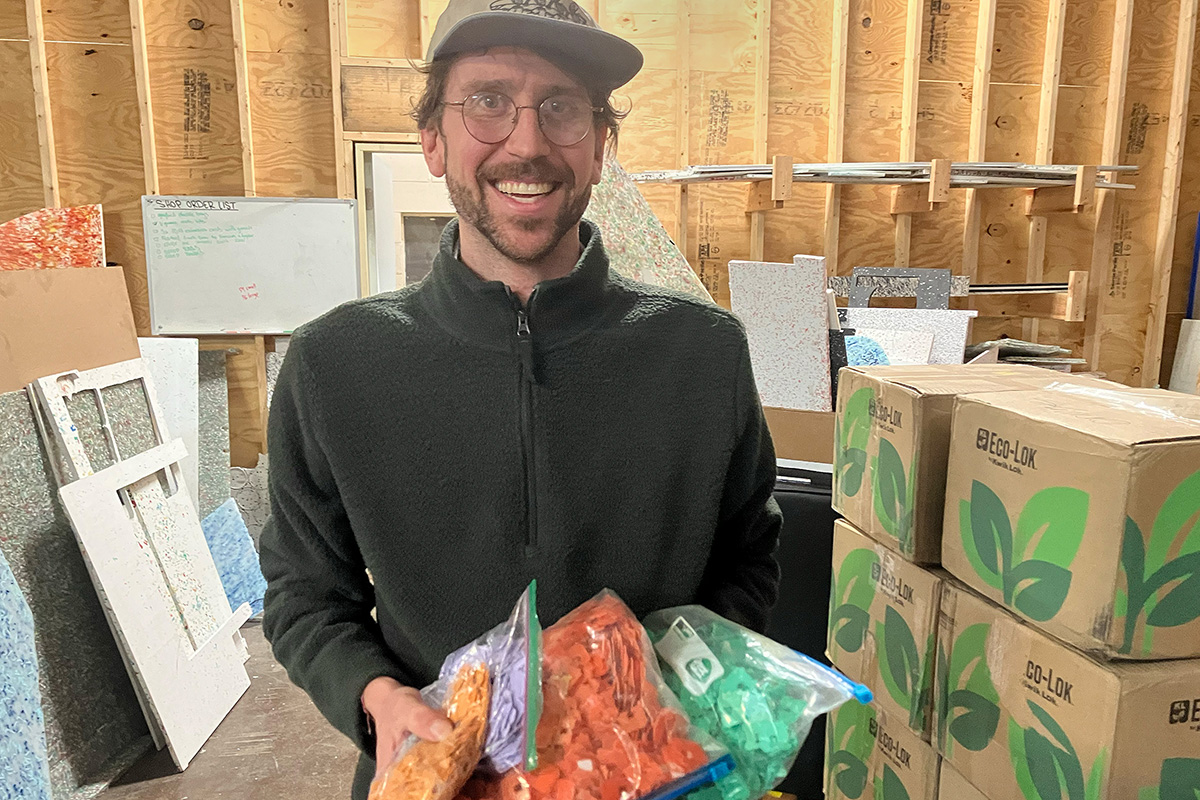
Here, tucked among other small workshops and neighboring discount retailers, materials mastermind Joseph Klatt and his team of six are turning hard-to-recycle plastics into durable, high-quality products used for construction, furniture and design.
Marble Plastics began, as many good ideas do, from frustration and an unanswered question: Why were small, high-quality plastics slipping through the recycling system untouched? During his early career at the Ohio Environmental Protection Agency, Klatt spent his days connecting companies with potential reuse opportunities for their waste. He often found materials with clear value but no viable match. “I would see a waste stream that I knew was valuable,” he said, “but I just couldn’t make a match.” Those moments pushed him toward a different path. “I wanted to be on the side of actually doing the recycling part myself,” he added.
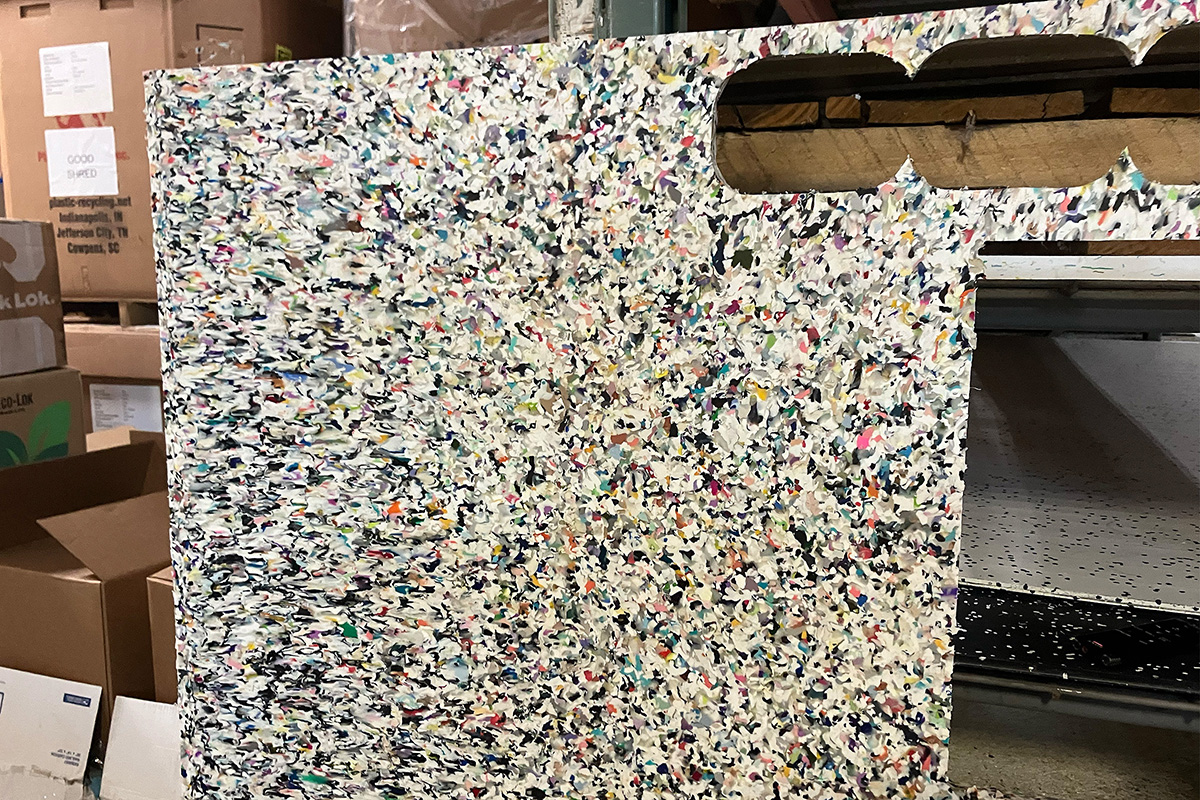
That shift led Klatt to Precious Plastic, an open-source recycling initiative in the Netherlands, and what was meant to be a three-month volunteer stint became almost five years. There, he helped design and refine small-scale recycling machinery, traveling to install equipment and train communities around the world. The project’s signature aesthetic – thick, terrazzo-like sheets made from visible fragments of recycled polymer – began gaining traction in Europe’s design and architecture sectors. Klatt watched it grow and realized “nobody was doing this in the US.”
He returned to Ohio in 2022 with a plan: take the technology he helped build abroad, pair it with the overlooked waste streams he was already familiar with and prove it could work commercially. Starting in a friend’s garage, he began experimenting with bread tags, Solo cups, refrigerator drawers, 3D-printing scraps and other small-format plastics. And early prototypes ultimately convinced him the idea was viable.
From waste to workable sheets
The production area next to the main workshop is where Klatt has adapted the open-source machinery he once helped build into a repeatable, industrial-scale system. He describes the space as a hybrid of the principles he learned through Precious Plastic and the engineering refinements required for commercial manufacturing.
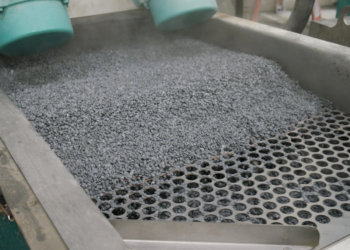
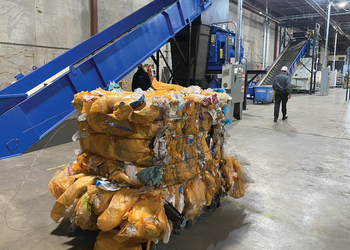
Incoming material including bread tags, plastic utensils and injection-molding scraps is hand-sorted to remove contaminants that would weaken the final product, Klatt says. As he put it, “Our mission is to reduce the environmental impact of plastic waste and create beautiful, functional materials that help designers and brands bring their visions to life.” Once the feedstock is shredded, it is funneled into custom-built heating and compression units that Klatt and his team engineered specifically for consistent, higher-volume output.
The processing system is designed at a scale suited for the production of high-quality items. Klatt credits his staff for making that possible. “I’m lucky to have such a hands-on, inventive team that isn’t afraid to experiment, fail and try again until we get to something great,” he said.
Sheets are pressed into half-inch to one-inch panels using heavy steel molds, then cooled under controlled conditions to prevent warping or stress. Once trimmed and sanded, they are dense, workable and suitable for countertops, shelving, tabletops and architectural surfaces built for long-term use.
Where the material meets the market
Marble Plastics’ customer base has grown well beyond early experiments in Klatt’s friend’s garage. “We consider 2024 our first real year to market,” he said, “and since then we’ve grown more than 200%.”
Much of that momentum has come from clients in commercial and hospitality design who are looking for recycled materials that still feel premium. “Our traction has been overwhelmingly in commercial and hospitality spaces – retail environments, fixtures, counters and architectural applications.”
Rather than cold-calling architects, Klatt says the demand has been organic. “We thought we’d have to educate the market, but instead the market is finding us.”
Those projects now span a wide range of aesthetics, scales and waste streams. In Brooklyn, the fashion and art collective KidSuper commissioned 14 modular benches for its new headquarters café, each one built from refrigerators, TVs and hospital waste. At the Ohio State Wexner Medical Center, Marble Plastics created custom outdoor benches using plastic collected directly from the hospital, producing a subtle pattern that nods to the university’s colors.
The company’s material has also served as the backbone for public art, including large exhibition panels for Kleis’s Celestia installation in Toronto, and it has shown up in hospitality settings like the Holey Moley mini-golf restaurant in Santa Monica, where the entire dining area features tables made from the company’s swirling gelato pattern.
High-end furniture designers are taking notice, too. At a New York design fair last year, Australian designer Ash Fischer exhibited the Camada Daybed, a retro-futuristic piece crafted entirely from Marble Plastics sheets. Klatt says the appeal is not just the look, but the experience.
“Sustainability resonates more deeply when it’s something you can touch,” he said, adding that architects appreciate that specifying a recycled material no longer requires compromising on beauty. “I’m really not a sales guy. The material sells itself.”
Forging a circular future, sheet by sheet
As Marble Plastics grows, Klatt has begun fielding inquiries from companies far outside the small community of early adopters. He says he’s currently in talks with a global sportswear manufacturer, and he’s also set to appear on a national network’s flagship morning program in the near future. For a business that started in a friend’s garage sorting bread tags, the attention is both unexpected and affirming.
Some of that momentum comes from new material streams that speak directly to consumer experience. One example is the company’s work with Pact Collective, a nonprofit founded by major cosmetics brands to address packaging waste in the beauty industry. Klatt receives the washed, ground plastic from items like makeup compacts, shampoo bottles and other cosmetic containers, and transforms them into finished products that go back to participating brands. It is a neat loop, both symbolic and practical, and one that reflects the company’s broader philosophy that recycled plastic should remain useful, tactile and valued.
For Klatt, that tactile connection is the whole point. He believes material can change how people think about waste, not through lectures or slogans but through something as simple as a countertop, a bench or a café table made from objects that would’ve otherwise been thrown away.
Marble Plastics may be small, but its ambition is anything but. As Klatt and his team continue refining their process, project by project and sheet by sheet, they are quietly reshaping what a circular future for plastic might look like and who gets to build it.