





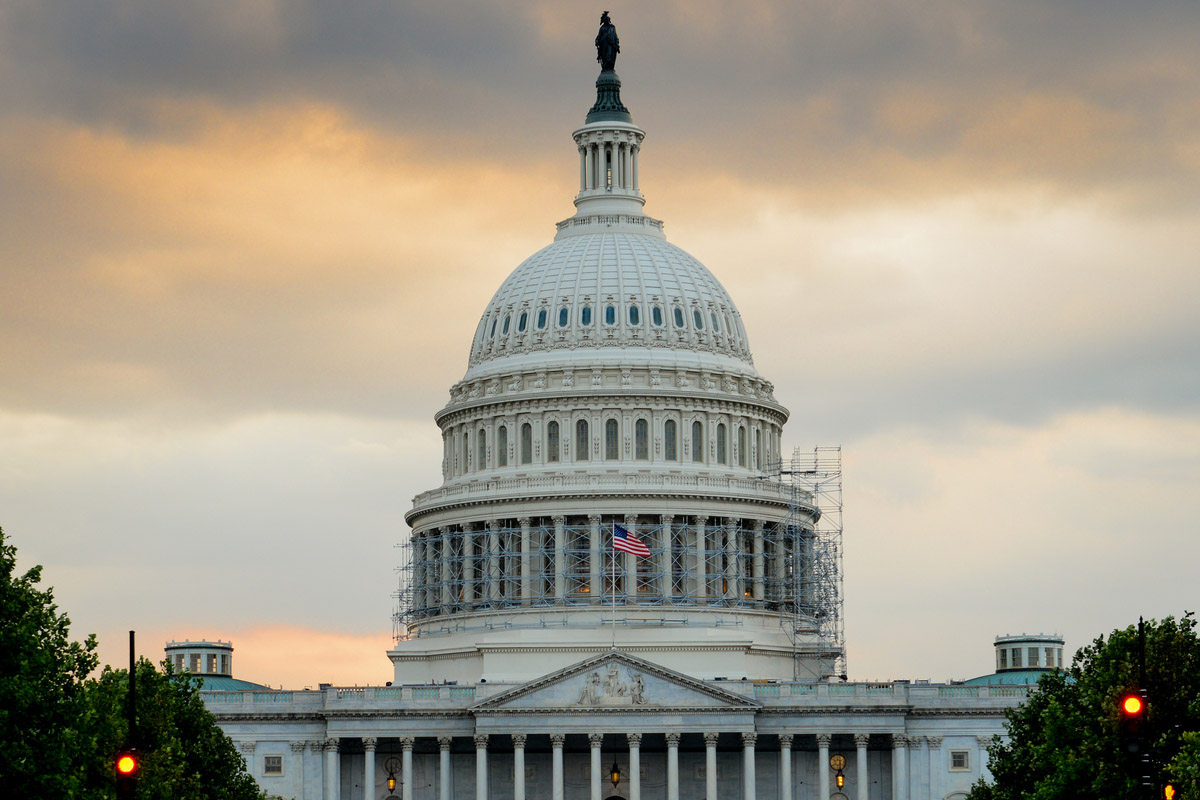
The clear ballot-box victory of Republicans across the branches of U.S. government could affect the municipal recycling world in a number of ways. It’s early, but some signs from the past – and some recent analysis from industry observers – offer a glimpse of what’s to come.
In the Nov. 5 general election, President-elect Donald Trump received 312 electoral votes to Kamala Harris’s 226; Republicans won control of the U.S. Senate with 53 seats to Democrats’ 47; and Republicans have secured 217 House seats to Democrats’ 208 as of this writing. The trifecta gives the party broad ability to enact its policies.
For recycling stakeholders, some of the impacts will be general: Tariffs, tax cuts and other economic policies would undoubtedly filter down to affect the recycling sector, as with virtually every other industry. Those policies could be similar to those proposed and enacted during Trump’s prior administration from 2017-2021.
For instance, Trump has suggested a 60% tariff on all goods imported from China and a 10-20% tariff on goods imported from elsewhere. That policy hearkens back to the Trump administration’s previous trade war with China, which filtered down to the U.S. recycling industry in the form of increased costs for machinery components and basic facility needs like baling wire, on top of the tariffs’ impact on the broader economy.
President Biden later kept and expanded some of those tariffs, but not on the level of the measures Trump has proposed. Industry groups such as the Recycled Materials Association have already shared analysis suggesting the new tariffs Trump has described would “negatively impact the U.S. economy.”
Meanwhile, the tax cuts of 2017 were lauded at the time by industry groups representing recycling interests, and among new tax proposals, the Trump administration is expected to extend the cuts, some of which were set to end at the end of 2025.
Familiar slew of potential EPA impacts
Recycling policy is largely set at the state and local level, and programs are mostly overseen by municipal governments. But the federal government does plenty of work collecting data and facilitating conversations to advance materials recovery.
Those efforts are always subject to change when there are leadership transitions in Washington. The early efforts of the prior Trump administration to significantly reduce the EPA’s budget offer clues about what could be coming down the line.
Back in early 2017, the Trump administration proposed cutting EPA’s budget by 31%, prompting fears among recycling stakeholders that the agency’s longstanding Sustainable Materials Management work could grind to a halt. Recycling lobbyists sought to defend the programs, noting both their economic and environmental benefits. And in the end, after working its way through the U.S. House and Senate – both of which were also Republican-controlled – the budget was revised to remove many of the drastic cuts.
When Congress finally passed a fiscal year 2018 budget, the agency received $8.8 billion, far higher than the $5.6 billion the administration initially requested that year.
The same pattern played out multiple times during the Trump years, with EPA’s budget growing steadily. In fiscal year 2019, it was kept at $8.8 billion; in fiscal year 2020, it was $9 billion; and in fiscal year 2021, it was $9.2 billion.
That’s not to say there weren’t impacts. In fiscal 2018, the workforce was cut from 15,408 down to 14,172, according to EPA figures. And the workforce stayed mostly the same the rest of the Trump years.
One longtime recycling industry stakeholder told Resource Recycling that the state-level emphasis could become even more pronounced amid the new political environment.
“Should residential recycling not be a priority at the federal level, one way it can prosper is for states to grab the bull by the horn and legislate it through mandates such as EPR or container deposit laws,” said Myles Cohen, founder of Circular Ventures and previously president of Pratt Recycling.
EPA pick highlighted for ‘deregulatory decisions’
Trump this week also announced he plans to nominate former Rep. Lee Zeldin of New York as EPA administrator. Zeldin served in the House of Representatives from 2015 through 2023 and has been an outspoken Trump ally over the years.
“Lee, with a very strong legal background, has been a true fighter for America First policies,” Trump wrote in a statement on social media, noting that Zeldin “will ensure fair and swift deregulatory decisions that will be enacted in a way to unleash the power of American businesses, while at the same time maintaining the highest environmental standards, including the cleanest air and water on the planet.”
Trump added that Zeldin “will set new standards on environmental review and maintenance, that will allow the United States to grow in a healthy and well-structured way.”
In a statement, Zeldin said he intends to “restore U.S. energy dominance, revitalize our auto industry to bring back American jobs, and make the U.S. the global leader in AI.”
Zeldin has cast votes favorable to the League of Conservation Voters 14% of the time, according to that organization, indicating relatively low support for pro-environment measures. A couple of exceptions were the votes he cast to increase regulation on PFAS, sometimes referred to as “forever chemicals.”
Zeldin voted in favor of the PFAS Action Act of 2021, which later died in the Senate but would have set requirements and established incentives to limit use of such chemicals in a variety of products.
The Environmental Protection Network, a group of 650 former EPA career staff and appointees that was founded in 2017 during the early months of the first Trump administration, said in a statement it was concerned about Zeldin’s appointment.
“There is a lot we don’t yet know about Lee Zeldin, but here is what we do know: First, Donald Trump tried to cripple EPA in the past, and we expect him to try again,” the group wrote. “Second, Zeldin has a long and alarming history of casting votes in Congress intended to weaken EPA. Finally, Trump has tasked Zeldin with rolling back dozens of clean air and water safeguards. If they succeed, those rollbacks would leave millions of people breathing unhealthy air and drinking unsafe water.”
EPN added it would be “watching closely as Trump and Zeldin reveal their plans for the agency.”
International waste and plastics treaties could be tabled
Recycling stakeholders should anticipate the U.S. pulling back from involvement in global regulatory efforts, according to law firm Beveridge & Diamond.
“Prepare for the withdrawal of engagement on international environmental and waste treaties, as the Trump administration prioritizes domestic development, tariffs (and potential restrictions on imported goods), and increased exports of domestic natural resources, including oil and LNG,” the firm recently wrote. “This includes the United States’ withdrawal from the Paris Agreement and implications to ongoing international conversations around global emissions reductions and the regulation of plastics.”
While the analysis didn’t mention the treaty by name, the implications would likely extend to the Basel Convention, which regulates the movement of hazardous waste materials around the world, and in recent years has expanded to cover shipments of mixed scrap plastic. The convention will expand its regulation of end-of-life electronics beginning next year.
The U.S. remains one of the only non-party countries to the Basel Convention, and that fact has increasingly shut U.S. companies out of the global trade of recycled materials. Non-party countries are prohibited from trading materials that are regulated under the convention with party countries.
With the 2021 plastics amendment and upcoming 2025 e-scrap changes further affecting the U.S. recycling industry, there has been renewed talk among industry stakeholders about the possibility of U.S. Basel Convention ratification. For instance, during the recent Electronics Sustainability Summit, an EPA director said the U.S. EPA is “committed” to “exploring” Basel Convention ratification. She stopped short of a more concrete position.
The Beveridge & Diamond analysis suggests those conversations will likely be tabled, returning ratification to a pipe dream for some U.S. traders who see growing advantages to becoming a party country.
Additionally, the analysis hints at the U.N.’s in-development global treaty on plastics. Countries are meeting later this month in Busan, South Korea, and the U.S. is actively engaged in these discussions.
Notably, the U.S. this year pivoted on key controversial components on the draft treaty. The country’s leadership in August reportedly reversed its stance on plastics production limits, indicating it will support inclusion of these efforts in the global treaty. The abrupt shift from previous U.S. opposition to such measures garnered a strong reaction from the plastics industry and cautious optimism from environmental groups.
Under a Trump administration, which is expected to be more favorable to industry interests, that stance could shift. Although the plastics treaty negotiations are supposed to conclude by the end of 2024, they could continue into 2025, and any voting would likely take place next year.
Meanwhile, back in the U.S., one industry association says the federal shift could affect the landscape of voluntary industry commitments as well. In a statement, the U.S. Plastics Pact said its work to achieve recycling targets occurs “independent of shifting federal policies.” But the group noted “critical gaps remain at the federal level that limit our ability to fully achieve these targets, regardless of the administration in power.”
The Pact added it doesn’t anticipate building up federal plastics recycling policies will be a priority for the next administration, but it emphasized that “plastics recycling is a bipartisan issue, and we remain committed to advancing the conversation within the supply chain.”
“Today, there is still no federally established national recycling rate for plastics — an essential benchmark for measuring progress,” the Pact stated. “Furthermore, the policies and resources needed to drive systemic recycling improvements remain underdeveloped, impacting our Roadmap targets.”