











Resource Recycling
  • The Latest
  • Analysis
    • All
    • Certification Scorecard
    • Industry Announcements
    • Opinion
    EPR fees are a market signal. Here’s what they’re telling you.

    EPR fees are a market signal. Here’s what they’re telling you.

    Wolframite ore, the primary ore of tungsten from Altai, Russia

    Tungsten scrap export controls draw industry attention

    Certification Scorecard — Week of April 6, 2026

    Closed Loop Partners acquires Sutter Metals, connecting electronics disposition to metals recovery

    Certification Scorecard — Week of March 30, 2026

    Industry announcements for January 2026

    Industry announcements for April 2026

    Certification scorecard – Week of March 23, 2026

    Certification Scorecard – Week of March 16, 2026

    Groups identify recovered plastics users in the Northeast

    Bale pricing for recycled plastics diverges

  • Conferences
  • Publications

    Other Topics

    Textiles
    Organics
    Packaging
    Glass
    Brand Owners

    Metals
    Technology
    Research
    Markets
    Grant Watch

    All Topics

Subscribe
No Result
View All Result
Resource Recycling
  • The Latest
  • Analysis
    • All
    • Certification Scorecard
    • Industry Announcements
    • Opinion
    EPR fees are a market signal. Here’s what they’re telling you.

    EPR fees are a market signal. Here’s what they’re telling you.

    Wolframite ore, the primary ore of tungsten from Altai, Russia

    Tungsten scrap export controls draw industry attention

    Certification Scorecard — Week of April 6, 2026

    Closed Loop Partners acquires Sutter Metals, connecting electronics disposition to metals recovery

    Certification Scorecard — Week of March 30, 2026

    Industry announcements for January 2026

    Industry announcements for April 2026

    Certification scorecard – Week of March 23, 2026

    Certification Scorecard – Week of March 16, 2026

    Groups identify recovered plastics users in the Northeast

    Bale pricing for recycled plastics diverges

  • Conferences
  • Publications

    Other Topics

    Textiles
    Organics
    Packaging
    Glass
    Brand Owners

    Metals
    Technology
    Research
    Markets
    Grant Watch

    All Topics

Subscribe
No Result
View All Result
Resource Recycling
No Result
View All Result
Home Recycling

AMP rebrands with a focus on supplying entire facilities

Colin StaubbyColin Staub
February 13, 2024
in Recycling
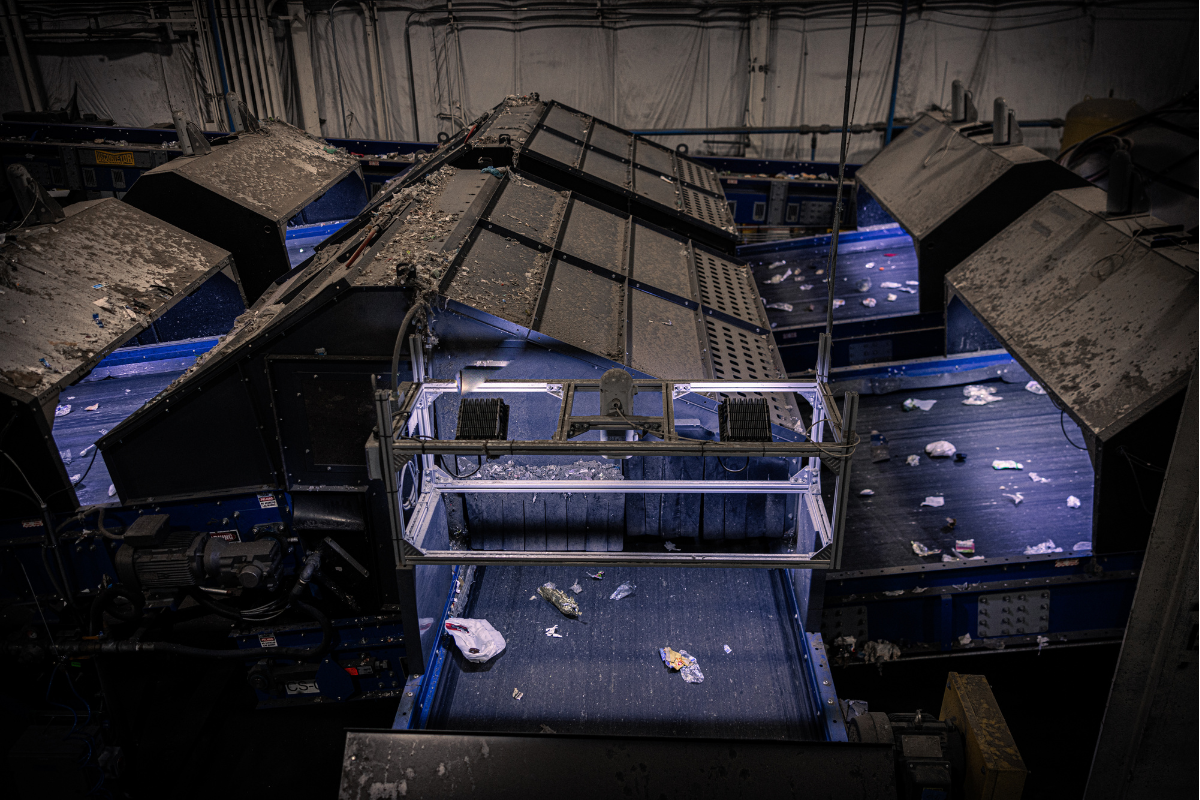
An AMP One fully automated AI sorting system operating at the company’s Cleveland, Ohio secondary sortation facility. | Courtesy of AMP

After 10 years helping materials recovery facilities retrofit with innovative robotics equipment, AMP Robotics has dropped the latter part of its name, reflecting an emerging focus on building recycling centers from scratch with AI-equipped sorting systems.

Based in Louisville, Colorado, AMP has expanded over the past decade from its roots as a fledgling tech startup piloting equipment in a local MRF to a major equipment supplier with units in facilities throughout North America. The company’s artificial intelligence (AI) and robotic sorting equipment is capable of processing all manner of municipal recyclables – including most plastic resins, fiber grades and metals – as well as e-scrap and even municipal solid waste (MSW).

As the company has neared the 10-year mark in the business of developing and supplying recycling industry equipment, it has begun a new focus on supplying facilities with a complete sorting system. It’s an evolution from installing one or two units on a sorting line, and it drove the company to remove “Robotics” from its name. A new website, AMPSortation.com, also reflects the focus on delivering full sortation systems.

“The story of the company has been this continual expansion of scope of AI in the industry and what’s possible,” said Matanya Horowitz, founder and CEO of AMP, in an interview. “But the transition to system levels, we think, is a bit of a seminal moment for the company.” 

The rebrand comes shortly after a round of layoffs at AMP late last year. Horowitz said the job cuts were unfortunate and were a response to broad macroeconomic trends that the company has to plan for, which guide its forecasts on purchasing and fundraising patterns. He noted the layoffs weren’t directly connected to the rebrand.

Entering new industry sectors

AMP began in late 2013 as a small operation, consisting of a workbench in Horowitz’s garage. “It was me buying stuff from Home Depot, smashing it up and putting it beneath the camera,” he recalls.

It steadily expanded from there, aided by multiple rounds of grant funding that enabled a small team of a half-dozen employees and a slightly larger workshop. By 2016, the company launched a pilot project installing one of its early robotic arms at a Denver-area MRF, Alpine Waste & Recycling. The project focused on carton recovery, with the AMP Cortex robotic arm plucking cartons off a sorting line and AMP learning about how to fine-tune the process.

“As I saw it, the first and most obvious opportunity was to help the industry with this problem of manual sorting in MRFs,” Horowitz said. 

In the years that followed, AMP’s units were installed in numerous MRFs across North America, not only improving sortation but also enabling facilities to collect new data and analyze changes in the inbound stream.

By 2021, AMP itself entered the sortation sector, starting up multiple secondary-sortation facilities around the country. These centers began bringing in bales of mixed plastics and residual materials from MRFs and other suppliers, sorting them using the company’s AI and growing suite of sorting equipment, and producing plastics and fiber grades for sale into end markets. 

Integrating AI from the onset

Also in the last few years, the company began to follow two emerging tracks that have led to the rebrand: First, AMP leaders began to explore the possibility of building MRFs from the ground up, with artificial intelligence incorporated from the very beginning at the design phase; and second, AMP continued expanding the types of sorting equipment it produces.

Beyond the company’s robotic arms, it has branched out into its own version of optical sorters (the Jet and MicroJet), which use visioning technology combined with AI to identify, and dozens of air nozzles to direct, recyclables on the sort line. AMP also produces a belt-mounted vacuum sortation system targeted for removing thin plastic film from sort lines.

The interest in supplying entire facilities, mixed with the expanded equipment offering, led to AMP One, which the company bills as “the first zero-manual-sortation MRF.” It’s a modular facility capable of achieving anywhere from 15,000 to 100,000 tons per year of throughput, using entirely automated equipment. The system “autonomously transforms single-stream, municipal solid waste, MRF residue, mixed plastics and other infeeds into valuable bales,” the company states on its website. AMP says its MRFs can be ready in less than nine months from order date.

“Building AI in at the facility level really is a transformative step,” Horowitz said, adding that it opened up new conversations with customers: “We were talking to folks in a really different way than we were talking to them about just one or two robots in a MRF.”

The idea of entirely automated, tailor-scaled, AI-driven MRFs also opens new doors: For example, it might make a rural MRF feasible where it was previously too expensive or logistically challenging, Horowitz said. 

Because the company was having different conversations, and talking with a wider range of customers beyond MRF operators doing retrofits, AMP officially rebranded on Feb. 1. Horowitz expanded on the name change in a post on AMP’s website.

For his part, Horowitz says the shift to supplying sorting systems on a facility level is fulfilling an early vision he had for AMP.

“This is kind of what I really wanted to be doing when I started the company 10 years ago,” he said. “Really move the economics of recycling, so that recycling access can be expanded, so that places where recycling centers didn’t make sense before, now make sense. It’s kind of like, ‘We’ve got all the tools we needed. We’re starting to make the sort of change we were hoping for.'”

A version of this story appeared in Plastics Recycling Update on Feb. 7.
TweetShare
Colin Staub

Colin Staub

Colin Staub was a reporter and associate editor at Resource Recycling until August 2025.

Related Posts

WM opens new $60m MRF in Indy

byAntoinette Smith
April 10, 2026

The newest recycling facility has annual capacity of 200,000 tons and will send all mixed paper to Pratt Industries for...

Oregon’s battery EPR bill officially charged for implementation

byStefanie Valentic
April 10, 2026

Oregon Governor Tina Kotek signed HB 4144 into law on April 7, setting into motion the mechanics for an extended...

EPR fees are a market signal. Here’s what they’re telling you.

EPR fees are a market signal. Here’s what they’re telling you.

byChristine Yeager
April 10, 2026

EPR is not asking companies to be perfect, but rather to be honest about what their packaging costs the system,...

German demo plant targets lithium recovery from battery scrap

byScott Snowden
April 10, 2026

Tozero has opened a demo plant processing 1,500 metric tons of battery scrap yearly, recovering lithium, graphite and nickel-cobalt to...

Bill to update New Jersey e-scrap program heads to governor

New Jersey recyclers talk EPR

byBrian Clark Howard
April 9, 2026

At the Association of New Jersey Recyclers’ spring meeting industry representatives discussed the state and future of the sector.

Wolframite ore, the primary ore of tungsten from Altai, Russia

Tungsten scrap export controls draw industry attention

byDavid Daoud
April 9, 2026

Businesses that rely on tungsten are urging the U.S. Department of Commerce to consider export controls on tungsten scrap.

Load More
Next Post

Textile recycling is at a pivotal moment, experts say

More Posts

Wineries help create model for film recycling

Wineries help create model for film recycling

April 7, 2026
With RPET in crisis, focus turns to solutions

With RPET in crisis, focus turns to solutions

April 2, 2026
End markets, policy key to RPET viability

End markets, policy key to RPET viability

April 8, 2026

Trafigura signs $1.1b deal for recycled battery metals

April 8, 2026
PCA closing Richmond plant

PCA closing Richmond plant

April 2, 2026
Oregon’s Recycling Modernization Act faces injunction

Why EPR’s biggest obstacle might not be legislation

April 6, 2026
EPR fees are a market signal. Here’s what they’re telling you.

EPR fees are a market signal. Here’s what they’re telling you.

April 10, 2026
Wolframite ore, the primary ore of tungsten from Altai, Russia

Tungsten scrap export controls draw industry attention

April 9, 2026

Apparel retailer organization challenges SB 707 textile PRO selection

April 2, 2026

Independents complement primary PRO in state EPR

April 6, 2026
Load More

About & Publications

About Us

Staff

Archive

Magazine

Work With Us

Advertise
Jobs
Contact
Terms and Privacy

Newsletter

Get the latest recycling news and analysis delivered to your inbox every week. Stay ahead on industry trends, policy updates, and insights from programs, processors, and innovators.

Subscribe

Welcome Back!

Login to your account below

Forgotten Password?

Retrieve your password

Please enter your username or email address to reset your password.

Log In

Add New Playlist

No Result
View All Result
  • The Latest
  • Analysis
  • Recycling
  • E-Scrap
  • Plastics
  • Policy Now
  • Conferences
    • E-Scrap Conference
    • Plastics Recycling Conference
    • Resource Recycling Conference
    • Textiles Recovery Summit
  • Magazine
  • About Us
  • Advertise
  • Archive
  • Jobs
  • Staff
Subscribe
This website uses cookies. By continuing to use this website you are giving consent to cookies being used. Visit our Privacy and Cookie Policy.