Resource Recycling
  • The Latest
  • Analysis
    • All
    • Certification Scorecard
    • Industry Announcements
    • Opinion
    MP Materials breaks ground on rare earth magnet campus in North Texas

    How critical mineral alliances aim to shape the future of e-scrap metals

    Certification Scorecard — Week of May 18, 2026

    Aurubis: Thefts involved scrap sample manipulation

    Metals and electronics recyclers report growth

    Plastic packaging

    Why SB 54 source reduction planning is becoming the industry’s most challenging EPR test

    Recycler cites market pressure in short-term closure

    AI, data anxiety push enterprises to destroy working devices: report

    Before the Bin: America’s textile waste problem starts in your closet

  • Conferences
    • Resource Recycling Conference
    • Plastics Recycling Conference
    • E-Scrap: The Longevity Conference
    • Textiles Recovery Summit
  • Publications
    • E-Scrap News
    • Plastics Recycling Update
    • Policy Now
    • Resource Recycling
    • Other Topics
      • Brand Owners
      • Critical Minerals
      • Glass
      • Grant Watch
      • Markets
      • Organics
      • Packaging
      • Research
      • Technology
      • Textiles
      • All Topics
Subscribe
No Result
View All Result
Resource Recycling
  • The Latest
  • Analysis
    • All
    • Certification Scorecard
    • Industry Announcements
    • Opinion
    MP Materials breaks ground on rare earth magnet campus in North Texas

    How critical mineral alliances aim to shape the future of e-scrap metals

    Certification Scorecard — Week of May 18, 2026

    Aurubis: Thefts involved scrap sample manipulation

    Metals and electronics recyclers report growth

    Plastic packaging

    Why SB 54 source reduction planning is becoming the industry’s most challenging EPR test

    Recycler cites market pressure in short-term closure

    AI, data anxiety push enterprises to destroy working devices: report

    Before the Bin: America’s textile waste problem starts in your closet

  • Conferences
    • Resource Recycling Conference
    • Plastics Recycling Conference
    • E-Scrap: The Longevity Conference
    • Textiles Recovery Summit
  • Publications
    • E-Scrap News
    • Plastics Recycling Update
    • Policy Now
    • Resource Recycling
    • Other Topics
      • Brand Owners
      • Critical Minerals
      • Glass
      • Grant Watch
      • Markets
      • Organics
      • Packaging
      • Research
      • Technology
      • Textiles
      • All Topics
Subscribe
No Result
View All Result
Resource Recycling
No Result
View All Result
Home Recycling

Insight from voices at the center of environmental justice

Dan LeifbyDan Leif
June 20, 2023
in Recycling
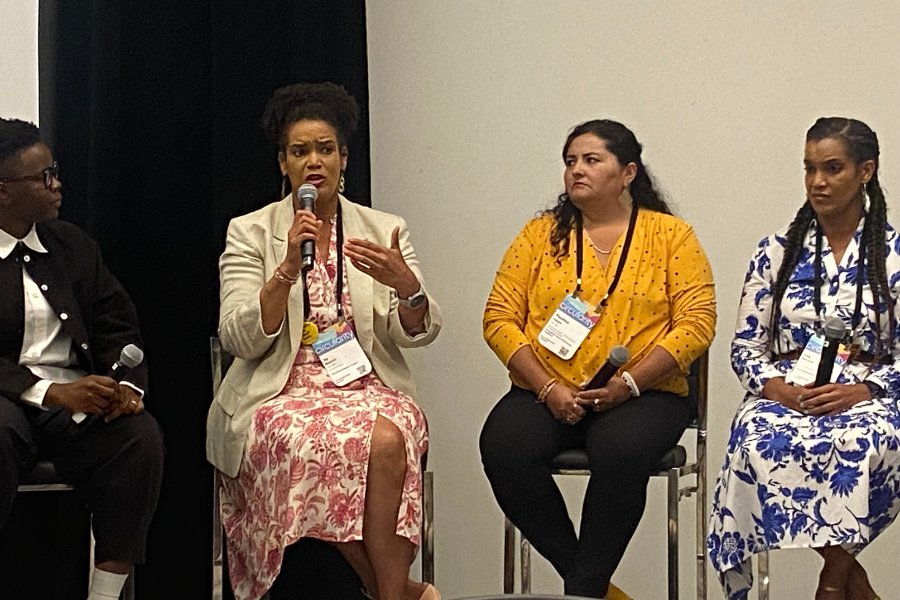
Speakers on the “Frontline Communities” panel included (from left) Sandra Gonza, Jo Banner, Paulina Lopez and Joy Banner. | Dan Leif/Resource Recycling

As companies across the sector try to navigate concerns around environmental justice, leaders of activist groups have some advice: Stop and listen to the local community first.

The initial step in the conversation may just be getting a handle on whether locals want an operation in their vicinity at all.

“The first thing is you need to do is ask – because we might not want you,” Jo Banner, founder and director of Louisiana-based nonprofit The Descendants Project, said during a panel at the Circularity conference in Seattle earlier this month. “’No’ may be the answer, and you should accept that instead of trying to play the politics and removing agency from the community.”

Jo Banner and her sister Joy were two panelists on the June 6 Circularity discussion “Shining a Light on Frontline Communities,” which gave community organizers an opportunity to speak directly to companies across the materials value chain. 

Operators in waste and recycling (and many other industries) are trying to walk an increasingly complicated line on environmental justice. Regulators at all levels of government, including the U.S. EPA, have in recent years put a greater emphasis on ensuring that industrial enterprises take steps to minimize health and environmental impacts on lower-income and traditionally marginalized populations. 

This has come alongside the growing environmental, social, governance (ESG) trend in the corporate sphere, where companies are attempting to mitigate negative impacts on people and the planet, often by way of public-facing targets and reporting.

But what panelists at the “Frontline Communities” session made very clear was that real movement on environmental justice is often a slow process, with affected populations sometimes having very little trust in the companies pledging to do better.

“We’re expected to sit at the table with our traumatizers,” Jo Banner said. “It may require slowing down a lot taking time to build that trust. This is just about all the companies that have come in and lied.”

The view from ‘Cancer Alley’

The Descendants Project is dedicated to supporting communities of slave descendants along the Mississippi River in Louisiana. The organization has raised alarms about health concerns tied to petrochemical production in areas of the Gulf Coast, an area they and other groups have dubbed “Cancer Alley.”

The Banner sisters expressed frustration at the way large companies have assumed economically disadvantaged communities would welcome industrial projects offering jobs and other financial resources. 

“You being there is contingent upon the community agreeing to have you there,” Joy Banner said. “If they don’t agree to that, it’s time to move on.”

Paulina Lopez, executive director of the Duwamish River Community Coalition in the Seattle area, said she expects companies wanting to establish operations in her area to build local partnerships based on “the three H’s”: help, heal and be human.

If those principles are not met, she noted, no amount of economic benefit is going to bring support from an organization like hers.

“I don’t want your jobs where I am breathing lead and arsenic,” she said. “We want people to go work for responsible companies.”

Sandra Gonza, a consultant who has experience working with East African communities that receive shipments of used textiles, added that even if a community is open to a project, companies should be ready for hard dialogue.

She recommended entering into an “exploratory phase,” a period in which local groups, government officials and company leaders should all be prepared to discuss the full range of impacts and concerns.

“Don’t just talk about positives, also discuss potential negatives,” said Gonza. “Have an honest dialogue.”

Disappointment at global plastic talks

The Banner sisters of The Descendants Project traveled to the Seattle conference straight from Paris, where they had participated in the second meeting of the Intergovernmental Negotiating Committee on Plastic Pollution.

That UN-backed initiative has in many ways exemplified the complexities surrounding environmental justice in the wider sustainability conversation, especially in relation to plastics.

Jo Banner said that the emphasis of the INC is on marine debris, and in her view the realities of plastic production have not been talked about enough.

“Environmental justice is not in the same conversation – it’s disappointing,” she said. “It was also disappointing to see how many nations are collaborating to shut us down. We have seen this agreement among nations to just not give us the floor.”

As the environmental justice conversation continues, it’s clear stakeholders will need to find a balance among conflicting priorities.

Lopez of the Duwamish River Community Coalition has hope that businesses can continue to evolve, lifting community members at the same time.

“I don’t want industries to close their doors,” she said. “I want them to be good neighbors – being ethical and doing the right thing for the community to thrive.”


Tags: PlasticsPolicy Now
TweetShare
Dan Leif

Dan Leif

Dan Leif is the managing editor at Resource Recycling, Inc., which publishes Resource Recycling, Plastics Recycling Update and E-Scrap News. He has been with the company since 2013 and has edited different trade publications since 2006. He can be contacted at [email protected].

Related Posts

EPR rules take shape in Oregon, as first test

Oregon OKs end-market verification from CAA

byStefanie Valentic
May 20, 2026

The state's Department of Environmental Quality has given the stamp of approval on CAA's Responsible End Markets program plan amendment.

Lawsuits hover days after SB 54 approval

Lawsuits hover days after SB 54 approval

byStefanie Valentic
May 6, 2026

NRDC and Californians Against Waste are suing CalRecycle over finalized EPR regulations they say unlawfully allow chemical recycling and other...

CAA seeks comment on REM recycling standard

byStefanie Valentic
May 6, 2026

Circular Action Alliance is now accepting public comment for its draft Responsible End Markets certification standard.

Lithium-ion battery recycler to build New York facility

Why battery EPR doesn’t have a packaging problem

byStefanie Valentic
May 4, 2026

While packaging EPR fights injunctions, battery EPR has achieved a mostly harmonized legal framework across nearly every state that has...

Electronics are the fire risk battery EPR keeps missing

Electronics are the fire risk battery EPR keeps missing

byStefanie Valentic
May 4, 2026

Most battery EPR frameworks don't cover what's actually igniting in collection trucks.

New version of California EPR regulations released

CalRecycle approves SB 54 regulations

byStefanie Valentic
May 2, 2026

CalRecycle approved permanent regulations under SB 54, the state's landmark packaging EPR law. The rules took effect immediately upon filing...

Load More
Next Post

Experts outline role of policy in sparking recycling markets

More Posts

Bottle bill backers see opportunity for action

PET collapse exposes gaps in US recycling infrastructure

May 15, 2026
Niagara acquires rPlanet Earth assets in California

Niagara acquires rPlanet Earth assets in California

May 15, 2026
Revised CA budget includes $200m for recycling

Revised CA budget includes $200m for recycling

May 20, 2026
Plastic packaging

Why SB 54 source reduction planning is becoming the industry’s most challenging EPR test

May 19, 2026
Extruder pushes out natural HDPE pellets at KW Plastics in Troy, Alabama.

Rare look inside the world’s largest plastics recycler

May 13, 2026
NJ e-scrap legislation

NJ qualifies PureCycle PP for minimum PCR law

May 14, 2026

Before the Bin: America’s textile waste problem starts in your closet

May 19, 2026
Industry descends on DC to fight for PET

Industry descends on DC to fight for PET

May 13, 2026
Retail aisle with paper and plastic packaging.

Loblaw’s recyclability push could reshape packaging design across North America

May 14, 2026
APR, industry groups testify on overcapacity

APR, industry groups testify on overcapacity

May 8, 2026
Load More

About & Publications

About Us

Staff

Archive

Magazine

Work With Us

Advertise
Jobs
Contact
Terms and Privacy

Newsletter

Get the latest recycling news and analysis delivered to your inbox every week. Stay ahead on industry trends, policy updates, and insights from programs, processors, and innovators.

Subscribe

Welcome Back!

Login to your account below

Forgotten Password?

Retrieve your password

Please enter your username or email address to reset your password.

Log In

Add New Playlist

No Result
View All Result
  • The Latest
  • Analysis
  • Recycling
  • E-Scrap
  • Plastics
  • Policy Now
  • Conferences
    • E-Scrap Conference
    • Plastics Recycling Conference
    • Resource Recycling Conference
    • Textiles Recovery Summit
  • Magazine
  • About Us
  • Advertise
  • Archive
  • Jobs
  • Staff
Subscribe
This website uses cookies. By continuing to use this website you are giving consent to cookies being used. Visit our Privacy and Cookie Policy.