






Resource Recycling
  • The Latest
  • Analysis
    • All
    • Certification Scorecard
    • Industry Announcements
    • Opinion
    Intel sign outside of company building.

    What Intel’s blockbuster quarter means for ITAD

    Feds to develop repairable computer donation program

    The whitebox blind spot in PC recycling

    Analysis: circular design still elusive in laptops

    PC shipments grew in Q1, but questions remain

    The independent ITAD at a crossroads

    The independent ITAD at a crossroads

    Certification Scorecard — Week of April 20, 2026

    Apple Watch on product box.

    Wearables are coming and ITAD isn’t ready

    Certification Scorecard — Week of April 13, 2026

    EV Battery Pack - Sergii Chernov-Shutterstock

    Redwood, Rivian deal fuels US infrastructure plans

    Bloom ESG and e-Stewards roll out critical metals metric

  • Conferences
  • Publications

    Other Topics

    Textiles
    Organics
    Packaging
    Glass
    Brand Owners

    Metals
    Technology
    Research
    Markets
    Grant Watch

    All Topics

Subscribe
No Result
View All Result
Resource Recycling
  • The Latest
  • Analysis
    • All
    • Certification Scorecard
    • Industry Announcements
    • Opinion
    Intel sign outside of company building.

    What Intel’s blockbuster quarter means for ITAD

    Feds to develop repairable computer donation program

    The whitebox blind spot in PC recycling

    Analysis: circular design still elusive in laptops

    PC shipments grew in Q1, but questions remain

    The independent ITAD at a crossroads

    The independent ITAD at a crossroads

    Certification Scorecard — Week of April 20, 2026

    Apple Watch on product box.

    Wearables are coming and ITAD isn’t ready

    Certification Scorecard — Week of April 13, 2026

    EV Battery Pack - Sergii Chernov-Shutterstock

    Redwood, Rivian deal fuels US infrastructure plans

    Bloom ESG and e-Stewards roll out critical metals metric

  • Conferences
  • Publications

    Other Topics

    Textiles
    Organics
    Packaging
    Glass
    Brand Owners

    Metals
    Technology
    Research
    Markets
    Grant Watch

    All Topics

Subscribe
No Result
View All Result
Resource Recycling
No Result
View All Result
Home Recycling

Mapping out MRF infrastructure nationwide

Colin StaubbyColin Staub
October 22, 2019
in Recycling
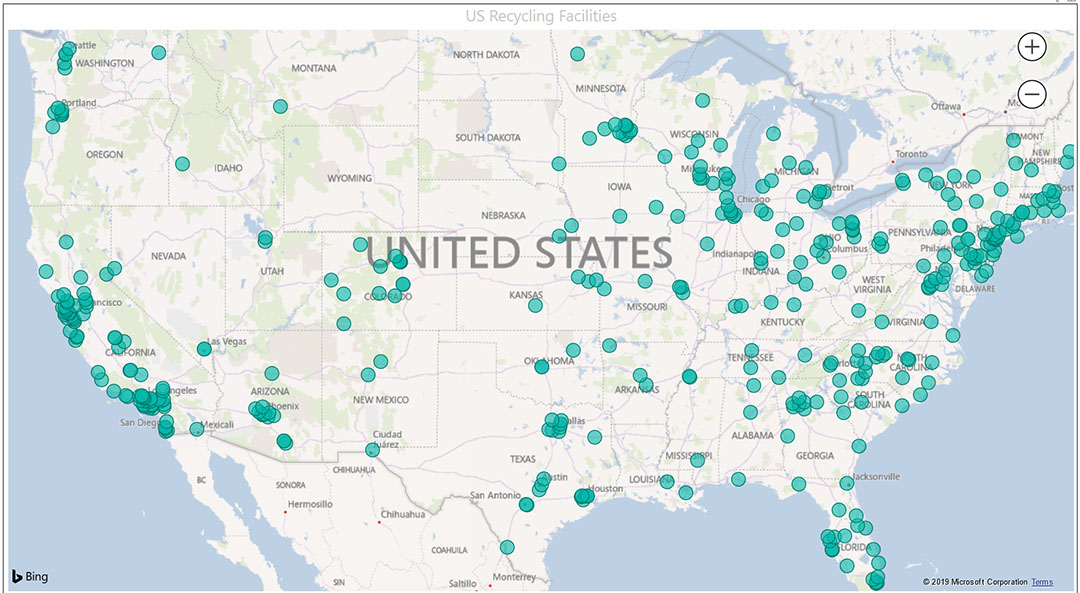
The Recycling Partnership tool provides a geographical picture of which regions are well-served with recycling infrastructure.

For the first time, a comprehensive map of municipal materials recovery facilities across the country has been compiled and released for public use.

The Recycling Partnership on Oct. 22 the published map detailing more than 350 residential recycling sorting facilities. It provides a geographical picture of which regions are well-served with recycling infrastructure and which areas need the most help.

Scott Mouw, senior director of strategy and research at The Recycling Partnership, said the map serves as a sort of accounting or census of what the landscape of MRFs looks like across the country. That information, he noted, is key to connecting downstream stakeholders with a significant component of the recycling infrastructure that serves communities.

“It’s important to all the programs across the country, it’s important to the markets that source their material from households, and yet it really hasn’t existed in any kind of very focused form nor been displayed publicly before,” Mouw said.

One important goal for The Recycling Partnership was to be precise in the language it used to define a MRF. For instance, this project did not want to conflate C&D MRFs with those handling the curbside stream. The aim was to achieve an apples-to-apples comparison.

“These are facilities that are focused on residential material, taking in commingled in some way shape or form, single-stream or dual-stream, not mixed waste, and then move that material to the market,” Mouw explained.

That means facilities that take in source-separated material, bale it and ship it out were not considered MRFs for the purpose of this project. Some level of sorting is required to fit the definition.

“We want to drive a conversation where we talk about MRFs in a very defined way,” Mouw said. “It helps us have conversations that advance the system, quite frankly.”

The data for the map came from a number of sources, including a large database compiled by Resource Recycling. The Recycling Partnership added to that information from the organization’s own staff knowledge of facilities around the country, completing some light research to determine what type of MRF each facility is.

Finally, the team shared the data with a number of state recycling offices to vet it with local experts.

“We think we’re pretty darn close to having an accurate representation of most of the residential MRFs in the country,” Mouw said. “We also, then, are mindful that it’s not perfect.”

Part of the exercise, he said, is to refine the map if there are errors. To that end, TRP is asking readers to share any information that might help advance the map so it has the most up-to-date and accurate information.

Looking at the geographic representation of MRF infrastructure, some dramatic differences by region are particularly clear. Major population centers like California and the Northeast have an abundance of residential sorting facilities. North Dakota and Wyoming, however, have no MRFs. Large swaths of Texas are also barren on the map.

“There are a lot of large towns there, pretty decent sized towns, that don’t have ready access to MRF processing,” Mouw said.

“There are parts of the country that are truly processing deserts, and parts of the country that are truly overbuilt,” he added.

‘Circularity’ report released

In addition to the map, The Recycling Partnership this week released “The Bridge to Circularity,” a report outlining how the current U.S. recycling system is insufficient to handle the amount of packaging waste being generated.

The report found there is an annual gap of more than 1 billion pounds between the current U.S. supply and projected 2025 demand for recycled PET for use in bottles. The report called for investment of $250 million over five years to boost the capture rate for packaging and another $250 million over five years to “design and implement the future recycling system.”

 

2020 Resource Recycling Conference

Tags: Industry GroupsMRFs
TweetShare
Colin Staub

Colin Staub

Colin Staub was a reporter and associate editor at Resource Recycling until August 2025.

Related Posts

EPR fees are a market signal. Here’s what they’re telling you.

Oregon DEQ flags 250 producers for RMA noncompliance

byStefanie Valentic
April 21, 2026

Oregon's packaging EPR program has its first list of noncompliant producers. On April 9, the Oregon Department of Environmental Quality...

Recycling Partnership CEO stepping down

byStefanie Valentic
April 15, 2026

Outgoing CEO Keefe Harrison will remain until August with the organization she built from the ground up.

NERC launches hub to promote PCR demand 

byAntoinette Smith
April 15, 2026

The Northeast Recycling Council's PCR Material Demand Hub offers resources for government procurement, material- and product-specific resources, and certification and...

Reverse Logistics Network launches to support industry

byPaul Lane
April 14, 2026

The reverse logistics community has a new organization to give companies in that sector a place to connect.

Colorado regulators suggest mid-range EPR scenario

Why collaboration on plastic waste still matters

byCrystal Bayliss
April 13, 2026

Six years ago, the U.S. Plastics Pact launched at a moment of rising concern about plastic waste and growing momentum...

Industrial sources drive rise in PVC recycling

byAntoinette Smith
April 13, 2026

Volumes of post-industrial PVC recycled in 2024 rose by 10% from 2019 levels, while post-consumer sources fell and missed a...

Load More
Next Post
Novolex brand begins using recycled PS in cutlery

Novolex brand begins using recycled PS in cutlery

More Posts

Birch Plastics gets FDA green-light for post-industrial PP

LyondellBasell upgrade to PreZero assets on hold

April 23, 2026
The independent ITAD at a crossroads

The independent ITAD at a crossroads

April 22, 2026
Towfiqu ahamed barbhuiya

Before the Bin: Breaking down food date labeling

April 20, 2026

Google pilots reuse kits to extend device life

April 21, 2026
EPR fees are a market signal. Here’s what they’re telling you.

Oregon DEQ flags 250 producers for RMA noncompliance

April 21, 2026
Industry group: Help us find the plastic bale volumes we need

PET bales sink further as other grades firm 

April 15, 2026

What Netflix’s ‘Plastic Detox’ gets wrong – and right

April 23, 2026
What is EPR and why it matters

What is EPR and why it matters

April 22, 2026

NERC launches hub to promote PCR demand 

April 15, 2026
Growth challenges drive M&A for packaging

Growth challenges drive M&A for packaging

April 20, 2026
Load More

About & Publications

About Us

Staff

Archive

Magazine

Work With Us

Advertise
Jobs
Contact
Terms and Privacy

Newsletter

Get the latest recycling news and analysis delivered to your inbox every week. Stay ahead on industry trends, policy updates, and insights from programs, processors, and innovators.

Subscribe

Welcome Back!

Login to your account below

Forgotten Password?

Retrieve your password

Please enter your username or email address to reset your password.

Log In

Add New Playlist

No Result
View All Result
  • The Latest
  • Analysis
  • Recycling
  • E-Scrap
  • Plastics
  • Policy Now
  • Conferences
    • E-Scrap Conference
    • Plastics Recycling Conference
    • Resource Recycling Conference
    • Textiles Recovery Summit
  • Magazine
  • About Us
  • Advertise
  • Archive
  • Jobs
  • Staff
Subscribe
This website uses cookies. By continuing to use this website you are giving consent to cookies being used. Visit our Privacy and Cookie Policy.