




Resource Recycling
  • The Latest
  • Analysis
    • All
    • Certification Scorecard
    • Industry Announcements
    • Opinion
    Apple store

    Apple leads on inputs, faces questions on ITAD

    Unlocking the power of source reduction in US EPR

    Unlocking the power of source reduction in US EPR

    Following petition, Microsoft extends Windows 10 support

    Windows AI Recall is pushing data destruction upstream

    Certification Scorecard — Week of April 27, 2026

    Five trends shaping PCR packaging to 2031

    Intel sign on company building with blue sky and trees.

    Intel boosts margins by selling what it used to scrap

  • Conferences
    • Resource Recycling Conference
    • Plastics Recycling Conference
    • E-Scrap: The Longevity Conference
    • Textiles Recovery Summit
  • Publications
    • E-Scrap News
    • Plastics Recycling Update
    • Policy Now
    • Resource Recycling
    • Other Topics
      • Brand Owners
      • Critical Minerals
      • Glass
      • Grant Watch
      • Markets
      • Organics
      • Packaging
      • Research
      • Technology
      • Textiles
      • All Topics
Subscribe
No Result
View All Result
Resource Recycling
  • The Latest
  • Analysis
    • All
    • Certification Scorecard
    • Industry Announcements
    • Opinion
    Apple store

    Apple leads on inputs, faces questions on ITAD

    Unlocking the power of source reduction in US EPR

    Unlocking the power of source reduction in US EPR

    Following petition, Microsoft extends Windows 10 support

    Windows AI Recall is pushing data destruction upstream

    Certification Scorecard — Week of April 27, 2026

    Five trends shaping PCR packaging to 2031

    Intel sign on company building with blue sky and trees.

    Intel boosts margins by selling what it used to scrap

  • Conferences
    • Resource Recycling Conference
    • Plastics Recycling Conference
    • E-Scrap: The Longevity Conference
    • Textiles Recovery Summit
  • Publications
    • E-Scrap News
    • Plastics Recycling Update
    • Policy Now
    • Resource Recycling
    • Other Topics
      • Brand Owners
      • Critical Minerals
      • Glass
      • Grant Watch
      • Markets
      • Organics
      • Packaging
      • Research
      • Technology
      • Textiles
      • All Topics
Subscribe
No Result
View All Result
Resource Recycling
No Result
View All Result
Home Resource Recycling Magazine

Community Spotlight: Pay-as-you-throw builds foundation in Boston suburb

Colin StaubbyColin Staub
October 1, 2018
in Resource Recycling Magazine

It’s hard to argue with data, and in one Northeast community, the numbers don’t lie: Natick, Mass. has increased diversion by 14 percentage points since implementing a system to add financial incentives to recycling.

Before launching its sliding scale payment system for trash disposal (called pay-as-you-throw), Natick’s curbside garbage collection frequently resembled what is now a special bulky waste collection day.

“Natick used to be a town that had a lot of trash,” said Jillian Wilson Martin, sustainability coordinator for the municipality. “Today, we have a much different picture.”

Natick, which is located about 15 miles from Boston, has some 34,000 residents. The town’s recycling program serves 11,000 households.

The town’s Public Works Department provides every-other-week recycling collection service, using automated trucks to pick up 96-gallon carts. The town has three garbage trucks and three recycling collection trucks.

Today, Natick provides a number of collection options for a variety of materials: Food scraps are collected in curbside compost bins, and the town is currently running a pilot program with 500 households to add yard debris into the compost collection. Additionally, since 2017, the town has contracted with Simple Recycling to provide curbside collection of clothing and other household goods.

But the robust collection program didn’t pop up overnight. Natick’s recycling efforts have evolved significantly over time, in part due to recycling incentives.

“Our journey to get there has largely been influenced by pay-as-you-throw,” Martin said.

Budget woes spur diversion move

The pay-as-you-throw (PAYT) program “has saved our town quite a bit of money, and it’s reduced our trash volumes by about 40 percent and increased the amount of recycling we have in town by about 20 percent,” Martin said.

The town began looking into PAYT and other options due to a decline in local aid from the state budget. In Massachusetts, local aid funding decreased substantially during the 1990s. Martin estimated the funding declined by 35 percent from 1994 to 2004. Solid waste program funding comes from property taxes, but the money wasn’t enough.

“At the same time, our disposal costs were rising, tip fees had increased by about 30 percent in that same 10-year period, and we ultimately had a budget shortfall of $1.5 million,” Martin said.

To avoid layoffs or other program cuts, local officials first initiated a $150-per-household yearly trash fee and began investigating PAYT for the future.

A government committee opted to implement PAYT in 2004, but it wasn’t a smooth transition. Town residents who were unhappy with the program began protesting it. They collected signatures and were successful in getting PAYT onto a ballot in a special election.

“We had some pretty significant political backlash,” Martin acknowledged.

However, despite the opposition, 72 percent of voters elected to keep the PAYT program, and it has been in place ever since. Martin noted community outreach was crucial in motivating residents to keep the program.
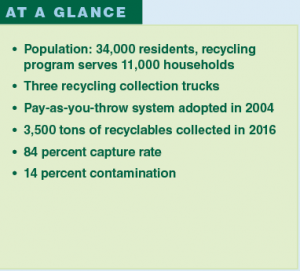
Natick, Mass. recycling program at-a-glanceGarbage bags are sold in 15- and 33-gallon sizes, and they are available for purchase at local retail stores. Recycling is offered for free.

In the time since PAYT was implemented, Natick’s garbage generation dropped substantially, from 9,800 tons the year before PAYT to 6,100 tons in 2016, the most recent year for which state data is available. At the same time, recycling has risen, from 23 percent diversion in 2003 to 37 percent in 2016.

Single-stream recycling launched two years after PAYT, and collection service was taken over by the town’s Public Works Department several years after that. The single-stream recycling program collected about 3,500 tons of material in 2016.

After performing a recent waste audit, the program calculated preliminary figures showing it captures 84 percent of recyclable materials.

Contamination, which is often a concern when switching to a PAYT system because it can seem easy to pay less for garbage by throwing more materials into the recycling stream, sits at about 14 percent by weight.

Besides the materials diversion increase, Natick emphasizes the financial implications of PAYT in its outreach to residents. The town estimates the program has saved more than $4 million in disposal fees since it began.

Reflecting and looking ahead

Beyond resolving Natick’s solid waste budget issues. moving into a PAYT system reduced waste disposal and therefore the amount paid for tipping fees. It also meant cutting costs on garbage collection service: Prior to PAYT, collection trucks went out every weekday, but since PAYT, the program has been able to cut collection to four days per week.

However, Martin emphasized that what works in one municipality might not be the best solution elsewhere.

“No one size fits all, every community is very different and it’s important for people to think about that in their programs,” she said.

For Natick, PAYT has allowed it to steadily increase its collection initiatives, and it has also given the town the opportunity to tackle additional streams such as yard waste through the in-progress pilot project.

Still, budget issues may not be completely in the rear-view mirror – like most smaller communities, competition for tax revenue is always a factor.

“It’s to be determined what the future is for Natick,” Martin said, noting that PAYT is “not a settled issue – but what ever is?”

This article originally appeared in the September 2018 issue of Resource Recycling. Subscribe today for access to all print content.

Think your local program should be featured in this space? Send a note to [email protected].

Tags: Local Programs
TweetShare
Colin Staub

Colin Staub

Colin Staub was a reporter and associate editor at Resource Recycling until August 2025.

Related Posts

Bill to update New Jersey e-scrap program heads to governor

New Jersey recyclers talk EPR

byBrian Clark Howard
April 9, 2026

At the Association of New Jersey Recyclers’ spring meeting industry representatives discussed the state and future of the sector.

Wineries help create model for film recycling

Wineries help create model for film recycling

byAntoinette Smith
April 7, 2026

A collaboration between California wineries and the recycling value chain has provided a closed-loop model the partners aim to see...

Waste Connection recycling cart in The Dalles, Oregon

First Oregon community expands curbside recycling with EPR funding

byBrian Clark Howard
April 1, 2026

The City of The Dalles in northern Oregon is now rolling out nearly 5,000 new 90-gallon recycling carts to customers...

Rural effort targets vapes as battery fire risk grows

byScott Snowden
March 24, 2026

A Wisconsin firefighter is building a rural vape collection service as discarded devices with lithium-ion batteries continue to raise fire...

New Providence carts underpin recycling campaign

New Providence carts underpin recycling campaign

byBrian Clark Howard
March 23, 2026

With grant assistance, the Rhode Island capital is providing about 55,000 new collection carts to help boost its recycling rate,...

Recycling education needs consistency, simplicity 

byBrian Clark Howard
February 25, 2026

Several members of Circular Action Alliance team shared insights during a workshop at the 2026 Resource Recycling Conference in San...

Load More
Next Post

MRF of the Month: Firstar Fiber

More Posts

What Netflix’s ‘Plastic Detox’ gets wrong – and right

April 23, 2026
EPR fees are a market signal. Here’s what they’re telling you.

Oregon DEQ flags 250 producers for RMA noncompliance

April 21, 2026
Intel sign on company building with blue sky and trees.

Intel boosts margins by selling what it used to scrap

April 29, 2026
Birch Plastics gets FDA green-light for post-industrial PP

LyondellBasell upgrade to PreZero assets on hold

April 23, 2026

PCA keeping focus on virgin fiber products

April 27, 2026
Intel sign outside of company building.

What Intel’s blockbuster quarter means for ITAD

April 27, 2026
Plastic Ingenuity to use PureCycle PP for coffee lids

Plastic Ingenuity to use PureCycle PP for coffee lids

April 30, 2026
Float-sink technology at the Quantum Lifecycle Partners facility in Toronto, Canada enables the processing of e-plastics.

E-plastics recovery line opens in Canada

April 28, 2026
Our top stories from April 2022

Peters-Michaud named CEO, Houghton chair of Sage Sustainable Electronics

April 28, 2026
Dow touts US PE advantage amid Iran war

Dow touts US PE advantage amid Iran war

April 24, 2026
Load More

About & Publications

About Us

Staff

Archive

Magazine

Work With Us

Advertise
Jobs
Contact
Terms and Privacy

Newsletter

Get the latest recycling news and analysis delivered to your inbox every week. Stay ahead on industry trends, policy updates, and insights from programs, processors, and innovators.

Subscribe

Welcome Back!

Login to your account below

Forgotten Password?

Retrieve your password

Please enter your username or email address to reset your password.

Log In

Add New Playlist

No Result
View All Result
  • The Latest
  • Analysis
  • Recycling
  • E-Scrap
  • Plastics
  • Policy Now
  • Conferences
    • E-Scrap Conference
    • Plastics Recycling Conference
    • Resource Recycling Conference
    • Textiles Recovery Summit
  • Magazine
  • About Us
  • Advertise
  • Archive
  • Jobs
  • Staff
Subscribe
This website uses cookies. By continuing to use this website you are giving consent to cookies being used. Visit our Privacy and Cookie Policy.