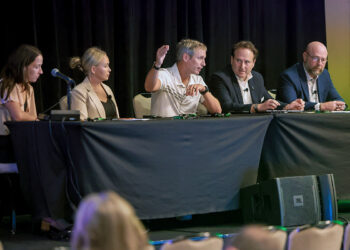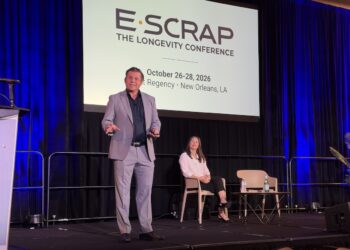





Last month, in New Orleans, the CEO of the country’s largest hauler and processor of trash and recyclables gave the keynote address for the seventh annual Resource Recycling Conference. And following that address [see the full text of the address], we had further questions for the executive.
Resource Recycling: Contamination is a key issue and one that we know that Waste Management has been doing real work on with your “Recycle Often. Recycle Right.” program. But research – both historic and new – shows that the most effective strategies include either direct interaction with customers or slowing routes down in various ways to make sure residents are putting the right things in their curbside carts. Simply put: Why would you slow routes down or slow vehicles down when you can just fine the town for too much garbage in their recycling?
David Steiner: Those areas of the country that have invested in public education clearly have much higher quality of materials collected in curbside programs. In fact, communities – for example in the Pacific Northwest, Minneapolis/St. Paul and upstate New York – who have invested significant resources in their public education programs consistently over many years, have overall inbound contamination rates that are less than half the national average.
It takes multiple efforts to effectively change recycling behavior. Effective education requires ongoing, multiple “touches” to reach different audiences. So, we are working to build consistent programs that reach our customers multiple times in multiple ways as part of our “Recycle Often. Recycle Right.” program.
Recently, we implemented several pilots that show the effectiveness of providing immediate customer feedback on our collection routes. Tagging carts ahead of the trucks, or driver tagging, has reduced contamination by about 20-40 percent. These pilots require training and a commitment of extra driver-time which has created some impediments to expanding the tagging programs, but we’re continuing to evaluate the costs and benefits of these programs.
This is not just a WM issue. In some cases, contracts offer little incentive for collectors to invest in public education efforts. Effective public education to drive effective recycling takes a collective commitment of time and resources, which we must all build into our recycling contracts and programs.
Question: You detailed how you will be making the recycling business more profitable for WM, but sometimes the recycling industry needs help as a whole, not just company-specific measures. What would be three key policy drivers that you could see pushing recycling forward?
Steiner: 1. Grants and incentives for research and development investments in recycling. 2. Demand-side incentives to encourage the use of post-consumer material in new products. 3. Moving away from weight-based goals to goals based on lifecycle thinking will help us all get better environmental results, more cost effectively.
Using a lifecycle thinking approach to set goals that focus on recycling the right things to achieve the greatest environmental benefit, rather than recycling everything to achieve what are oftentimes arbitrary weight-based recycling goals, allows efforts to be focused more effectively on those materials that have the biggest “bang for the buck.”
That said, as we talked about in New Orleans, if customers want us to recycle all materials, we can absolutely do that, but the costs will be higher.
Question: I know we covered this in our Q&A after your speech, but it bears asking again – when the landfill operations are both more stable financially and more profitable than recycling (certainly true in recent years), how can WM as a company support recycling over landfilling, when that would be more financially profitable and provide a better return for your shareholders?
Steiner: What we are trying to do is to improve the economics of recycling so that it can be as profitable as our landfill business. If we can do that, we will increase our already significant investment in recycling.
We have more than 3,000 Waste Management teammates in our recycling business and we processed and brokered over 11 million tons of recyclables in 2015. We’ve invested over $1 billion to build the largest residential recycling business in the entire world. We built it because it was profitable, and in the business world, investment follows profit.
I said this when I spoke in New Orleans, and I’ll reiterate it – for those that think we are only a landfill company, you might be surprised to know that the returns on investment in recycling have historically been much higher than those in our landfill business. And while we were growing our recycling businesses, we were keeping our investment in our landfills static, while investment in our recycling infrastructure went up by over 400 percent.
We are a customer-focused company and we provide the services that our customers want from us. So we offer our customers choices, and let them make decisions based on the cost of various services. In most cases, our customers continue to choose to recycle.
Given the global changes in recycling, combined with this ongoing demand for service, a shift in the business model is necessary to address the changes that we see in recycling. We know that at some point the economics will change to where they favor recycling. We just don’t know when it will happen. In the past, it only took months. The current downturn has been going on for four years, and it is hard to see it changing in months. That is why we need to alter the business model. Times change and WM, as well as the recycling industry as a whole, has to change with them.
Question: Mixed-waste processing facilities for handling residential municipal solid waste (MSW) have grabbed headlines in recent years. Do you see any areas of the country that this type of approach would be viable?
Steiner: Although there are several mixed-waste processing facilities in California, they play a very different role there than we’ve seen in some other parts of the country. Mixed-waste processing facilities in California are generally built in addition to – not in place of – strong recycling programs. They process residuals after recycling, they play a role in processing commercial recyclables (where collectors can create routes to collect from customers with dry/office versus wet/restaurant routes), and they are used for multi-family buildings. The policy drivers in California play an important role in supporting the high cost of these facilities.
Where mixed-waste processing facilities are used as the sole solution for recycling, they’ll continue to struggle. Communities will likely continue to try – and fail – to make these “too-good-to-be-true” facilities work, due to both cost and quality reasons. Successful recycling requires investments in programs and policies that ensure economically sustainable programs and marketable end products. One day we may have that “magic bullet” that allows us to beneficially use mixed waste, but in today’s economic environment we need research and development grants or other incentives to support our efforts to process or beneficially reuse mixed waste.
Question: You mentioned in the question-and-answer period the concept of a “natural payer,” meaning that, in any given transaction, there is a participant that would “naturally” pay for a good or service. At times of high commodity prices for OCC, for instance, it would be the consumer of that material. At times where prices for PET are not, it would potentially be the municipalities that are receiving the service of pick-up and processing of recyclables.
Could you elaborate on the concept of “natural payer” and how that fits in with recycling?
Steiner: As we see it, there are a number of “natural payers,” and the selection of who pays is a function of customer choice or political resolve. For example, in recycling, the local municipality could be a natural payer. If the community has problems with its citizens contaminating the recycling stream, they may shift the cost to the citizens by charging those that cause the most contamination. As another example, tires have created issues since the invention of the automobile. Governmental units placed the cost of disposal [of tires] on the consumer. Every time I buy new tires I pay a disposal fee for the old tires. So, there are a number of “natural payers,” but we leave it up to others to determine who those are and how to implement the charge.
The economics of recycling have changed. When times were good and commodity prices were a whole lot higher, issues like contamination didn’t matter – as much. Many contracts built the cost of recycling into garbage rates – making it look like recycling is “free;” but we all know it’s definitely not free!
In order to ensure recycling survives and thrives, we need to re-educate our customers on the true economics of recycling. When it comes to our residential customers, services generally start with contract language. We are now insisting that contracts cover the cost of processing recyclables. This changes the role of recycling in our community from a commodity-based, perceived “free” service, to one of a community cost-based service.
We need to make sure that we value the behavior and start with the consumer, or the generator. Our customers are the “natural payers” for their recycling service, and our contracts should reflect this in the residential sector just as they do in the commercial sectors. This is no different than the provision of most other goods and services. By owning the payment of recycling as a service, customers, or generators, also take responsibility for their behavior.
Question: The term “sufficient revenues” was used a number of times during our interview. What is the rough estimate of sufficient revenues from recycling? Say, if the commingled ton is worth roughly $70, would it have to go above $100 per ton?
Steiner: The short answer? It depends. Each of our processing facilities would have a different revenue number in order to cover the processing cost and return on investment. On average, most single stream processors should be able to generate adequate returns above $100/ton.
Keep in mind that these numbers refer only to the MRF processing portion of the integrated recycling processing. Collection costs would need to be evaluated separately, which is important since many residential recycling contracts are fully integrated (collection/processing and marketing).
Question: WM is somewhat unique in that its recycling segment includes a brokerage arm, where WM employees buy recovered materials from other collectors and processors, then resell the material to U.S. and foreign mills. This isn’t a traditional function of publicly traded garbage companies. Can you describe WM’s corporate strategy in operating a materials brokerage?
Steiner: Our brokerage business is an interesting part of our business, and while historically the brokerage margins in that business are 3-4 percent, it does not require a large capital investment. We can leverage this business to expand our service offerings to large retailers and national account customers that want a comprehensive provider for all of their waste management services. We can also get better prices for our customers’ tons because we manage such a large volume of recyclables. The better pricing we get for the tons gets passed on to our customers, allowing us to be a lower-cost provider.