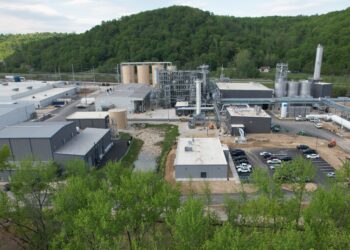









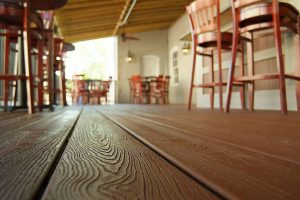
Trex is preparing to start up for its new composite decking production facility in Arkansas, an executive said during an interview, as the company works toward vertical integration in its supply chain.
Amy Fernandez, chief sustainability officer at Virginia-based Trex, said the company is completing the Little Rock facility, and “we’re still working through when we actually want to do the startup.” She added that a couple plastics processing lines are already running, and the company has the “capacity to run a lot more lines there, but we don’t need it yet.”
The three-year downturn in global consumer demand has not spared Trex, whose products rely on the construction and remodeling sector. However, “demand hasn’t dropped to the point where we’ve had to really take any drastic measures,” instead taking advantage of the company’s considerable warehouse storage space across the US to store film bales rather than ceasing buying altogether.
That extended slump in end-user demand has hit recyclers across all sectors, including the sudden shuttering of WM’s Natura PCR plant in Texas last fall.
Ensuring consistent supply is among several reasons Trex and other companies are moving toward vertical integration. Buying smaller companies or developing their own supply chains also can help improve costs and streamline logistics. Other examples include LyondellBasell and ExxonMobil’s investment in the Cyclyx pre-processing facility in Texas, and PureCycle’s construction of a secondary sorting operation to feed its polypropylene dissolution recycling plant.
Trex has been producing its own LDPE pellets since 2024, when it started up the processing lines at the Arkansas site. The company had been using the recycled resin at its Virginia and Nevada board-production facilities, reducing its dependence on third-party suppliers. The pellets will now be used at the new production lines as well.
Fernandez added, “In the past we couldn’t meet all of our own demand, and so we did have to buy some pellets outside of Trex. We want to manufacture all of our raw materials.”
Expanding feedstock slate helps lower costs
Trex develops its own equipment, Fernandez told Plastics Recycling Update. “We don’t buy off-the-shelf equipment, which is what helps us process a broader range of material. And we’re always trying to improve our costs for our products.”
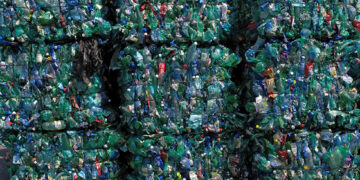
The bespoke equipment allows Trex to accept a wide range of LDPE film, with increasing levels of contamination being acceptable as sorting processes advance, she said. The company can process C-grade LDPE film bales, with up to 25% contamination depending on the foreign material. For example, 25% paper fiber may be acceptable but 25% metal would not be, she said.
Using lower-grade bales can make a significant difference in costs. In March, LDPE A-grade film bales (containing 95-99% clear film) were at a national average of 13.50 cents/lb, versus 5.25 cents/lb for B-grade (around 80% clear film) and -0.56 cents/lb for C-grade, according to RecyclingMarkets.Net data.
And of course, the new plant’s location was strategic, to provide access to feedstock sources in the central part of the country, Fernandez said. To help enable feedstock collection, Trex also provides balers for supply partners, and when they amass enough material for a truckload, Trex sends one of its large fleet of trailers to pick it up. The company also has numerous warehouses across the US, to optimize regional logistics.
“We have really long-standing relationships with the companies we source from,” she said. Although long-term contracts are not yet a part of the procurement strategy, Trex typically establishes one- or two-year agreements that are renewed repeatedly, she said.
Value chain partners include Ohio’s ScottsMiracle-Gro, which diverts plastic film scrap from its soil bag production, into the NexTrex program.
“For the companies that want to be able to say that they recycle or that their bags are recyclable, they are looking to try to partner with us to be able to put that NexTrex mark on their bag, and then to be able to assist us to get them because if they do get into that collection bin, it gets to us.”
And while single-use bag bans have become popular, Trex’s reliance on post-consumer bags is minimal, so the company has felt minimal effects, Fernandez said. Even so, the company maintains a film drop-off directory, and uses post-consumer plastic bags as an opportunity to educate the public about recycling.
Initiatives include collection bins placed at universities and retirement communities, and extended producer responsibility (EPR) laws have spurred bag makers to seek out the NexTrex commercial recycling program to source EPR-compliant shopping bags, she said.
Aside from used shopping bags, the company can adapt to unusual feedstocks, including rolls of off-spec commercial stretch wrap. For those, the engineering team had to design equipment to cut through giant rolls of blue film, and devised a solution for processing and incorporating the material, she said. “We’re constantly reaching out to various companies and industries to try and figure out what we can take and how we’re going to process it.”