












This story has been updated to reflect the open comment period for a plan amendment.
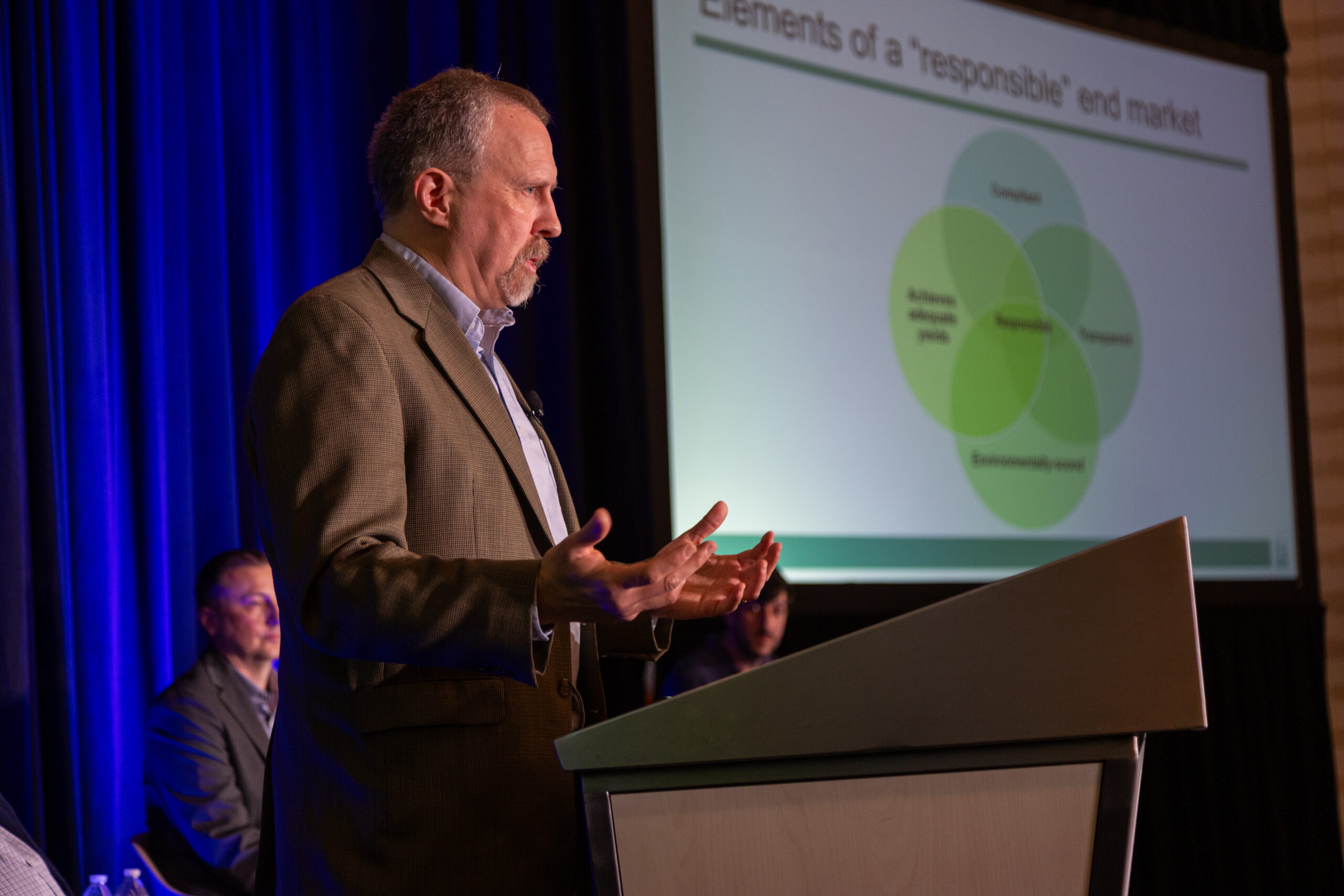
Of the many confusing terms associated with emerging extended producer responsibility (EPR) legislation for packaging, responsible end markets (REMs) may inspire the most anxiety for industry stakeholders. At the 2026 Plastics Recycling Conference the week of Feb. 23, panelists from government as well as industry explored what REM standards really mean for recyclers.
Among the seven states that so far have adopted EPR legislation for packaging, all but one included an REM requirement.
Although the definition of an REM may vary among the emerging programs, in general it refers to a market in which materials are recycled or recovered in a way that benefits the environment and minimizes health and safety risks to the public and to workers, said panel moderator Dan Leif, director of policy implementation at The Recycling Partnership.
In Oregon, the first state to implement packaging EPR, the state regulator sets the requirements for REMs via the rulemaking process, then the PRO must outline the plan for meeting those requirements, said panelist Shane Buckingham, chief of staff at Circular Action Alliance (CAA).
While some recyclers may question the need or purpose for REMs, the standard has an overarching goal, said David Allaway, senior policy analyst at the Oregon Department of Environmental Quality (DEQ).
“For decades, recycling in this country has been all about collection and a little bit about processing, and end markets have been kind of an afterthought, which is kind of upside down from the way it should have been,” Allaway said during the panel. “And this whole conversation around responsible end markets is actually a step towards righting the balance and putting end markets where they belong, which is central in the conversation of recycling policy.”
Ajit Perera, vice president of post-consumer operations at California-based reclaimer Talco Plastics, said, “Ultimately, no matter how much material you collect, if my warehouse is full of product that has no place to go, then I am not purchasing.”
REMs in practice
And while the definition of an REM may be relatively simple, putting the concept into practice is “where things get pretty complicated,” Leif said.
In Oregon, EPR law took effect July 1, 2025, and included an REM standard, which currently defines the end market for most plastics as all entities downstream of the MRF, including brokers and secondary sortation facilities, Allaway said. Details about the standard are included in a plan amendment that is open for public comment until March 27. The DEQ response is due in May.
As the PRO for all six states requiring REM standards for packaging, CAA is working to drive consistency and harmonize requirements that still meet the varying rules set forth in individual states’ legislation, Buckingham said.
And despite differences in state laws, the common element in REM standards is transparency, Allaway said.
That transparency can lead to worries about disclosing proprietary data via required reporting for EPR systems. But CAA’s Buckingham said that in his experience in implementing Canadian EPR schemes, “it’s really taken a lot of trust building with the sector. There have been a lot of concerns raised over the confidentiality of commercially sensitive information. And we’ve just had to work through that.”
The REM verification process itself arose in response to the implementation of China’s 2018 implementation of its National Sword policy, which exposed issues with improper handling of erstwhile waste, Leif said. Under the policy, China essentially banned waste imports and disrupted recycled commodities markets globally.
“Since then, there’s been more of an emphasis on the fact that we didn’t always know exactly what was happening with the material that we sent to market,” he said, adding that one goal of REMs is to rebuild public trust in recycling systems by providing transparency and verification.
Costs vs benefits of REM verification
In an industry with razor-thin margins, a major concern for recyclers is the costs associated with meeting REM standards, which may require equipment upgrades to ensure the recycler meets certification and other thresholds.
Talco’s Perera acknowledged that upgrading sorting systems with AI, robots and infrared sensors “is not cheap” and should be borne by the MRF or service provider rather than the REM. “As reclaimers, sometimes we live by the skin of our teeth,” he said.
However, he stressed the importance of achieving high-quality commodity plastic bales with lower contamination to improve yields, and noted that long-term procurement contracts – a concept yet to take hold in recycled plastic markets – “make the difference. This allows one to lay out funds to build a reclaiming system,” he said.
“If you do not modernize with AI, robots, and so on and so forth, you will be left behind,” he said, adding that “regulatory uncertainty is temporary. We know that the regulations will be written, and we will know what our target is. Early adoption of the programs will give you an edge.”