












Several big recycling updates came out of the Golden State this weekend, including new policy, a lawsuit challenging ExxonMobil’s chemical recycling claims and an update about carpet recycling rates.
Policy Movement
On Sept. 22, California Gov. Gavin Newsom signed SB 1053 into law, removing an exemption to the state’s existing plastic bag ban for thicker plastic bags that had been considered reusable.
In a statement, Ocean Conservancy‘s Director of Plastics Policy Anja Brandon said that plastic grocery bags have ranked among the top 10 most commonly collected items by California Coastal Cleanup Day volunteers in seven of the last 10 years.
“Plastic grocery bags are not only one of the most common plastics polluting our beaches, but also one of the top five deadliest forms of plastic pollution to marine life,” she said. “But we have a simple solution that has been shown to reduce this type of plastic pollution: banning them.”
Environmental group Oceana also applauded the move, with Plastics Campaign Director Christy Leavitt noting in a statement that “the new ban on single-use plastic bags at grocery store checkouts solidifies California as a leader in tackling the global plastic pollution crisis.”
“Our state and national elected leaders should continue to adopt new policies to stop plastic pollution at the source,” Leavitt added.
Recycling firms opposed the expansion of the bag ban, arguing that it will remove a huge end market for PCR.
Newsom also vetoed AB 457, which would have reduced the redemption payment and refund value for wine or distilled spirit beverage containers of less than 24 fluid ounces from 25 cents to 10 cents beginning Jan. 1. It also would have allowed certain distributors and beverage manufacturers to make one annual payment of fees to the state.
In a veto message, he stated that lowering the refund value would undermine SB 1013, which “created a market signal incentivizing the industry to either stimulate development and create recycling pathways.”
“Lowering the CRV for these materials, as proposed by this bill, would disrupt this market signal, create confusion for recyclers, and likely result in consumers paying a higher CRV than they will be able to redeem,” he added. “For this reason, I cannot sign this bill.”
However, he added that he does think the state should “do more to encourage participation from small beverage manufacturers in the BCRP, and am thereby directing the Department of Resources Recycling and Recovery to incorporate similar reporting flexibility in the SB 1013 regulations currently under development.”
There are several other recycling-related bills still on Newsom’s desk. He has until Sept. 30 to sign or veto them.
ExxonMobil lawsuit
In addition, California’s attorney general filed a lawsuit against ExxonMobil over its chemical recycling claims, seeking to “hold one of the largest petrochemical companies in the world accountable for misleading the public on plastic’s recyclability and polluting California’s environment and communities,” a press release stated.
The lawsuit is the result of a two-year investigation by the state into fossil fuel and petrochemical industries and their role in “the global plastics waste and pollution crisis.”
The 147-page complaint, filed in the San Francisco County Superior Court, alleges that ExxonMobil has “been deceiving Californians for half a century through misleading public statements and slick marketing promising that recycling would address the ever-increasing amount of plastic waste ExxonMobil produces.”
“ExxonMobil, one of the most powerful companies in the world, falsely promoted all plastic as recyclable, when in fact the vast majority of plastic products are not and likely cannot be recycled, either technically or economically,” the complaint states.
An ExxonMobil spokesperson said in an emailed statement that “for decades, California officials have known their recycling system isn’t effective. They failed to act, and now they seek to blame others.”
“Instead of suing us, they could have worked with us to fix the problem and keep plastic out of landfills,” the statement said.
The legal complaint notes that only about 5% of U.S. plastic waste is recycled, and the recycling rate has never exceeded 9%, figures that several recycling organizations have pushed back on as misleading based on how they are calculated.
The Association of Plastic Recyclers said in response to the numbers that today, about 10% of plastics produced are collected for recycling – but “that number is impacted by the fact that more than 55% of all plastics are used in non-packaging applications such as medical devices, car parts, clothing, electronics and more, and these products are not part of the curbside recycling system.”
“When plastics are collected, they are recycled,” APR added, noting that 80% of rigid consumer plastic packaging is made of either PET, HDPE or PP, and the “best available data show that the U.S. recycles those plastics at a rate of 19.8%.”
APR owns Resource Recycling Inc., which publishes Plastics Recycling Update.
ExxonMobil’s statement added that the first step for California “would be to acknowledge what their counterparts across the U.S. know: advanced recycling works.”
“To date, we’ve processed more than 60 million pounds of plastic waste into usable raw materials, keeping it out of landfills,” the statement said. “We’re bringing real solutions, recycling plastic waste that couldn’t be recycled by traditional methods.”
The complaint alleges that ExxonMobil violated state nuisance, natural resources, water pollution, false advertisement and unfair competition laws. The attorney general aims to compel ExxonMobil to “end its deceptive practices that threaten the environment and the public,” according to the press release, as well as to pay into an abatement fund, disgorgement and civil penalties “for the harm inflicted by plastics pollution upon California’s communities and the environment.”
Disgorgement requires the defendants to give up the profits gained through illegal conduct. The filing also requests a jury trial of the case.
The Sierra Club, Surfrider Foundation, Heal the Bay and Baykeeper have separately filed another lawsuit raising similar issues.
Ocean Conservancy and Beyond Plastics both released statements supporting the lawsuit.
APR said in a statement that “as long as the world uses plastic products, a robust recycling supply chain is essential to minimize waste and strengthen sustainability.”
Carpet EPR
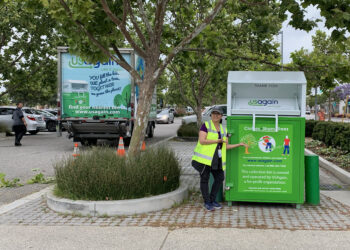
Carpet America Recovery Effort, or CARE, submitted its California carpet stewardship program’s 2023 annual report to CalRecycle on Sept. 1, emphasizing a record-high recycling rate of 35% for 2023.
That rate has the producer responsibility group in legal compliance with state law, which mandates a minimum 24% recycling rate. In the past, CARE didn’t achieve that minimum rate, leading the state to take enforcement action against the group in 2017, when the rate was 14%. It fined CARE and rejected its stewardship plan.
In the following years, the rate climbed to 15.3% in 2018, 19.1% in 2019 and 20.9% in 2020, before it jumped to 27.9% in 2021 and continued to climb.
CARE Executive Director Robert Peoples said in a press release that “this historically high recycling rate has been reached thanks to the hard work of our dedicated recycler community and the CARE California Team.”
“We have seen a lot of press lately expressing skepticism about recycling, but the California Carpet Stewardship Program is showing tremendous success and uninterrupted growth in the face of multiple challenges,” he said. “This program is a California success story.”
The recycling rate reached 41% in Q1 2024, the press release added, “pulling even with the statewide recycling rate for all materials.”
In addition, 71% of the carpet collected, or about 66 million pounds, was turned into recycled products, the report noted, while 2.4 million pounds of carpet were sent for reuse.