Resource Recycling
  • The Latest
  • Analysis
    • All
    • Certification Scorecard
    • Industry Announcements
    • Opinion
    The electronics recycling industry is undergoing a transformation from labor-intensive manual operations to highly automated, AI-driven facilities that use advanced robotics, cleaner chemistry and digital tracking systems to extract critical materials.

    The cyber-physical MRF: AI and robotics reshape e-waste recovery

    Certification scorecard for the week of Feb. 9, 2026

    Meta-Corning deal signals IT hardware retirement wave

    Meta-Corning deal signals IT hardware retirement wave

    Malaysia clamps down on illegal e-waste imports amid probes

    Malaysia clamps down on illegal e-waste imports amid probes

    URT builds alliance to remake electronics plastics at scale

    ICYMI: Top 5 e-scrap stories from January 2026

    The electronics recycling industry is undergoing a transformation from labor-intensive manual operations to highly automated, AI-driven facilities that use advanced robotics, cleaner chemistry and digital tracking systems to extract critical materials.

    Certification scorecard for the week of Feb. 2, 2026

    Auditors warn EU may fall short on critical metals

    Auditors warn EU may fall short on critical metals

    Industry announcements for January 2026

    Industry announcements for February 2026

    ICYMI: Top 5 recycling stories from January 2026

  • Conferences
  • Publications

    Other Topics

    Textiles
    Organics
    Packaging
    Glass
    Brand Owners

    Metals
    Technology
    Research
    Markets
    Grant Watch

    All Topics

Subscribe
No Result
View All Result
Resource Recycling
  • The Latest
  • Analysis
    • All
    • Certification Scorecard
    • Industry Announcements
    • Opinion
    The electronics recycling industry is undergoing a transformation from labor-intensive manual operations to highly automated, AI-driven facilities that use advanced robotics, cleaner chemistry and digital tracking systems to extract critical materials.

    The cyber-physical MRF: AI and robotics reshape e-waste recovery

    Certification scorecard for the week of Feb. 9, 2026

    Meta-Corning deal signals IT hardware retirement wave

    Meta-Corning deal signals IT hardware retirement wave

    Malaysia clamps down on illegal e-waste imports amid probes

    Malaysia clamps down on illegal e-waste imports amid probes

    URT builds alliance to remake electronics plastics at scale

    ICYMI: Top 5 e-scrap stories from January 2026

    The electronics recycling industry is undergoing a transformation from labor-intensive manual operations to highly automated, AI-driven facilities that use advanced robotics, cleaner chemistry and digital tracking systems to extract critical materials.

    Certification scorecard for the week of Feb. 2, 2026

    Auditors warn EU may fall short on critical metals

    Auditors warn EU may fall short on critical metals

    Industry announcements for January 2026

    Industry announcements for February 2026

    ICYMI: Top 5 recycling stories from January 2026

  • Conferences
  • Publications

    Other Topics

    Textiles
    Organics
    Packaging
    Glass
    Brand Owners

    Metals
    Technology
    Research
    Markets
    Grant Watch

    All Topics

Subscribe
No Result
View All Result
Resource Recycling
No Result
View All Result
Home Plastics

Equipment Spotlight: Separate black PS from black ABS

byJared Paben
April 28, 2017
in Plastics
Equipment Spotlight: Separate black PS from black ABS

Electronics and appliances present an attractive source for reclaimed plastics, but technical challenges can often inhibit recovery. Many of the e-plastics are black, which can make separation by polymer difficult.

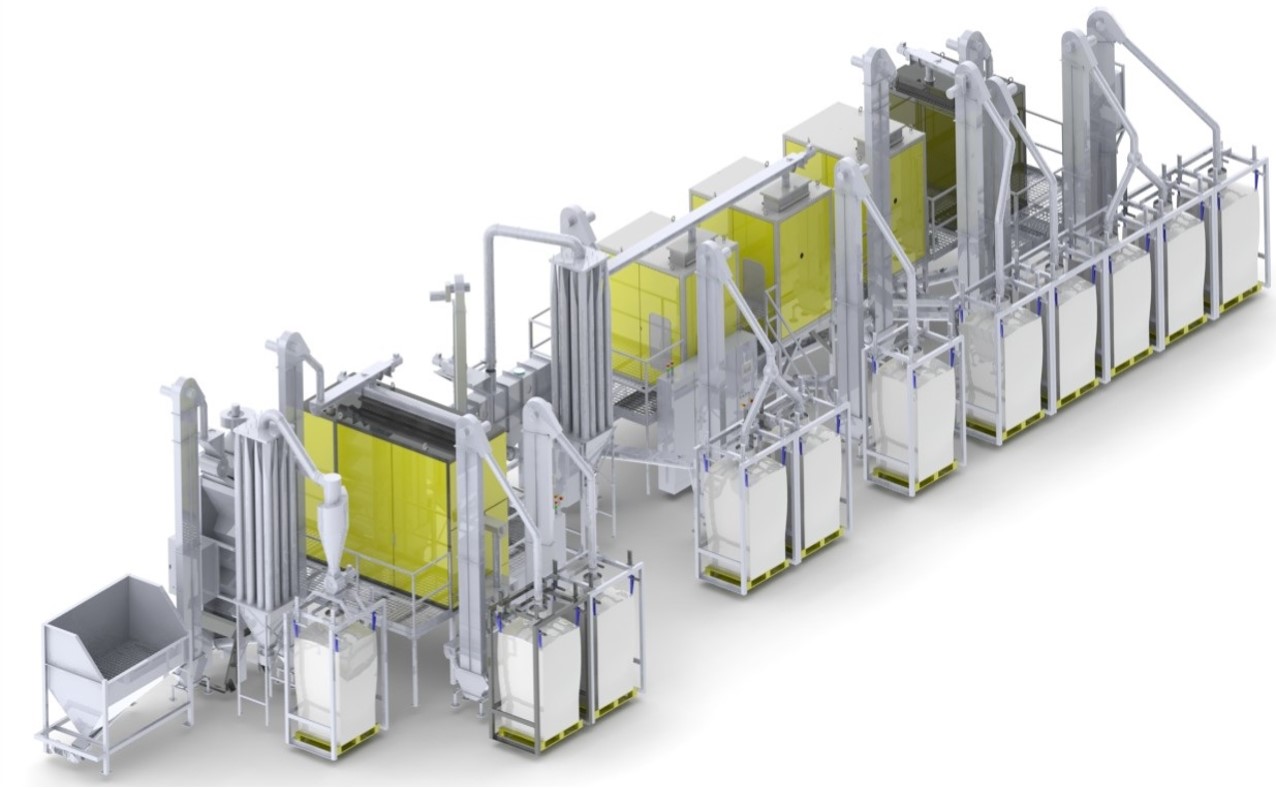
Germany-based company Hamos supplies a sorting line for plastics reclaimers looking to sort black plastics from other black plastics in those end-of-life devices.

The system is capable of removing a variety of contaminants, including rubber, wood, silicone, dirt and more, while also recovering separate black PS and black ABS stream, according to Hamos.

“Even completely black-colored fractions can be separated at the lowest sorting costs with purities of PS and ABS of better (than) 98.5 percent, something that other separation systems cannot do,” said Rainer Koehnlechner, managing director of Hamos.

The first step in Hamos’ full separation line involves pretreatment of the material, which includes screening by size, de-dusting, removal of heavy materials and the elimination of metals.

After that, float-sink techniques are used. Using a salt solution, the tank is able to sink plastics containing flame retardants to the bottom for removal, while allowing non-flame retardant PE, PS, ABS and PP/PP20 (polypropylene 20 percent talc-filled) to float. Then, using the float-sink process with freshwater, PE and PP float while PS, ABS and PP20 sink to the bottom.

The final pre-treatment step involves granulation, reducing plastics to less than 10 millimeters in size, and drying of material. The equipment will dry plastics but leave wood wet, which aids in removal of wood in the next step: electrostatic separation targeted at plastics.

Each of the company’s EKS electrostatic separators can sort up to 1,650 pound per hour of material, separating black plastics from other black plastics. Via the use of triboelectric charging, the equipment can separate PS from ABS and PP20. According to Hamos, it can achieve purities of 98.5 percent in the resulting PS stream and 99 percent in ABS stream.

The company says the sorting technologies can be used to recover plastics from a printer or a toner cartridge, for example. The e-plastics would go through the line, generating streams of PS and ABS regrind that can then be extruded and compounded and sold back to an electronics manufacturer for use in new products. The use of recycled content helps the manufacturer qualify for EPEAT ratings, a recognition of a product’s comparably lighter environmental impact. That, in turn, helps them sell products.

The company is using its technology in a demonstration plant in Germany. That plant is run by Hamos’ sister company, Wersag, which reclaims and sells PS, ABS and PP regrind from end-of-life electronics and appliances streams.
“Our know-how in WEEE (waste electrical and electronic equipment) plastic separation is based upon the experience with our own plant,” Koehnlechner said.

He noted other potential separation applications for the EKS electrostatic separators. For example, he said it would be used to eliminate PVC from PET flakes in post-consumer bottle recycling, or it can separate polyolefin mixtures into clean streams of HDPE and PP.

Koehnlechner said Hamos can provide full e-plastics lines or single EKS electrostatic separators.


 

SDS Logistics

Tags: ABSE-PlasticsEquipmentEuropeHard-to-Recycle MaterialsPSTechnology
TweetShare
Jared Paben

Jared Paben

Related Posts

The electronics recycling industry is undergoing a transformation from labor-intensive manual operations to highly automated, AI-driven facilities that use advanced robotics, cleaner chemistry and digital tracking systems to extract critical materials.

The cyber-physical MRF: AI and robotics reshape e-waste recovery

byDavid Daoud
February 12, 2026

The electronics recycling industry is entering a new phase of technological acceleration. Advances in artificial intelligence, robotics, advanced chemistry, and...

Texas sues over dumped wind turbine blades

Texas sues over dumped wind turbine blades

byScott Snowden
February 10, 2026

The state attorney general sued Global Fiberglass Solutions over alleged illegal storage and disposal of all turbine blades at two...

Member states select new chair for global plastics treaty

Member states select new chair for global plastics treaty

byAntoinette Smith
February 10, 2026

During a short session, the Intergovernmental Negotiating Committee elected Chilean diplomat Julio Cordano to continue efforts toward an internationally binding...

Royal Mint, Procurri partner for ITAD metals recovery

byScott Snowden
February 5, 2026

Reformation Metals partnered with Procurri to combine secure IT asset disposal with clean technology recycling that recovers up to 99%...

Auditors warn EU may fall short on critical metals

Auditors warn EU may fall short on critical metals

byDavid Daoud
February 4, 2026

A recent report showing Europe is unlikely to secure enough critical minerals by 2030 has implications for ITAD firms and...

German researchers say plastics treaty still within reach

byAntoinette Smith
February 4, 2026

In a new white paper, the group proposes three key changes to revive the treaty talks after a new chair...

Load More
Next Post

In other news: May 2, 2017

More Posts

Oregon’s Recycling Modernization Act faces injunction

Court partially blocks Oregon EPR law, dismisses bulk of lawsuit

February 10, 2026
Chinese processing group details goals for US visit

AMP lays out vision of next-generation, AI-driven MRFs

July 24, 2024
Malaysia clamps down on illegal e-waste imports amid probes

Malaysia clamps down on illegal e-waste imports amid probes

February 6, 2026

REUSE Act heads to US House for consideration

February 9, 2026
Meta-Corning deal signals IT hardware retirement wave

Meta-Corning deal signals IT hardware retirement wave

February 9, 2026

ecoATM recycled 7.5M phones in 2025 as payouts hit $1.5B

February 10, 2026
Texas sues over dumped wind turbine blades

Texas sues over dumped wind turbine blades

February 10, 2026

APR, industry create proactive guidance for PET caps

February 12, 2026

Alpek talks PET overcapacity, soft demand

February 11, 2026
The electronics recycling industry is undergoing a transformation from labor-intensive manual operations to highly automated, AI-driven facilities that use advanced robotics, cleaner chemistry and digital tracking systems to extract critical materials.

The cyber-physical MRF: AI and robotics reshape e-waste recovery

February 12, 2026
Load More

About & Publications

About Us

Staff

Archive

Magazine

Work With Us

Advertise
Jobs
Contact
Terms and Privacy

Newsletter

Get the latest recycling news and analysis delivered to your inbox every week. Stay ahead on industry trends, policy updates, and insights from programs, processors, and innovators.

Subscribe

Welcome Back!

Login to your account below

Forgotten Password?

Retrieve your password

Please enter your username or email address to reset your password.

Log In

Add New Playlist

No Result
View All Result
  • The Latest
  • Analysis
  • Recycling
  • E-Scrap
  • Plastics
  • Policy Now
  • Conferences
    • E-Scrap Conference
    • Plastics Recycling Conference
    • Resource Recycling Conference
    • Textiles Recovery Summit
  • Magazine
  • About Us
  • Advertise
  • Archive
  • Jobs
  • Staff
Subscribe
This website uses cookies. By continuing to use this website you are giving consent to cookies being used. Visit our Privacy and Cookie Policy.