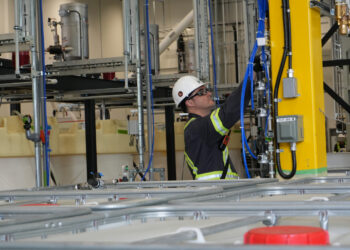













The rapid expansion of artificial intelligence infrastructure is expected to reshape how recyclers and IT asset disposition providers manage retired data center hardware, as a new generation of complex servers begins approaching end-of-life cycles later this decade.
Operators across the IT asset disposition (ITAD) sector say the next wave of decommissioned systems will differ significantly from earlier generations of enterprise hardware because of the concentration of high-value components packed into AI-focused server racks, including graphic processing units (GPUs).
“Most hyperscale operators refresh their core server infrastructure every three to five years,” said Linda Li, chief strategy officer at Li-Tong Group, the Hong Kong-based parent company of IT lifecycle management firm Re-Teck. “Given how dramatically GPU deployments scaled between 2022 and 2024, the first real wave of GPU-dense AI servers is likely to enter decommissioning cycles between 2026 and 2029.”
Re-Teck, which began operations in 2000 under Hong Kong-based Li-Tong Group, provides reverse supply chain management services including logistics, secure data handling, refurbishment and materials recovery for retired technology equipment. The company operates facilities across North America, Europe and Asia and says those sites process more than 100 million devices each year, including enterprise servers, telecom hardware and networking equipment.
AI hardware brings new recovery challenges
Data centers built to support large-scale AI workloads rely heavily on GPUs, high-capacity memory systems and specialized cooling assemblies. Those systems are significantly denser than conventional enterprise servers, which introduces both economic opportunities and technical hurdles for processors handling the equipment after retirement.
“What makes this wave different is what’s inside the hardware,” Li said. “GPU-dense systems are packed with highly valuable components.”
That concentration of valuable components can make refurbishment, harvesting and resale more economically attractive than direct shredding or bulk materials recovery, particularly when GPUs and other specialized hardware retain secondary market demand.
Li said the company prioritizes extracting value from equipment before it enters the recycling stream. “What sets Re-Teck apart is the conviction that shredding electronics is a last resort,” Li said. “Our focus is on data-secure disassembly, testing, grading, parts harvesting and repurposing.”
Automation and AI reshape processing
The growing complexity of AI-focused hardware is also accelerating adoption of automation and analytics within recycling and asset recovery facilities. Companies across the sector are experimenting with machine vision systems and data tools to identify devices, classify components and improve processing throughput in recycling and refurbishment operations.
“At the front end of the process, AI-enabled visual recognition systems identify device models, configurations and cosmetic grades in seconds,” Li said.
Automated inspection and component recognition systems can reduce the time technicians spend identifying equipment and grading components while helping standardize reporting across facilities that process equipment from multinational customers.
At the same time, Li said the evolving design of AI infrastructure introduces new operational challenges for recyclers and ITAD providers attempting to scale those technologies.
“AI models for our business need regular retraining as hardware form factors evolve, and in the world of high-density AI servers those form factors evolve quickly,” she said.
Processors must also contend with variation in incoming equipment streams and the difficulty of integrating automation with older facility infrastructure.
“Normalizing data across global facilities is complex, and integrating legacy equipment isn’t always clean or straightforward,” Li said.
The AI boom is also increasing demand for more detailed lifecycle documentation as large cloud operators track the environmental and operational impacts of their equipment fleets. Asset owners increasingly request serialized tracking, compliance documentation and carbon-related reporting associated with retired hardware.
Server refresh cycle expected later this decade
Li said that shift is contributing to a broader change in how the industry views end-of-life technology management.
“AI’s rise is pushing our entire industry toward higher technical standards, tighter compliance and a much stronger emphasis on giving components a second life before they ever reach the recycling stream,” she said.
The retirement of early AI server deployments is unlikely to occur as a single surge of equipment entering recycling channels. Instead, industry observers expect a gradual turnover as data center operators replace systems in stages.
“What’s more likely is a rolling, staggered series of retirements as operators continuously upgrade to more power-efficient, higher-density accelerators,” Li said.
As those systems begin reaching recovery facilities and secondary markets, recyclers may encounter hardware that carries greater technical complexity and higher component value than previous generations.
“The defining characteristic of this next chapter in ITAD will be that the hardware is more technically demanding and more valuable per rack than anything the industry has dealt with before,” Li said.