

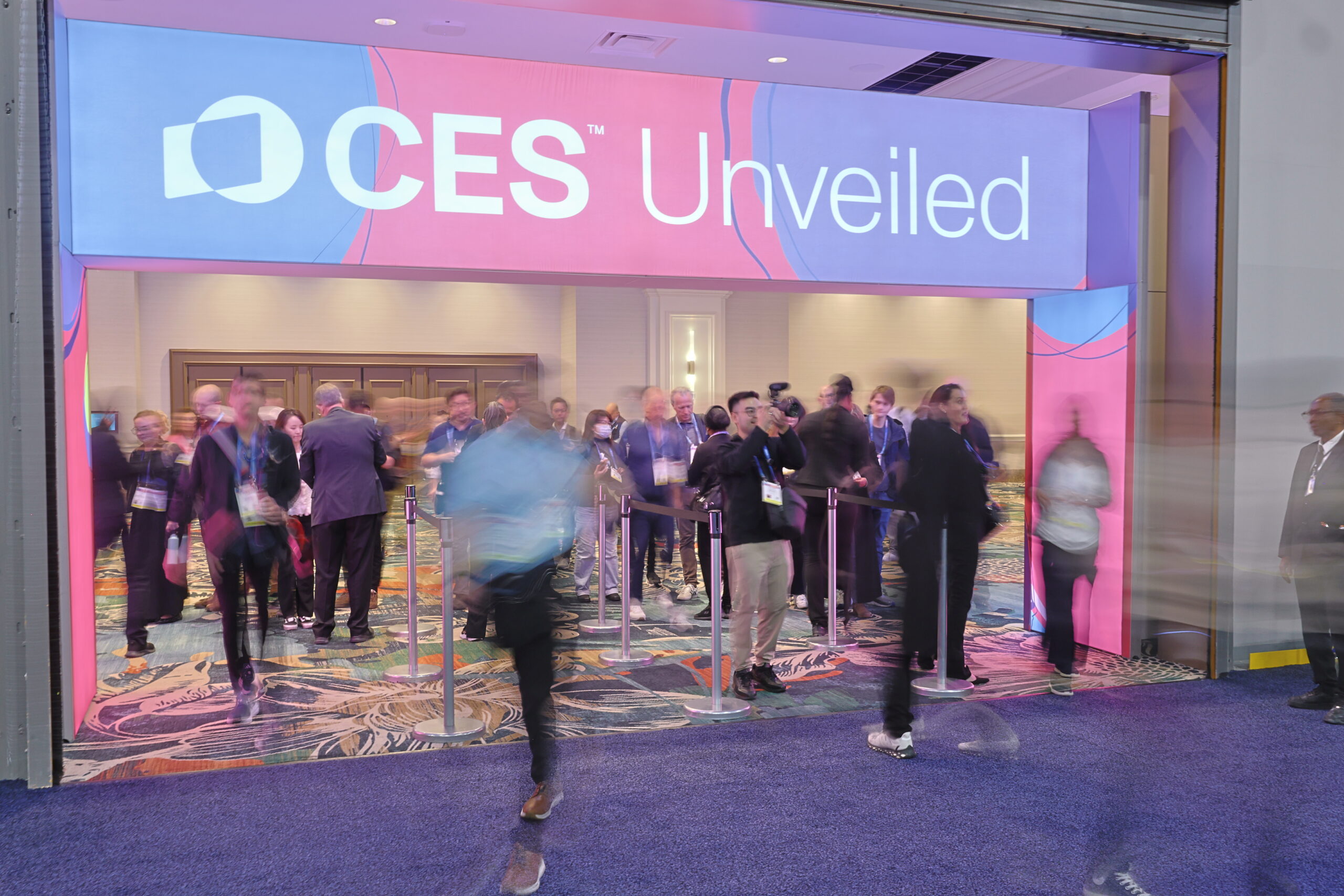
In Las Vegas, CES 2026 provided a glimpse of what ITAD companies and electronics recyclers will be confronting three to five years from now.
Among the more prominent industrial narratives at the show was NVIDIA’s presentation of what it described as the “factory of tomorrow,” a vision built around artificial intelligence, robotics, digital twins and software-defined industrial systems.
While these demonstrations were largely framed around manufacturing, logistics, and automation rather than recycling, the underlying operating principles offer a useful reference point for how IT asset disposition and e-scrap processing facilities may evolve over the coming decade.
The show also featured a large share of new notebooks and desktops marketed as “AI PCs,” particularly in premium and business-class segments. While most consumer-facing coverage focused on productivity and user features, the show offered early indicators of the client hardware that will feed reuse, refurbishment and e-scrap streams over the next several refresh cycles.
The processors, form factors, and lifecycle programs highlighted in Las Vegas point to gradual but material changes in what downstream operators will receive and process in the second half of the decade.
Serviceability and modularity in specific designs
Some of the most operationally relevant CES 2026 announcements for the e-scrap sector focused less on peak performance and more on serviceability. HP’s EliteBoard G1a, recognized through the CES Innovation Awards, was presented as an enterprise-focused AI PC integrated into a desktop keyboard form factor, with all core components housed within the keyboard itself.
The CES Innovation Awards description emphasizes a modular, service-oriented design intended to support maintenance and lifecycle management rather than ultra-compact construction. For ITAD operators and recyclers, a keyboard-based PC with documented service-friendly attributes suggests clearer opportunities for first-life maintenance, parts harvesting, and more predictable downstream processing once devices exit managed fleets.
Lifecycle programs and sustainability positioning
Several OEMs used CES 2026 to emphasize lifecycle services rather than novel form factors. Lenovo’s CES materials highlighted device-as-a-service offerings, Premier Support for Devices, and CO₂ offset options tied to enterprise fleet deployment and refresh cycles.
This messaging reflects a broader trend of OEMs maintaining deeper involvement in the lifecycle of client hardware through managed services. A likely consequence is closer alignment between OEMs, channel partners, and certified reuse and recycling providers when devices exit managed fleets, although the structure and depth of that alignment will vary by program and geography.
Sustainability messaging at CES 2026 remained uneven, but some announcements tied environmental claims directly to device attributes. Asus, for example, positioned certain CES laptops as exceeding Energy Star 9.0 efficiency criteria, framing reduced energy consumption as a sustainability differentiator.
What CES 2026 signals for downstream operators
Nothing shown at CES 2026 will transform inbound e-scrap streams overnight. However, the PCs introduced at the show outline the hardware profile likely to arrive in volume over the next several refresh cycles.
First, and as expected, client fleets are being steered toward AI-optimized CPUs and NPUs, concentrating compute value and increasing the importance of disciplined data handling at end of life.
Second, specific designs such as HP’s EliteBoard G1a indicate OEM experimentation with modular, service-oriented hardware that may simplify parts harvesting and materials separation.
Finally, OEM lifecycle and sustainability programs highlighted at CES provide clearer frameworks for collaboration with reuse and recycling partners capable of delivering traceable, standards-conformant downstream processing.
For downstream operators, the cohort of systems introduced this year offer a practical preview of the assets that will define intake profiles, processing complexity, and compliance expectations later in the decade.