




Resource Recycling
  • The Latest
  • Analysis
    • All
    • Certification Scorecard
    • Industry Announcements
    • Opinion
    The electronics recycling industry is undergoing a transformation from labor-intensive manual operations to highly automated, AI-driven facilities that use advanced robotics, cleaner chemistry and digital tracking systems to extract critical materials.

    The cyber-physical MRF: AI and robotics reshape e-waste recovery

    Certification scorecard for the week of Feb. 9, 2026

    Meta-Corning deal signals IT hardware retirement wave

    Meta-Corning deal signals IT hardware retirement wave

    Malaysia clamps down on illegal e-waste imports amid probes

    Malaysia clamps down on illegal e-waste imports amid probes

    URT builds alliance to remake electronics plastics at scale

    ICYMI: Top 5 e-scrap stories from January 2026

    The electronics recycling industry is undergoing a transformation from labor-intensive manual operations to highly automated, AI-driven facilities that use advanced robotics, cleaner chemistry and digital tracking systems to extract critical materials.

    Certification scorecard for the week of Feb. 2, 2026

    Auditors warn EU may fall short on critical metals

    Auditors warn EU may fall short on critical metals

    Industry announcements for January 2026

    Industry announcements for February 2026

    ICYMI: Top 5 recycling stories from January 2026

  • Conferences
  • Publications

    Other Topics

    Textiles
    Organics
    Packaging
    Glass
    Brand Owners

    Metals
    Technology
    Research
    Markets
    Grant Watch

    All Topics

Subscribe
No Result
View All Result
Resource Recycling
  • The Latest
  • Analysis
    • All
    • Certification Scorecard
    • Industry Announcements
    • Opinion
    The electronics recycling industry is undergoing a transformation from labor-intensive manual operations to highly automated, AI-driven facilities that use advanced robotics, cleaner chemistry and digital tracking systems to extract critical materials.

    The cyber-physical MRF: AI and robotics reshape e-waste recovery

    Certification scorecard for the week of Feb. 9, 2026

    Meta-Corning deal signals IT hardware retirement wave

    Meta-Corning deal signals IT hardware retirement wave

    Malaysia clamps down on illegal e-waste imports amid probes

    Malaysia clamps down on illegal e-waste imports amid probes

    URT builds alliance to remake electronics plastics at scale

    ICYMI: Top 5 e-scrap stories from January 2026

    The electronics recycling industry is undergoing a transformation from labor-intensive manual operations to highly automated, AI-driven facilities that use advanced robotics, cleaner chemistry and digital tracking systems to extract critical materials.

    Certification scorecard for the week of Feb. 2, 2026

    Auditors warn EU may fall short on critical metals

    Auditors warn EU may fall short on critical metals

    Industry announcements for January 2026

    Industry announcements for February 2026

    ICYMI: Top 5 recycling stories from January 2026

  • Conferences
  • Publications

    Other Topics

    Textiles
    Organics
    Packaging
    Glass
    Brand Owners

    Metals
    Technology
    Research
    Markets
    Grant Watch

    All Topics

Subscribe
No Result
View All Result
Resource Recycling
No Result
View All Result
Home E-Scrap

Experts map out landmines in electronic data destruction

byJared Paben
June 16, 2022
in E-Scrap
Experts map out landmines in electronic data destruction

A client may ask a processor to destroy their hard drives, but doing so may not accomplish their ultimate goal: protecting the company by destroying all data. That’s because data may lurk in unsuspecting places.

That was a point Luke Westerman of Computer Recycling Center made at last month’s i-SIGMA Conference and Expo, held in Orlando, Fla. Westerman was speaking during a session titled “Capitalizing on the Growing & Transforming ITAD Opportunity.” In the audience were document and electronic media shredding professionals.

“My big concern as an industry, as a group and for you as potential service providers in this world, is that we have a big disconnect,” said Westerman, who is owner and general leader of the Springfield, Mo. electronics recycling company, “because a customer says, ‘Shred these hard drives.’ We take it and shred the hard drives and everybody feels good. But at the end of the day the customer really didn’t mean, ‘Shred these hard drives.’ The customer meant, ‘Take all this equipment and destroy all the data so that it can never harm me.'”

Westerman noted that even after an HD is removed, discs, tapes, SSDs and integrated memory may lurk in a device, holding ample data. With Chromebooks, for example, the memory is integrated onto the circuit board.

Westerman, who is also owner and general leader of mobile document shredding company Big Bear Shredding, said the situation presents a huge risk when data destruction companies send devices downstream to non-NAID-certified recyclers, which could do whatever they want with it. His company is NAID AAA and R2 certified.

“It could go anywhere,” he said. “And so we put our customers at great risk by doing that.”

Also speaking during the panel was Michael Harstrick of Garner Products, a Roseville, Calif. company that produces degaussers and drive shredders. Harstrick pointed out that electronic media present completely different challenges from paper document shredding, given how much data they can contain. For example, at 1.4 terabytes per square inch, if a company shreds the drives to 2 millimeters, each of the 2mm pieces still holds 600,000 pages of data on the surface that could be read with a magnetic force microscope (MFM).

“So the question for your client is how much risk do they want to take?” he said. “If they don’t degauss it, you cannot get this small enough to make this safe. It’s that simple.”

The third panelist was Jason Teliszczak of Orlando-based JT Environmental Consulting, which assesses clients to help them achieve standards, including NAID AAA certification. He noted that even if a data destruction firm sends equipment out the door with residual data, sending it to an R2- or e-Stewards-certified recycling facility will offer protection. That’s because those standards also touch on data security.

“They’re going to have a little bit of data in their background, so in case you botched, you missed something simple, it’s nice to go to someone like that because they’ll kind of swoop in behind you, kind of cover your butt,” Teliszczak said.

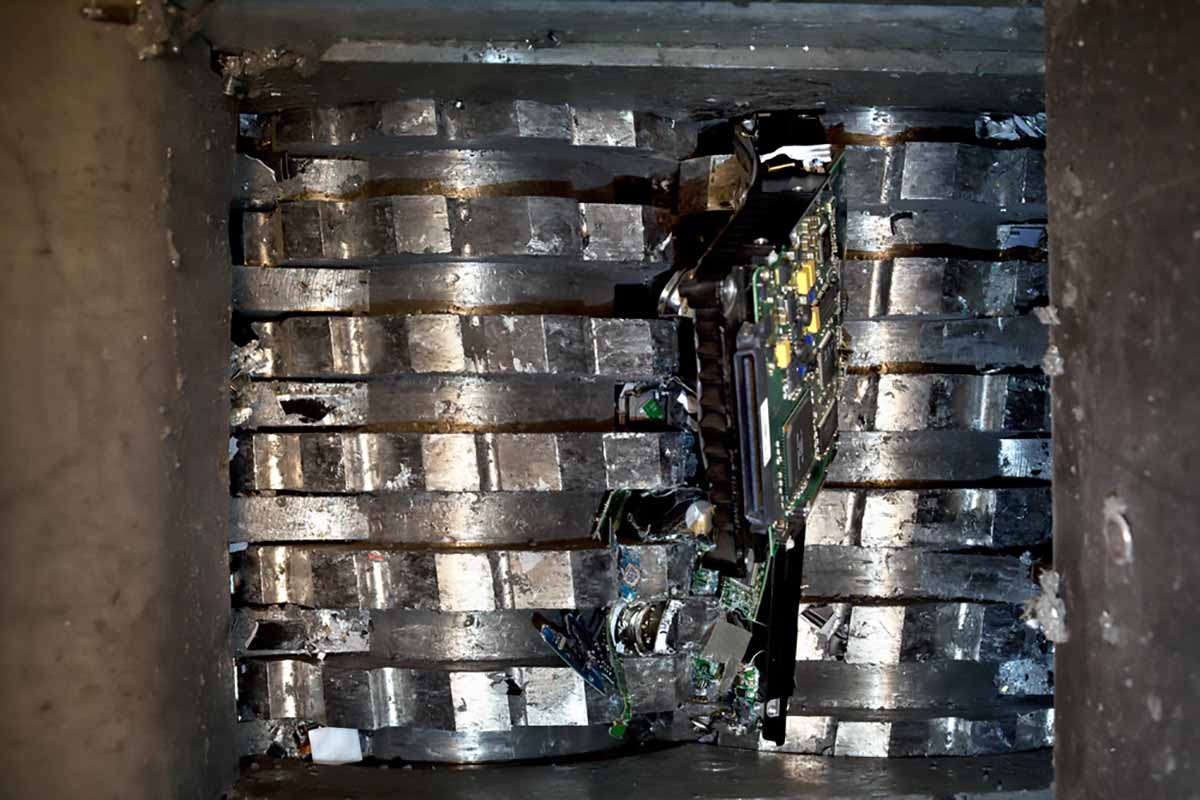
Harstrick also noted the fire risks present – but not always obvious – in shredding electronics. For example, manufacturers are embedding watch batteries to power SSDs now, because there’s so much happening with the drives that even a power flicker can be a “catastrophe.” But shredding SSDs without first removing the batteries can trigger a fire.

He noted that it’s time consuming – and thus, expensive – to take apart a KVM motherboard (KVM stands for keyboard, video, mouse, and it’s a motherboard that allows a user at one terminal to control multiple computers), and that they can contain three watch batteries.

Despite the complexities of destroyed information on electronics devices, Westerman said he feels document shredding companies wanting to enter the business have a distinct advantage over e-scrap recycling companies. That’s because document shredders have so many more frequent “touches” with customers than e-scrap companies, which “end up in more of a purge business.” He thinks they can pull 80% of the value from 20% of the efforts electronics recycling companies are putting out.

“So, to leverage that relationship with the right person already, you have such an advantage over all of us traditional electronics recycling people right out of the gates,” he said.

 

Tags: Data SecurityIndustry Groups
TweetShare
Jared Paben

Jared Paben

Related Posts

Focus on recycling film, flexibles takes shape in two reports

byAntoinette Smith
February 13, 2026

The US Plastics Pact and the Alliance to End Plastic Waste released reports outlining necessary steps to improving recycling outcomes...

Bipartisan reps introduce bill on recycling claims

Bipartisan reps introduce bill on recycling claims

byAntoinette Smith
February 12, 2026

Legislators introduced the Recycled Materials Attribution Act in the US House, drawing support from a new industry group and scrutiny...

APR, industry create proactive guidance for PET caps

byAntoinette Smith
February 12, 2026

The Association of Plastic Recyclers recognized that developing guidelines before PET caps were completely developed and commercialized was crucial, and...

APR expands recycling efforts in Mexico, Latin America

byAntoinette Smith
February 11, 2026

The organization aims to leverage Mexico's leadership in plastics recycling and vital role in North American markets.

Member states select new chair for global plastics treaty

Member states select new chair for global plastics treaty

byAntoinette Smith
February 10, 2026

During a short session, the Intergovernmental Negotiating Committee elected Chilean diplomat Julio Cordano to continue efforts toward an internationally binding...

SWANA hires new executive director

SWANA partners with Product Stewardship Institute

byStefanie Valentic
February 4, 2026

The Solid Waste Association of North America and the Product Stewardship Institute are formalizing their collaboration to address materials management...

Load More
Next Post
Photo by IISD/ENB

Treaty tightens regulations on global e-scrap trade

More Posts

Chinese processing group details goals for US visit

AMP lays out vision of next-generation, AI-driven MRFs

July 24, 2024
Oregon’s Recycling Modernization Act faces injunction

Court partially blocks Oregon EPR law, dismisses bulk of lawsuit

February 10, 2026
Malaysia clamps down on illegal e-waste imports amid probes

Malaysia clamps down on illegal e-waste imports amid probes

February 6, 2026

APR, industry create proactive guidance for PET caps

February 12, 2026

REUSE Act heads to US House for consideration

February 9, 2026

Alpek talks PET overcapacity, soft demand

February 11, 2026
The electronics recycling industry is undergoing a transformation from labor-intensive manual operations to highly automated, AI-driven facilities that use advanced robotics, cleaner chemistry and digital tracking systems to extract critical materials.

The cyber-physical MRF: AI and robotics reshape e-waste recovery

February 12, 2026
Texas sues over dumped wind turbine blades

Texas sues over dumped wind turbine blades

February 10, 2026

ecoATM recycled 7.5M phones in 2025 as payouts hit $1.5B

February 10, 2026
Bipartisan reps introduce bill on recycling claims

Bipartisan reps introduce bill on recycling claims

February 12, 2026
Load More

About & Publications

About Us

Staff

Archive

Magazine

Work With Us

Advertise
Jobs
Contact
Terms and Privacy

Newsletter

Get the latest recycling news and analysis delivered to your inbox every week. Stay ahead on industry trends, policy updates, and insights from programs, processors, and innovators.

Subscribe

Welcome Back!

Login to your account below

Forgotten Password?

Retrieve your password

Please enter your username or email address to reset your password.

Log In

Add New Playlist

No Result
View All Result
  • The Latest
  • Analysis
  • Recycling
  • E-Scrap
  • Plastics
  • Policy Now
  • Conferences
    • E-Scrap Conference
    • Plastics Recycling Conference
    • Resource Recycling Conference
    • Textiles Recovery Summit
  • Magazine
  • About Us
  • Advertise
  • Archive
  • Jobs
  • Staff
Subscribe
This website uses cookies. By continuing to use this website you are giving consent to cookies being used. Visit our Privacy and Cookie Policy.