



Advertisement Header Ad
Resource Recycling
  • The Latest
  • Analysis
    • All
    • Certification Scorecard
    • Industry Announcements
    • Opinion

    Certification scorecard for December 10, 2025

    Industry Announcements for Week of December 8

    Certification Scorecard for December 3, 2025

    Industry Announcements for Week of December 1

    News from Dynamic Lifecycle Innovations, Precision E-Cycle

    News from Northeast Recycling Council, Plastipak and more

    News from Northeast Recycling Council, Sortera Technologies and more

    News from MKV Polymers, Metallium Ltd. and more

    Certification Scorecard for November 19, 2025

  • Conferences
  • Publications

    Other Topics

    Textiles
    Organics
    Packaging
    Glass
    Brand Owners

    Metals
    Technology
    Research
    Markets
    Grant Watch

    All Topics

Subscribe
No Result
View All Result
Resource Recycling
  • The Latest
  • Analysis
    • All
    • Certification Scorecard
    • Industry Announcements
    • Opinion

    Certification scorecard for December 10, 2025

    Industry Announcements for Week of December 8

    Certification Scorecard for December 3, 2025

    Industry Announcements for Week of December 1

    News from Dynamic Lifecycle Innovations, Precision E-Cycle

    News from Northeast Recycling Council, Plastipak and more

    News from Northeast Recycling Council, Sortera Technologies and more

    News from MKV Polymers, Metallium Ltd. and more

    Certification Scorecard for November 19, 2025

  • Conferences
  • Publications

    Other Topics

    Textiles
    Organics
    Packaging
    Glass
    Brand Owners

    Metals
    Technology
    Research
    Markets
    Grant Watch

    All Topics

Subscribe
No Result
View All Result
Resource Recycling
No Result
View All Result
Home E-Scrap

UN research digs into e-scrap impacts of COVID-19

byJared Paben
June 24, 2021
in E-Scrap
UN research digs into e-scrap impacts of COVID-19
Share on XLinkedin

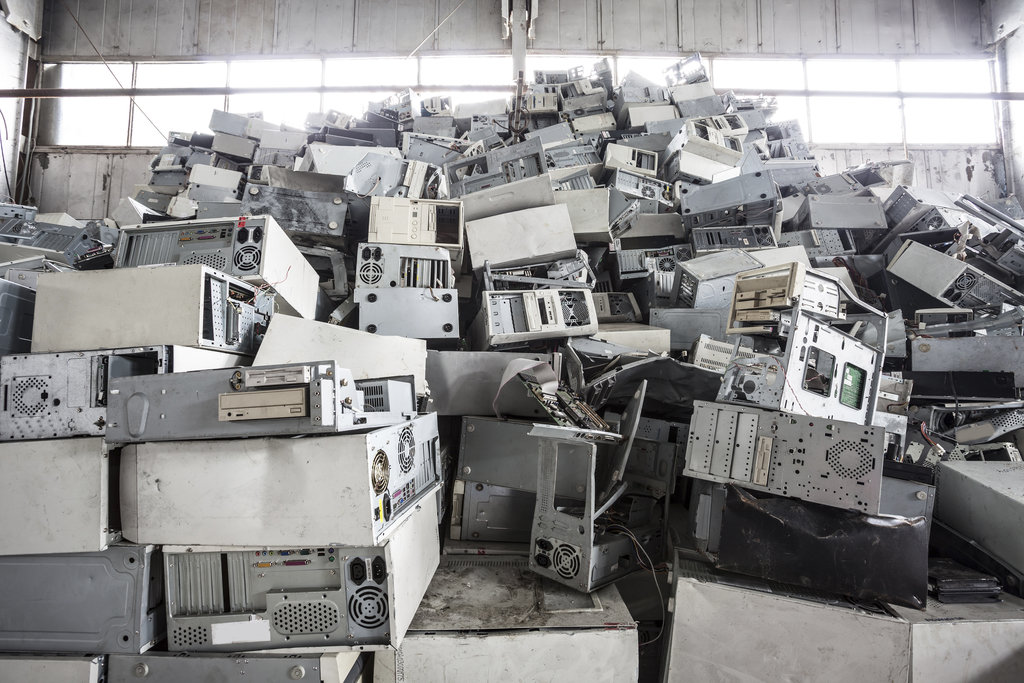
COVID-19 caused global consumption of electronics and electrical appliances to fall by about 6.4%, which likely means the planet will witness a dip in e-scrap generation, according to new report estimates.

The United Nations University (UNU) Sustainable Cycles programme (SCYCLE) and United Nations Institute for Training and Research (UNITAR) earlier this month released the results of its research on the effects of the pandemic on electronics and appliance purchases during the first three quarters of 2020.

Examining global trade data, researchers estimated that worldwide consumption fell by about 4.9 million metric tons, compared with a theoretical “business-as-usual” scenario in which the pandemic never happened. That’s a drop of about 6.4%.

But the decrease varied drastically in different regions. The report’s authors, Kees Baldé of UNU and Ruediger Kuehr of UNU SCYCLE and UNITAR, noted the implications for global disparities in access to technology.

“The so-called digital divide is increasing,” Kuehr stated in a press release. “The ability to adapt to digitisation and earn a living or simply to own and benefit from electronics is decreasing in some parts of the world. COVID-19 also revealed a digital divide in high-income countries, where many poor are left behind.”

Buying decreased in low- and middle-income countries

The report noted that low- and middle-income regions of the world saw huge drops in consumption, with declines of around 30% reported in Africa, parts of the Middle East/Western Asia and Central Asia.

“Those are the regions with typically no (or inadequate) e-waste management infrastructure in place,” the report stated. “So, in one respect, this can be interpreted as positive, as less e-waste is likely to be mismanaged, causing environmental and health effects. However, it should be noted that this effect is expected to be only temporary, and e-waste is still generated in the region and is still expected to grow in the coming years.”

Additionally, electronics enable development, meaning citizens of those countries will have less access to the ability to earn a living or otherwise benefit from the latest technologies, the report stated.

Higher-income countries, such as those in Europe, North America, East and Southeast Asia, saw much smaller decreases – in the single digits – in electronics consumption. And Australia and New Zealand actually purchased about 4% more weight of electronics and appliances.

The authors pointed to government economic stimulus efforts trickling down to consumers, allowing them to afford to buy electronics and appliances.

“The reason is understood as being that the wealthy G20 countries have injected USD $10.325 billion into their economies, including significant measures to support workers and the general population,” the report notes. “By contrast, the majority of low- and middle-income countries have not been able to deploy measures to protect their people and economies. These measures in high-income countries, or the lack of measures in low- and middle-income countries, trickle down to the consumption and e-waste generation.”

The analysis of month-by-month import-export data also showed that consumption rebounded in the third quarter in high-income countries but not in low- and middle-income ones, the press release states.

High-income countries bought more small electronic devices

The researchers also noted a disparity in purchases of different types of electronics.

The biggest drop, percentage-wise, was in screens and monitors (including laptops), at around 8%, followed by large appliances, lamps and small appliances, temperature-exchange equipment (refrigerators, air conditioning units, etc.) and small IT and telecommunications equipment.

Globally, small IT and telecommunications equipment, which includes game consoles, cell phones, desktop computers and printers, decreased only 1.4%. But there were also notable exceptions within that category. High-income countries bought more game consoles, cell phones, electrical ovens and laptops during the height of COVID-19; low- and middle-income countries bought less of those devices, too.
 

Tags: Research
Jared Paben

Jared Paben

Related Posts

Chemical bonds

Alberta catalyst discovery targets hydrogen and plastics

byScott Snowden
December 10, 2025

A chance discovery inside a University of Alberta laboratory has developed into a Canadian cleantech project that aims to reshape...

Global recycling patent trends may reflect legislative push

Global recycling patent trends may reflect legislative push

byAntoinette Smith
November 25, 2025

Patent applications for chemical recycling technologies have reached a record high globally with government initiatives among the factors driving innovation,...

Study maps barriers to firms’ supply chain climate goals

byAntoinette Smith
October 14, 2025

Publicly articulating clear sustainability goals helps ensure company follow-through, according to an annual supply chain study from the Massachusetts Institute...

US recycles 13.3% of packaging, Plastic Pact estimates

New report explores the future of CPG packaging goals

byAntoinette Smith
July 23, 2025

A new report from RaboResearch explores the factors behind brand owners' retreat from 2025 packaging recycled content goals – and...

Project brings rare earth recovery into e-scrap facility

Project brings rare earth recovery into e-scrap facility

byColin Staub
July 10, 2025

A pilot project is demonstrating a bolt-on modular system that could make it logistically and economically feasible for e-scrap processors...

RIT researchers develop AI-based textile recycling system

RIT researchers develop AI-based textile recycling system

byAndrew Hawthorne
July 2, 2025

Researchers at the Rochester Institute of Technology are developing a high-speed automated system to disassemble and recycle clothing.

Load More
Next Post
Logistics Recycling Inc.

Processor expands with Twin Cities-area plant

More Posts

Analysis: EU softens ESG rules as compliance pressure builds for US

Analysis: EU softens ESG rules as compliance pressure builds for US

November 19, 2025
Sector holds wide gaps in environmental standards

Sector holds wide gaps in environmental standards

November 19, 2025
From crawl to run: a clear roadmap for ITAD ESG

From crawl to run: a clear roadmap for ITAD ESG

November 19, 2025
New entrepreneurs bring renewed energy to e-cycling

New entrepreneurs bring renewed energy to e-cycling

November 19, 2025
The Re:Source Podcast Episode 1: E-Scrap look-back and 2026 outlook

The Re:Source Podcast Episode 1: E-Scrap look-back and 2026 outlook

November 21, 2025
ERI and ReElement partner on rare earth magnet recovery

ERI and ReElement partner on rare earth magnet recovery

November 26, 2025
Cyber risks confront ITAD work, contracts, coverage

Cyber risks confront ITAD work, contracts, coverage

November 26, 2025
Canadian PROs join forces to align design guidance

Canadian PROs join forces to align design guidance

November 17, 2025
Weak bale pricing compounds hauler headwinds

Weak bale pricing compounds hauler headwinds

November 18, 2025
Paper grades, plastic film bales soften 

Paper grades, plastic film bales soften 

November 18, 2025
Load More

About & Publications

About Us

Staff

Archive

Magazine

Work With Us

Advertise
Jobs
Contact
Terms and Privacy

Newsletter

Get the latest recycling news and analysis delivered to your inbox every week. Stay ahead on industry trends, policy updates, and insights from programs, processors, and innovators.

Subscribe

Welcome Back!

Login to your account below

Forgotten Password?

Retrieve your password

Please enter your username or email address to reset your password.

Log In

Add New Playlist

No Result
View All Result
  • The Latest
  • Analysis
  • Recycling
  • E-Scrap
  • Plastics
  • Conferences
    • E-Scrap Conference
    • Plastics Recycling Conference
    • Resource Recycling Conference
    • Textiles Recovery Summit
  • Magazine
  • About Us
  • Advertise
  • Archive
  • Jobs
  • Staff
Subscribe
This website uses cookies. By continuing to use this website you are giving consent to cookies being used. Visit our Privacy and Cookie Policy.